

{
  "authors": [
    "Ashley J. Tellis",
    "Ayesha Siddiqa",
    "Shuja Nawaz"
  ],
  "type": "event",
  "centerAffiliationAll": "dc",
  "centers": [
    "Carnegie Endowment for International Peace"
  ],
  "collections": [],
  "englishNewsletterAll": "ctw",
  "nonEnglishNewsletterAll": "",
  "primaryCenter": "Carnegie Endowment for International Peace",
  "programAffiliation": "SAP",
  "programs": [
    "South Asia"
  ],
  "projects": [],
  "regions": [
    "North America",
    "United States",
    "Pakistan"
  ],
  "topics": [
    "Political Reform",
    "Security",
    "Military",
    "Foreign Policy"
  ]
}
The Pakistani Army and Post-Election Scenarios
Wed, February 13th, 2008
Washington, D.C.
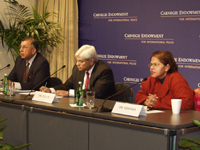
IMGXYZ844IMGZYX Carnegie Senior Associate Ashley J. Tellis explored the Pakistani military’s possible reactions to various post-election scenarios in Pakistan with Dr. Ayesha Siddiqa from the University of Pennsylvania, and Pakistani journalist and author Shuja Nawaz at an event at the Carnegie Endowment on February 13.
Nawaz spoke about the army’s role in past elections in Pakistan, and then discussed some possible outcomes of the February 18 polls. It’s possible, he suggested, that the PML-Q, the party supporting President Pervez Musharraf, might manage to secure a victory in parliament and form a ruling coalition with Islamic parties. Such a scenario would preserve the status quo as much as possible. Or, the late Benazir Bhutto’s party, the PPP, could win big in Sindh and form a coalition of moderate parties. But the PML-Q’s control over the Senate would curtail the PPP’s reform efforts. Nawaz stressed that Pakistan’s future will remain uncertain and unsettled well after the elections.
Ayesha Siddiqa told the audience that though she is heartened by General Kayani’s moves to keep the military from intervening in the election, save for providing security at the polls, such a voluntary withdrawal could easily be overturned with the appointment of more "predatory" generals in the future.
Carnegie India does not take institutional positions on public policy issues; the views represented herein are those of the author(s) and do not necessarily reflect the views of Carnegie, its staff, or its trustees.
Event Speakers
Former Senior Fellow
Ashley J. Tellis was a senior fellow at the Carnegie Endowment for International Peace.
Ayesha Siddiqa
Shuja Nawaz