

{
  "authors": [
    "James Cameron",
    "James G. Hershberg",
    "Togzhan Kassenova"
  ],
  "type": "event",
  "centerAffiliationAll": "dc",
  "centers": [
    "Carnegie Endowment for International Peace"
  ],
  "collections": [],
  "englishNewsletterAll": "ctw",
  "nonEnglishNewsletterAll": "",
  "primaryCenter": "Carnegie Endowment for International Peace",
  "programAffiliation": "NPP",
  "programs": [
    "Nuclear Policy"
  ],
  "projects": [],
  "regions": [
    "North America",
    "United States",
    "Russia"
  ],
  "topics": [
    "Nuclear Policy"
  ]
}
The Demise of America’s First Missile Defense System and the Rise of Strategic Arms Limitation
Mon, February 5th, 2018
Washington, DC
Why did the United States move from a position of nuclear superiority over the Soviet Union at the beginning of the 1960s to one of nuclear parity under conditions of mutual assured destruction in 1972? The story of this transition both sheds new light on the Cold War and offers new insights for today’s nuclear challenges.
Drawing on declassified conversations between three presidents and their most trusted advisers, James Cameron offers an original answer to this question in his new book The Double Game: The Demise of America’s First Missile Defense System and the Rise of Strategic Arms Limitation. John F. Kennedy, Lyndon B. Johnson, and Richard Nixon struggled to reconcile their personal convictions about the nuclear arms race with public demands. In doing so they engaged in a double game, hiding their true beliefs behind a façade of strategic language, while grappling in private with the complex realities of the nuclear age.
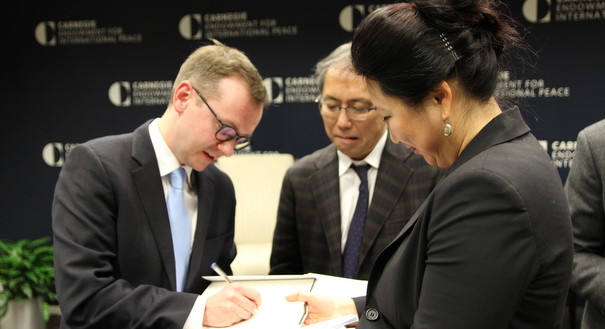
Hosted by Carnegie Endowment for International Peace and the Woodrow Wilson Center, the discussion was moderated by Togzhan Kassenova and featured James Cameron and James G. Hershberg.
James Cameron
James Cameron is assistant professor in international relations at Fundação Getulio Vargas in São Paulo.
James G. Hershberg
James G. Hershberg is a professor of history and international affairs at the George Washington University Elliott School of International Affairs.
Togzhan Kassenova
Togzhan Kassenova is a fellow in the Nuclear Policy Program at the Carnegie Endowment for International Peace.
Carnegie India does not take institutional positions on public policy issues; the views represented herein are those of the author(s) and do not necessarily reflect the views of Carnegie, its staff, or its trustees.
Event Speakers
James Cameron
James G. Hershberg
Former Nonresident Fellow, Nuclear Policy Program

Kassenova was a nonresident fellow in the Nuclear Policy Program at the Carnegie Endowment.