

Article
Andrew Kuchins
{
  "authors": [
    "Andrew Kuchins"
  ],
  "type": "legacyinthemedia",
  "centerAffiliationAll": "dc",
  "centers": [
    "Carnegie Endowment for International Peace"
  ],
  "collections": [],
  "englishNewsletterAll": "ctw",
  "nonEnglishNewsletterAll": "",
  "primaryCenter": "Carnegie Endowment for International Peace",
  "programAffiliation": "russia",
  "programs": [
    "Russia and Eurasia"
  ],
  "projects": [],
  "regions": [
    "Caucasus",
    "Russia"
  ],
  "topics": [
    "Foreign Policy"
  ]
}
REQUIRED IMAGE
Source: Carnegie
The Moscow Times,
Friday, Aug. 3, 2001. Page 8
What a two-week period would-be geopoliticians have had. It began with the Bush
administration's announcement of plans for testing of ballistic missile systems
that will likely "bump up" against the ABM Treaty, followed by the
successful test of the missile defense kill vehicle. Then Chinese President
Jiang Zemin arrived in Moscow to sign a new Chinese-Russian Friendship Treaty.
Finally in Genoa U.S. President George W. Bush had another opportunity to confer
with European allies as well as his new soulmate President Vladimir Putin. The
head of Sir Halford MacKinder, the godfather of geopolitics and originator of
the term "Eurasian heartland," must be pinning in his grave.
Many observers have been quick to resurrect the notion of triangular politics that was popularized by Henry Kissinger during the Nixon administration's efforts to ombine detente with the Soviet Union with the historic opening to China. But with the demise of the Cold War coupled with an increasingly interdependent world, the xplanatory power of triangular politics does not get us very far in understanding what is really going on between Moscow and Beijing. Washington's worst-case scenario artists delight in pointing to anti-American rhetoric and transfers of Russian weapons and technologies to China to conjure up the anti-hegemonic alliance in-waiting that will bring down Pax Americana. The fact is that both China and Russia are too heavily invested or want to be too heavily invested in benefiting from Pax Americana to really want to bring the forces of globalization down.
Russia cannot have a prosperous future without deep integration in the world economy. And an impoverished and consequently unstable Russia will not be an attractive partner for anybody in the long run, be it the European Union, China, Japan, India, or even Iran. Mikhail Gorbachev understood this, and so set forth with perestroika and new thinking in foreign policy. Boris Yeltsin understood this, and so accelerated reform efforts. Putin understands this and will continue to hew to a primarily Western orientation, especially toward Europe, but he needs to be constantly reminded that contemporary European powers respect human rights.
While the Chinese and the Russians oppose some aspects of U.S. policy, most notably missile defense, they share a number of common interests that have little or nothing to do with opposing the United States. The first is to maintain a peaceful border and ensure that Central Asia not be overwhelmed by separatist forces, terrorism, and drug trafficking. These factors

Former Senior Associate and Director, Russian & Eurasian Program
Recent Work
Andrew Kuchins
Andrew Kuchins
Carnegie India does not take institutional positions on public policy issues; the views represented herein are those of the author(s) and do not necessarily reflect the views of Carnegie, its staff, or its trustees.

After the chill in ties between 2020 and 2024 that brought India–China relations to their lowest point in several decades, the two countries have engaged each other afresh. This paper argues that there are predominantly four imperatives guiding India’s approach to China, and they exist in an order of priority.

Saheb Singh Chadha

This piece argues that India’s central challenge is not managing a single flashpoint but resolving the underlying tension between expansion and institutional coherency of the BRICS grouping.

Vrinda Sahai

A partnership between India, a country of subcontinental size, and Africa, a continent of fifty-four countries, may seem asymmetric until one notes that both are home to nearly the same number of people—1.4 billion. This essay spells out the existing challenges to the partnership, its optimal potential, and the possible pathways to realize it over the next quarter-century.

Rajiv Bhatia

The India–EU Free Trade Agreement (FTA) is shaping up to be one of the most consequential trade negotiations, both economically and strategically. But, what’s in the agreement, what’s missing, and what will determine its success in the years ahead
Vrinda Sahai, Nicolas Köhler-Suzuki
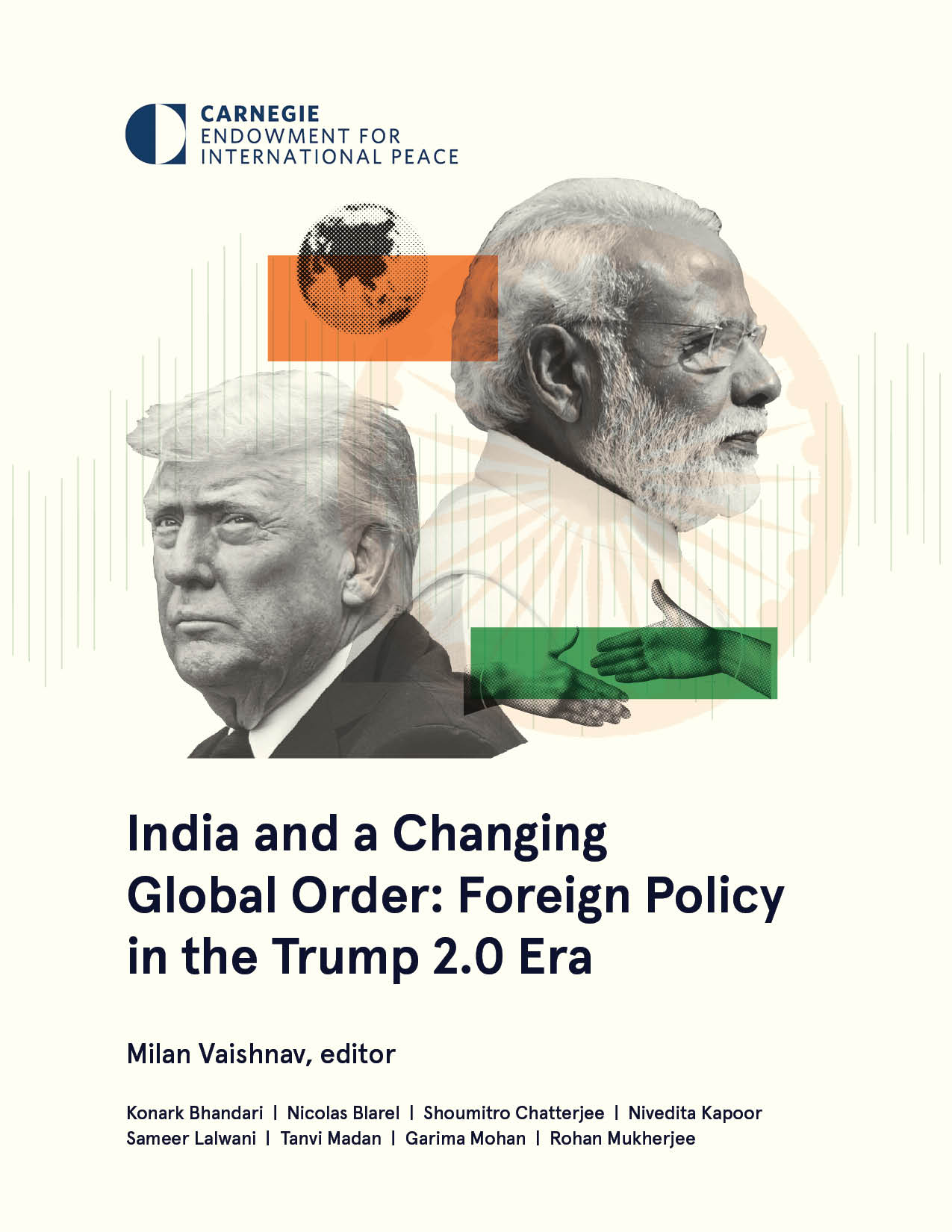
Trump 2.0 has unsettled India’s external environment—but has not overturned its foreign policy strategy, which continues to rely on diversification, hedging, and calibrated partnerships across a fractured order.



Milan Vaishnav, ed., Sameer Lalwani, Tanvi Madan, …