

Report
Mr. Husain Haqqani, Ashley J. Tellis
{
  "authors": [
    "Husain Haqqani"
  ],
  "type": "legacyinthemedia",
  "centerAffiliationAll": "dc",
  "centers": [
    "Carnegie Endowment for International Peace"
  ],
  "collections": [],
  "englishNewsletterAll": "ctw",
  "nonEnglishNewsletterAll": "",
  "primaryCenter": "Carnegie Endowment for International Peace",
  "programAffiliation": "russia",
  "programs": [
    "Russia and Eurasia"
  ],
  "projects": [],
  "regions": [],
  "topics": [
    "Foreign Policy"
  ]
}
REQUIRED IMAGE
Source: Carnegie
Originally appeared in The Wall Street Journal, May 22, 2003
Some Muslim groups in the U.S. have launched a campaign to block the appointment of Daniel Pipes to the board of the United States Institute of Peace. The USIP is a taxpayer-funded institution with a mandate to promote "peaceful resolutions of international conflicts." Mr. Pipes, a Bush administration nominee, is a scholar of Islam and the Middle East and an outspoken critic of militant Islamists.
Although the Washington Post, among others, has editorialized against his appointment, the controversy should be seen in the context of the civil war of ideas in the Muslim world -- between those who wish to reconcile adherence to their faith with modernity and those seeking the restoration of a mythical glorious past. The Pipes nomination has become a test of strength for those Islamists who wish to paint the war against terrorism as a war against Islam. If they can rally American Muslims to their cause, they would be able to limit the scope of debate about Islamic issues within parameters set by them. That objective doesn't serve the interests of the U.S. or of Muslims.
Many Islamic revivalists, or Islamists, have turned to terrorism in an effort to destroy the West's military, economic, cultural and technological domination. Above all, they resent and resist the free flow of ideas within the Muslim community and with the West. In dealing with terrorism, the U.S. cannot afford to ignore the ideas -- and the lack of openness in Muslim discourse -- that generate terrorist thinking. While his detractors label Mr. Pipes an "Islamophobe," the tussle is less about Daniel Pipes and more about the terms on which the U.S. should engage the world's Muslims, including many American citizens. Mr. Pipes is probably not always right in all his arguments. As a Muslim, I disagree with several of his policy prescriptions. But his views are neither racist nor extremist; they fall within the bounds of legitimate scholarly debate.
Muslims have suffered a great deal from their tendency to shun discussion of ideas, especially those relating to history and religion and their impact on politics. Hard-liners won't tolerate questioning of their views that Islam has nothing to learn from "unbelievers" or that Muslims have a right to subdue other faiths, by force if necessary. The notion of an Islamic polity and state -- supported by extremists, questioned by moderates -- is also an issue which must be aired. Promoting such debate should be an essential element of U.S. engagement with the Islamic world. That objective is better served by including and debating the ideas of intellectuals such as Mr. Pipes than by attacking them.
Americans are keen to understand why some people hate them enough to want to fly planes into buildings and blow themselves up while trying to kill civilians. But similar introspection is missing among Muslims. Shouldn't they be asking themselves why it's difficult for them to criticize terrorism without fearing that they'll be labeled anti-Islamic? Just as the U.S. needs to understand why Muslims resent its power, Muslims must figure out why they cannot win America's trust and respect.
Islam's external enemies, and their real and perceived conspiracies, are the focus of most discourse in the Muslim world. Colonial rule and, since then, injustices meted out to Muslims under non-Muslim occupation in several countries are real issues that need to be addressed. But the failure of Muslim societies -- in particular the leaders -- to embrace education, expand economies or to innovate cannot be attributed solely to outside factors. The root causes also lie in the fear of some Muslims to embrace reasoned debate and intellectual exchange, lest this openness somehow dilute the purity of their beliefs.
The campaign against Mr. Pipes is an example of this tendency to scuttle discussion. Muslims who disagree with his views should respond to him with arguments of their own. Slandering him might help polarize secular and Islamist Muslims, but it won't raise the level of discourse about Islamic issues. It's time for Muslim leaders in the U.S. to break the pattern of agitation that has characterized Muslim responses to the West.
Reprinted from The Wall Street Journal © 2003 Dow Jones & Company,
Inc. All rights reserved.
Former Visiting Scholar
Recent Work
Mr. Husain Haqqani, Ashley J. Tellis
Mr. Husain Haqqani
Carnegie India does not take institutional positions on public policy issues; the views represented herein are those of the author(s) and do not necessarily reflect the views of Carnegie, its staff, or its trustees.

A partnership between India, a country of subcontinental size, and Africa, a continent of fifty-four countries, may seem asymmetric until one notes that both are home to nearly the same number of people—1.4 billion. This essay spells out the existing challenges to the partnership, its optimal potential, and the possible pathways to realize it over the next quarter-century.

Rajiv Bhatia

The India–EU Free Trade Agreement (FTA) is shaping up to be one of the most consequential trade negotiations, both economically and strategically. But, what’s in the agreement, what’s missing, and what will determine its success in the years ahead

Vrinda Sahai, Nicolas Köhler-Suzuki
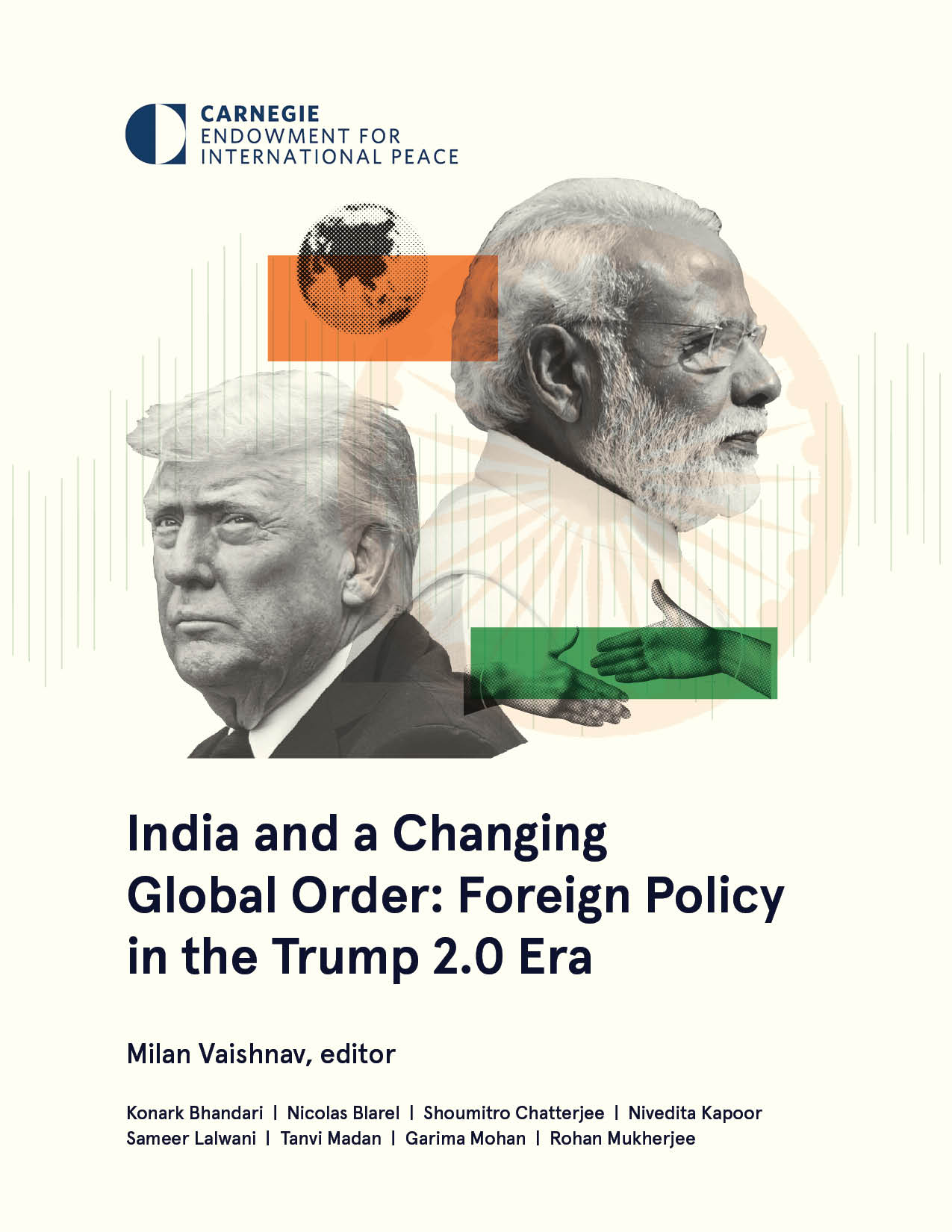
Trump 2.0 has unsettled India’s external environment—but has not overturned its foreign policy strategy, which continues to rely on diversification, hedging, and calibrated partnerships across a fractured order.



Milan Vaishnav, ed., Sameer Lalwani, Tanvi Madan, …

This piece examines India’s response to U.S. sanctions and tariffs, specifically assessing the immediate market consequences, such as alterations in import costs, and the broader strategic implications for India’s energy security and foreign policy orientation.
Vrinda Sahai
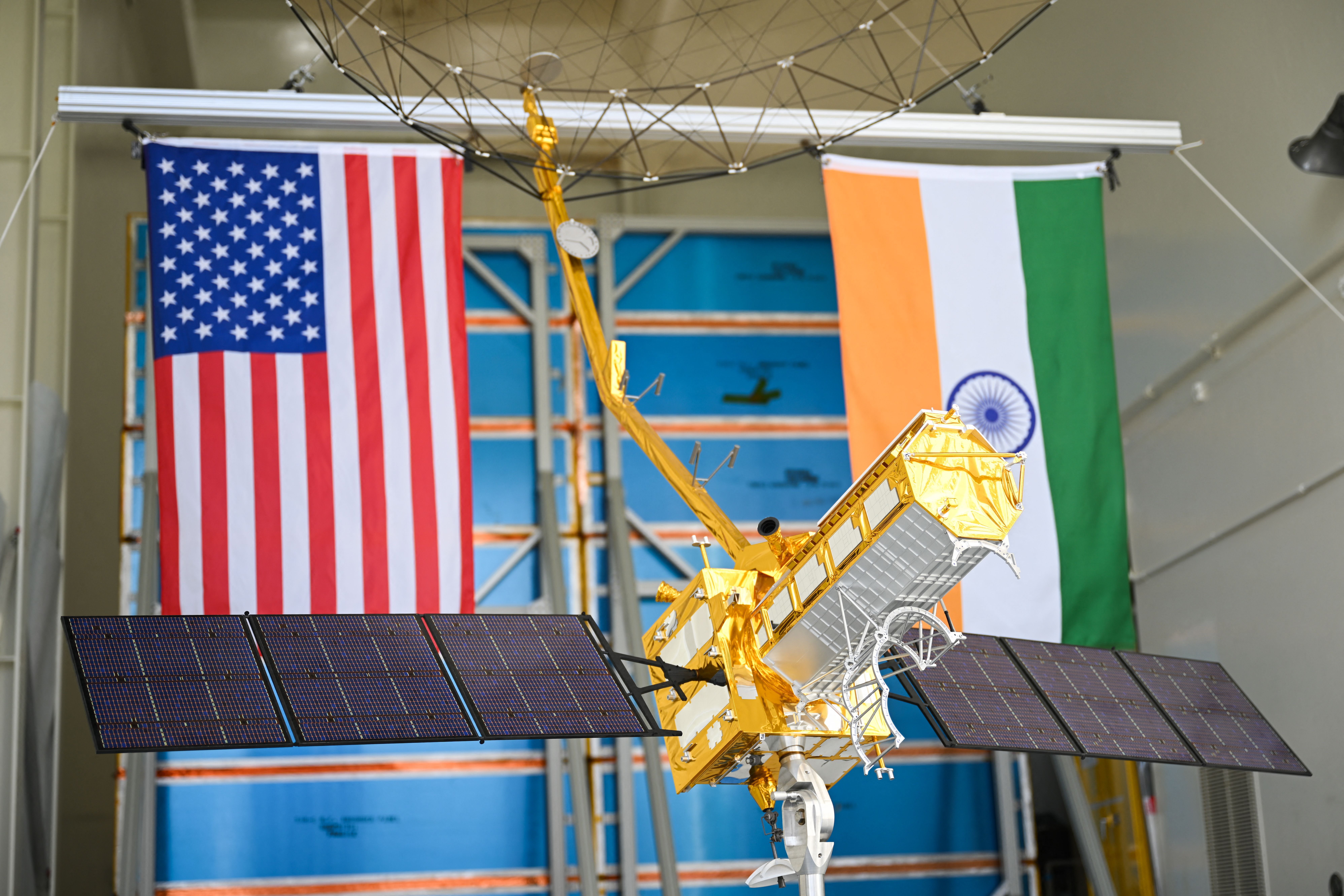
On July 30, 2025, the United States announced 25 percent tariffs on Indian goods. While diplomatic tensions simmered on the trade front, a cosmic calm prevailed at the Sriharikota launch range. Officials from NASA and ISRO were preparing to launch an engineering marvel into space—the NASA-ISRO Synthetic Aperture Radar (NISAR), marking a significant milestone in the India-U.S. bilateral partnership.

Tejas Bharadwaj