

In The Media
Minxin Pei
{
  "authors": [
    "Minxin Pei"
  ],
  "type": "legacyinthemedia",
  "centerAffiliationAll": "dc",
  "centers": [
    "Carnegie Endowment for International Peace"
  ],
  "collections": [],
  "englishNewsletterAll": "asia",
  "nonEnglishNewsletterAll": "",
  "primaryCenter": "Carnegie Endowment for International Peace",
  "programAffiliation": "AP",
  "programs": [
    "Asia"
  ],
  "projects": [],
  "regions": [
    "China"
  ],
  "topics": []
}
REQUIRED IMAGE
Source: International Herald Tribune
Powerful forces are pushing the United States and China toward a more antagonistic relationship. This ominous shift was signaled by the anti-Chinese fever in Congress that doomed the takeover bid by the Chinese National Offshore Oil Corporation for the U.S. company Unocal, and by a Pentagon report that paints China as a threat. The recent downturn in U.S.-China relations indicates that if left to its own course, America's post-Cold War policy toward China may be politically unsustainable.
For the past decade, Washington has based its China policy on three pillars: political engagement, economic integration and strategic hedging.
In the political sphere, both Bill Clinton and George W. Bush have cultivated personal ties with top Chinese leaders to build trust and reduce Beijing's fears about an American "containment" strategy. Although Bush initially viewed China as a "strategic competitor," he quickly changed course after 9/11 and reverted to an essentially Clintonian policy. Between them, Clinton and Bush have met China's top leadership (Jiang Zemin and Hu Jintao) no less than 18 times since 1994 (including four summit meetings).
On the economic front, the United States pursued a policy of integrating China into the global economy. Business interests aside, Washington has two political objectives. One is to enmesh Beijing in multilateral institutions and make China a stakeholder in the existing global order. The other is to use market forces to open up its closed political system.
As insurance, the United States adopted strategic hedging against the risk that a stronger China could threaten vital American interests. During the Clinton administration, American strategic hedging was subtle in nature and soft in form. Washington focused on strengthening its alliances in Asia-Pacific to keep in place a framework of containment against China.
By and large, the three-pillared policy served both the United States and China well in the last decade. Washington and Beijing saw mutual benefits and managed to weather, against huge odds, repeated crises.
A decade after this policy was put into place, the political foundations upon which it was based are eroding. China's economic rise has been much faster and has begun to affect the global trading system and markets for critical resources in ways the United States has ill-prepared itself for. Washington's policy of economic integration may have been too successful for its own good, as China's growing economic power has been blamed by American politicians for every imaginable ill (deflation, inflation, trade deficit, job losses and high oil prices). In the popular imagination, China looms large as a threat to American well-being.
The perception of China as an adversary is further reinforced by Washington's failure to entice the Chinese Communist party to liberalize its political system. Today the party remains, as it was ten years ago, entrenched in power and shows no willingness to embrace democratic reforms.
Inevitably, China's supercharged economic rise and authoritarian political system have begun to influence Washington's security policy. In addition, the presence of China-hawks in the Pentagon in the Bush administration has made it much easier to put a hard edge to strategic hedging. Consequently, over last four years, "soft" strategic hedging has been morphing into something suspiciously similar to hard containment. One only has to look at the Pentagon's shift of focus to the Western Pacific, its unprecedented military cooperation with Taiwan, Washington's all-out campaign to cut China off from its key (and potential) military suppliers, and the recent U.S. success in recruiting Japan as a partner in a potential military conflict with China over Taiwan.
The perception of China as a mercantilist power, an unreconstructed Communist dictatorship and an expansionist military threat may be a caricature. But in any American policy debate over China, hardliners can easily invoke democracy and national security to gain an enormous advantage over those inclined toward accommodation.
With some of the bases of America's decade-old China policy increasingly untenable, Bush, who has kept his China policy on autopilot while preoccupied with Iraq, must now make tough choices. He must reassert control of his China policy and maintain and use his upcoming meeting with President Hu to press for policy changes in Beijing that will assuage American anxieties about the nature of the Chinese regime and its aspirations for power.
Minxin Pei is the director of the China Program at the Carnegie Endowment for International Peace in Washington.
Originally published in the International Herald Tribune, September 9, 2005.

Former Adjunct Senior Associate, Asia Program
Pei is Tom and Margot Pritzker ‘72 Professor of Government and the director of the Keck Center for International and Strategic Studies at Claremont McKenna College.
Recent Work
Minxin Pei
Minxin Pei
Carnegie India does not take institutional positions on public policy issues; the views represented herein are those of the author(s) and do not necessarily reflect the views of Carnegie, its staff, or its trustees.

After the chill in ties between 2020 and 2024 that brought India–China relations to their lowest point in several decades, the two countries have engaged each other afresh. This paper argues that there are predominantly four imperatives guiding India’s approach to China, and they exist in an order of priority.

Saheb Singh Chadha

This piece argues that India’s central challenge is not managing a single flashpoint but resolving the underlying tension between expansion and institutional coherency of the BRICS grouping.

Vrinda Sahai
This paper examines the evolution of India-China economic ties from 2005 to 2025. It explores the impact of global events, bilateral political ties, and domestic policies on distinct spheres of the economic relationship.

Santosh Pai
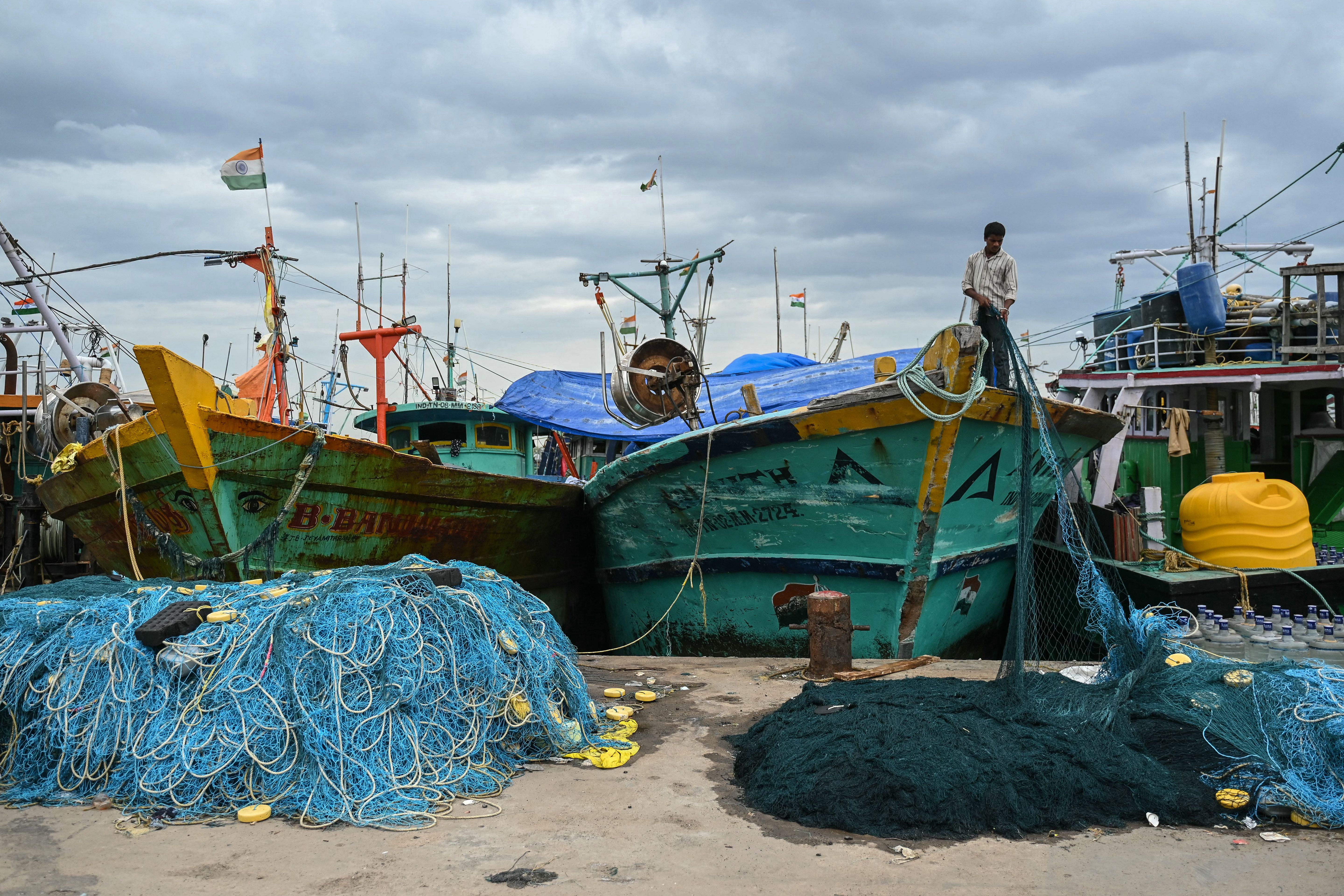
This article examines the scale and impact of Chinese IUU fishing operations globally and identifies the nature of the challenge posed by IUU fishing in the Indian Ocean Region (IOR). It also investigates why existing maritime law and international frameworks have struggled to address this growing threat.


Ajay Kumar, Charukeshi Bhatt

This compendium brings together three essays by scholars who participated in Carnegie India's Security Studies Dialogue in 2024, each examining a different aspect of China’s policies. Drawing on their expertise and research, the authors offer fresh perspectives on key geopolitical challenges.



Vijay Gokhale, Suyash Desai, Amit Kumar, …