

Paper
Saheb Singh Chadha

Source: Getty
After the chill in ties between 2020 and 2024 that brought India–China relations to their lowest point in several decades, the two countries have engaged each other afresh. This paper argues that there are predominantly four imperatives guiding India’s approach to China, and they exist in an order of priority.
Note: The analyses presented in this paper are based on developments up to June 1, 2026.
Indian Prime Minister Narendra Modi visited China in August–September 2025 for the Shanghai Cooperation Organization (SCO) summit and also met with Chinese President Xi Jinping in October 2024 on the sidelines of the BRICS summit in Kazan. These two interactions, and the diplomacy and geopolitics that have transpired in between, mark the beginning of a new chapter in India-China relations. After five years of a border standoff that brought ties to their lowest in four decades, high-level political engagement has resumed between the two sides. Their defense ministers, foreign ministers, national security advisers, vice foreign ministers/foreign secretaries, and diplomats have since held substantive discussions on issues of bilateral interest apart from their border standoff. This was largely not the case between June 2020 and October 2024, where discussions were focused on the border standoff. This was because the Government of India took the position that the broader relationship could not be delinked from developments at the border, and thus progress in resolving the border standoff was a pre-condition for the development of broader ties. With progress in resolving the border standoff, both sides now desire to move beyond the difficulties of the past five years and engage afresh.
In August 2025, Indian External Affairs Minister S. Jaishankar stated, during his counterpart’s first visit to New Delhi in three years, “Having seen a difficult period in our relationship . . . our two nations now seek to move ahead.”1 Likewise, in his meeting with Modi in New Delhi, China’s Foreign Minister Wang Yi referenced “promoting bilateral relations to enter a new course of improvement and development.”2
In this context, the factors driving India’s engagement with China assume relevance. It is important to understand India’s interests and imperatives in engaging China, as well as the likelihood of success of such engagement based on China’s calculus. This is to enable better understanding and sounder decisionmaking among several stakeholders—in the Indian government, armed forces, businesses, academia, think tanks, and the general public. It will also help other countries understand India’s interests and find avenues of cooperation based on a complementarity of interests.
Largely, two arguments have gained currency in popular discourse for these developments. One, that the United States’ foreign policy under President Donald Trump and the consequent churn in India-U.S. ties is bringing New Delhi closer to Beijing. Second, that India’s economic imperatives are driving its engagement with Beijing. These are part of the answer, but they are incomplete.
Based on conversations with serving and retired stakeholders from the Indian government, industry, and a close reading of government statements, this paper argues that there are predominantly four imperatives guiding India’s approach to China, and they exist in an order of priority. First is the imperative of securing and managing the disputed border with China. This consideration is key for the Indian government, and it is the progress in achieving peace and tranquility at the border that has enabled movement in the bilateral relationship. As Jaishankar noted to his Chinese counterpart in July 2025, “We have made good progress in the past nine months for the normalization of our bilateral relations. It is a result of the resolution of friction along the border and our ability to maintain peace and tranquility there. This is the fundamental basis for mutual strategic trust and for smooth development of bilateral relations.”3 Second is India’s economic imperative of securing supply chains dependent on China, reducing trade vulnerabilities, and attracting capital and technological investment. Third is the search for a new modus vivendi and political understanding with Beijing. Fourth are geopolitical pressures arising out of a changing international order driven by the changes in U.S. foreign policy. The relative importance of these imperatives waxes and wanes based on the priorities of the Indian government, but over the course of the past few years, these have featured consistently as drivers of engagement, in this order.
This paper proceeds in three parts.
Part I briefly introduces the state of play in India-China relations since both sides embarked on the path to normalcy with the Modi-Xi meeting in October 2024. It thereafter details the methodology of the paper and reviews existing literature on the state of India-China relations today, and the drivers and prospects for their normalization.
Part II details India’s imperatives in engaging Beijing, with separate sections on the border, economic necessities, the search for a political détente, and geopolitical pressures. It further details how each imperative is being addressed or pursued. To be clear, the Government of India’s domestic measures to secure its interests with China, such as military modernization or economic reform, are out of the scope of this paper. This paper exclusively deals with India’s bilateral engagements with China in pursuit of its interests.
Part III discusses whether India’s efforts are likely to bear fruit, based on China’s geopolitical outlook, and its appetite for engagement and for accommodating India’s interests. Accordingly, China’s imperatives in engaging India and the signals emanating from Beijing are briefly discussed. The paper concludes an outline of the most likely scenario for India-China relations going forward, ending with reflections on the research.
India-China relations are emerging from the deep chill that lasted between May 2020 and October 2024 caused by the standoff at their shared border; a stakeholder within the Indian government labelled it as the “biggest disruption” since the 1962 war.4 Both sides have been engaged in a military standoff at their disputed border since April–May 2020, triggered by China’s unilateral attempts to change the status quo along the Line of Actual Control (LAC).5 This was due to the scale and scope of the attempts coupled with the violent conduct of Chinese troops. Chinese forces attempted to change the status quo of actual control along seven separate locations: the north and south banks of Pangong Tso, the Gogra-Hot Springs area, the Galwan valley, the Depsang plains, and Demchok. This was accompanied by violence at Pangong Tso in early May 2020, and in the Galwan incident on the night of June 15, 2020. The latter left twenty soldiers dead on the Indian side, and at least four on the Chinese side.6
These developments were treated by the Indian government as a “serious disturbance” to peace and tranquility in the border areas, and “in complete disregard of all mutually agreed norms,” with respect to the border management regime that both sides had constructed over the course of twenty years.7 Particularly on the Galwan incident, Jaishankar had stated that the “unprecedented development will have a serious impact on the bilateral relationship.”8 The government reiterated India’s longstanding position that peace and tranquility in the border areas could not be delinked from the rest of the India-China relationship, and essentially froze bilateral exchanges in the political, economic, and people-to-people domains. These were subject to the restoration of peace and tranquility in the border areas, through disengagement and de-escalation in eastern Ladakh. Between 2020 and 2024, India and China negotiated disengagement in the seven friction points, which enabled a meeting at the highest level between Prime Minister Narendra Modi and President Xi Jinping in October 2024. This paved the way for subsequent high-level diplomatic and political engagements between the principals, foreign ministers, national security advisors, defense ministers, foreign secretary vice ministers, and the special representatives (SRs) of the two sides on the India-China boundary question. As Jaishankar noted in July 2025 during his meeting with Foreign Minister Wang Yi in Beijing, “we have made good progress in the past nine months for the normalization of our bilateral relations. It is a result of the resolution of friction along the border and our ability to maintain peace and tranquility there. This is the fundamental basis for mutual strategic trust and for smooth development of bilateral relations.”9 Both sides have sought to resume exchanges in a variety of domains. As China’s Ministry of Foreign Affairs (MFA) noted in the days leading up to Indian Foreign Secretary Vikram Misri’s visit to China in January 2025, both sides agreed at the SR talks in December 2024 “to improve and strengthen exchanges, resume institutional dialogue and exchanges and cooperation in various fields, and promote China-India relations to return to the track of healthy and stable development as soon as possible.”10 Similarly, India’s statement from Misri’s visit noted that both sides “took stock of the extant mechanisms for functional exchanges. It was agreed to resume these dialogues step by step and to utilize them to address each other’s priority areas of interest and concern.”11
An Indian government stakeholder shared their assessment in November 2025 that ties are certainly “warmer” as compared to October 2024.12 However, both sides recognize the systemic distrust that hinders the relationship and the path to normalcy.13 In this context, both sides, since January 2025 have focused on more readily achievable outcomes, particularly people-to-people ties that are comparatively easier to negotiate and can serve as preliminary steps in building confidence and trust if concluded successfully.14 As the statement from Misri’s visit to Beijing in January 2025 noted, both sides “reviewed the state of India-China bilateral relations comprehensively and agreed to take certain people-centric steps to stabilize and rebuild ties.”15 These include the resumption and expansion of the Kailash Mansarovar pilgrimage, border trade, the resumption of direct flights between the two countries (stalled since the COVID-19 pandemic and the border standoff thereafter), visa facilitation, and business, media, think tank, and civil society exchanges.16
The two sides are also focusing on people-to-people ties to reframe the public narrative around the relationship more positively, a narrative which has remained largely adversarial since 2020. Both sides have referred to a stable India-China relationship as beneficial for the cumulative “2.8 billion people who live in the two countries.”17 During Misri’s visit to Beijing, both sides noted redoubling “public diplomacy efforts to create better awareness about each other and restore mutual trust and confidence among the public.” This is also to enable a political atmosphere conducive for meaningful negotiations. Government statements have signaled a softer tone on China, a significant example being Modi noting in March 2025 that the “relationship should remain just as strong in the future. It should continue to grow. Of course, differences are natural. When two neighboring countries exist, occasional disagreements are bound to happen. Even within a family, not everything is always perfect.”18 China’s MFA responded with appreciation.19
A mixed-methods approach was adopted for this paper, with textual sources corroborated by stakeholder interviews.
The textual sources can be divided into primary and secondary sources. On the Indian side, primary sources include press releases, speeches, statements, and media briefings from the Ministry of External Affairs (MEA) and Ministry of Defence (MoD), along with any other public statements by government representatives. On the Chinese side, primary sources include statements, releases, and briefings from the MFA, Ministry of National Defense (MND), and any other public statements by government representatives. Secondary or quasi-primary sources on either side include research, analysis, and statements from authors, institutions, or publications perceived or understood to be expressing views in alignment with those of primary actors. This situation is more present on the Chinese side than the Indian side. For example, publications such as the People’s Daily, the official newspaper of the Chinese Communist Party (CCP), or the Global Times, the international-facing publication of the CCP, provide insights into Chinese thinking.
This paper also draws from the research and analysis conducted for a previous working paper published by this author which details the negotiations that India and China undertook between 2020–2024 to resolve their border standoff.20
The analysis of primary and secondary sources generated preliminary takeaways which were then tested in meetings with Indian stakeholders, whose inputs have informed and added nuance to this analysis. The stakeholders include senior retired or serving officials from the Indian Army, MEA, MoD, the National Security Council Secretariat (NSCS), as well as industry stakeholders and observers. Consultations with Chinese policymakers were beyond the ambit of this research paper. Thus, the understanding of the Chinese position is developed by corroborating Chinese primary and secondary statements with the inputs of Indian policymakers and scholars on Chinese thinking, rather than those of Chinese policymakers.
The literature and conversation on the present thaw in India-China relations are characterized by the following features. Most works reviewed primarily assign the thaw in India-China ties to geopolitical reasons, especially the uncertainty in the foreign policy of the United States under Trump.21 Others assign it to India’s economic needs—supply chain resilience, investments, and technology transfers.22 Comparatively fewer pieces attribute the thaw to peace and tranquility at the India-China border, and the necessities thereof.23 Other causes still include a reconsideration of the benefits and costs of an adversarial posture toward each other,24 and attempts by both sides to deepen political understandings about their bilateral relationship.25
On the trajectory of reconciliation, it recognizes stumbling blocks but sees opportunities for both sides nonetheless.26 It overstates the extent of India-China reconciliation, and the ambition present on either side for this.27 Literature on all the above issues is also primarily characterized by short-form opinion pieces with less scope for the imperatives to be fleshed out.
In contrast, this long-form paper studies all four imperatives through an analysis of primary and secondary sources, detailing and ranking the imperatives, how they arise, and how the Indian government is pursuing these interests. It argues that without progress in resolving the standoff at the India-China border in 2024, an improvement in the larger bilateral relationship would have likely been difficult to imagine. It juxtaposes these imperatives with each other and with China’s outlook and accordingly hypothesizes the future trajectory of India-China relations. It also extrapolates on the deep trust deficit plaguing the relationship and endeavors for normalization, and correspondingly, the Indian government’s cautious appetite for engagement with Beijing.
Four key imperatives guide India’s approach to China at this moment. This section explains each imperative, why it arises, and how the Government of India is pursuing its interests in its engagement with China. The four imperatives are:
This order of the Government of India’s imperatives is gleaned from conversations with stakeholders inside and outside of the government. Stakeholders were also asked to rank these imperatives in order of their sense of the Indian government’s priorities. In the past year, whether in the government, military, or strategic community, most stakeholders put the border first, followed by India’s economic necessities, then the search for a new political understanding, and lastly, geopolitical pressures. However, the author recognizes that the importance of each imperative can wax or wane depending on domestic and international developments and considerations.
The primary imperative for India in engaging Beijing is to achieve a stable, predictable, and settled border.
India’s border with China is a fact of geography that cannot be changed. The disputed border is a national security issue over which both countries engaged in conflict in 1962. It remains a source of concern for New Delhi, and a source of tension for the broader India-China relationship. Both sides assert their claims to the disputed territories with troops on the ground, who have clashed and faced off in tense engagements over the past several decades. Most notably, the frequency of these events has increased in the past two decades, with standoffs in 2013, 2014, 2015, 2017, and 2020 to present, which, according to the Government of India, have arisen due to attempts by the Chinese side to alter the status quo on the ground.28
The border imperative can further be broken down into three sub-imperatives, differentiated by time-sensitivity. The first is India’s need to resolve the present standoff along the India-China border, which began in April–May 2020. The second is the need to ensure peace and tranquility along the border, and to manage the border with a view to prevent future clashes, standoffs, and further attempts to change the status quo on the ground. The third and more long-term imperative is the settlement of the India-China boundary question.
Currently, both sides still have an estimated 50,000–60,000 troops deployed by either side in forward areas along the India-China border, facing each other.29 These frontline deployments risk ground troops coming into kinetic contact. The deployment, likened by Indian stakeholders to be of quasi-wartime levels, imposes financial, military, and human costs.30 India’s imperative is to achieve the de-escalation of these troops. As part of negotiations on the standoff, both sides also agreed to moratoriums on patrolling in certain disputed areas, with a view to prevent troops coming into contact, which could lead to fresh tensions. It is in India’s interest to negotiate new patrolling arrangements in these areas, as it has in Depsang and Demchok.31 These arrangements would allow India to patrol in these locations and assert its claim to them. According to an Indian military stakeholder formerly at the strategic level of command, conversations on these moratoriums are ongoing.32 Neither government has stated that de-escalation has been undertaken or completed, and it has been described by government stakeholders as a work in progress.33
In pursuit of the border imperative, both sides are engaged in discussions at the military, diplomatic, and political levels to achieve de-escalation and draw down forward deployed troops. Negotiations through these channels were successful in achieving disengagement between 2020 and 2024.34 A description of the channels of negotiation and their hierarchy, based on an earlier work by the author, is placed below.
The first channel includes the meetings at the politico-strategic level between the heads of states, external affairs ministers, defense ministers, and national security advisors. Second is the Working Mechanism for Consultation and Coordination on India-China Border Affairs (WMCC), which is a working group of diplomatic and military experts on both sides. Third is Senior Highest Military Commander Level (SHMCL) talks at the military level.
A stakeholder at the strategic level of decisionmaking further explained the hierarchy and roles of each mechanism to the author.35 The politico-strategic level meetings set out the framework, the WMCC meetings detail the next steps, and military commanders discuss and implement them on the ground. Jaishankar referenced these as the “main mechanisms” as channels of negotiation with China: “We have a mechanism called WMCC, and we have a mechanism called Senior High Level Commander’s Meeting. One, you know, one is a kind of military-led with MEA in it, the other is MEA-led with military in it. These mechanisms continue to do the work . . . obviously you have to have a leadership level by it.”36 India’s Ministry of External Affairs (MEA) too notes that “since June 2020, the two sides have engaged in discussions through WMCC and Senior Commander’s Meeting (SCM) for disengagement in the border areas along the LAC in Eastern Ladakh.”37
Meetings at the politico-strategic level include interactions between representatives such as the two sides’ foreign ministers, defense ministers, national security advisors (who also engage in their capacity as SRs on the India-China boundary question), and foreign secretary–vice-foreign ministers. The SR mechanism is particularly important as a political mechanism, where the two sides have been specifically appointed by their respective principals to discuss the boundary question. Most significantly, meetings at the politico-strategic level include interactions between the state leaders, Prime Minister Narendra Modi and President Xi Jinping.
The WMCC predates the 2020 standoff, having been established in 2012 through the India-China Agreement on the Establishment of a Working Mechanism for Consultation and Coordination on India-China Border Affairs.38 It is mandated to “deal with important border affairs related to maintaining peace and tranquility in the India-China border areas” and “will address issues and situations that may arise in the border areas that affect the maintenance of peace and tranquility.” The Indian side is headed by the joint secretary in the East Asia division of the MEA and the Chinese side by the director-general of the Department of Boundary and Ocean Affairs under the MFA.
The SHMCL talks, better known as the corps commander talks, are held between senior highest military commanders (SHMCs) of the two sides responsible for eastern Ladakh. The Indian side is led by the general officer commanding corps of the Indian Army’s XIV Corps based at Leh, in the union territory of Ladakh.39 The Chinese side is led by the commander of the South Xinjiang Military District, part of the People’s Liberation Army’s Western Theater Command.40
Before the standoff began, meetings were taking place at the level of brigade commander or division commander.41 Unable to initially find a resolution at that level, the Chinese side suggested a meeting at the SHMC level, which was subsequently undertaken on June 6, 2020, the first corps commanders meeting.42 These meetings began with the purpose of managing tensions and evolved to discuss the granularities around disengagement. On the Indian side, the China Study Group convenes ahead of each meeting of the corps commanders to lay out the minimum and maximum that the corps commander can negotiate.43 The corps commanders meet at the Border Personnel Meeting points in eastern Ladakh, either at Chushul on the Indian side or Moldo on the Chinese side.
In the present context, India and China are discussing de-escalation of the troops still deployed on the border in the course of the 2020 standoff, through political, diplomatic, and military channels. India’s statements from Wang’s visit to New Delhi in August 2025 noted that both sides discussed de-escalation.44 Jaishankar noted during his meeting with Wang that “It is . . . essential that the de-escalation process move forward.”45 Most specifically, India’s statement from the twenty-fourth round of SR talks noted using the “border management mechanisms at diplomatic and military levels to carry forward the process of border management, and discuss de-escalation, beginning with the principles and modalities thereof.”46 The August 2025 statement also mentioned “holding an early meeting of the General Level Mechanism in the Western Sector,” which is a reference to the SHMCL mechanism; this meeting took place in October 2025.47 Further, after Modi’s meeting with Xi in Tianjin on the sidelines of the SCO summit, Misri noted that “This is a discussion that will go forward in the designated mechanisms between the two sides dealing with these issues.”48 As mentioned, an agreement on de-escalation has not yet been reached and is under discussion.49
Beijing has utilized the ambiguity in its claim lines to make several, at times contradictory, claims at different points in time, and to coerce India militarily at the border in pursuit of these. The ambiguity serves Beijing well: It allows China to escalate at the border at a time and place of its choosing.
While discussions on resolving the Ladakh standoff continue, the second imperative is border management. This involves the ability of Indian troops to patrol to India’s claimed territory while managing contact and tension with China’s troops, which are undertaking the same activity and for the same purposes. It also involves detecting, preventing, and countering attempts by Chinese forces to change the status quo, in violation of the border management agreements between the two countries. Most of all, it involves preventing another situation like in 2020, when Indian and Chinese troops clashed as a result of Chinese attempts to change the status quo in eastern Ladakh.
To this end, discussion to formulate new border management protocols and confidence building measures (CBMs) are underway. A September 2020 joint statement, after the Indian and Chinese foreign ministers met in Moscow, first indicated this. This discussion was arguably the most significant meeting in the standoff up to that point and the joint statement signaled that both sides saw eye-to-eye, to an extent, on the way out of the Ladakh crisis. From the time the standoff began, it remains the only joint statement at the political level. The statement noted that “The Ministers agreed that as the situation eases, the two sides should expedite work to conclude new Confidence Building Measures to maintain and enhance peace and tranquillity in the border areas.”50
Thereafter, matters relating to disengagement took precedence in bilateral conversations over the next four years. It was only after the agreement on disengagement in October 2024 and the meeting between Modi and Xi, that the subject of new confidence building measures came up. In response to a question on CBMs posed at an MEA briefing following the meeting, Indian Foreign Secretary Vikram Misri noted that “these evolve continuously, as the two sides engage once again in multiple formats. This is certainly a subject that I think will be under discussion between the two sides.”51 It was separately reported that as part of the agreement on patrolling in Depsang and Demchok, both sides will coordinate patrolling in those areas, to avoid face-offs.52 Announcing the completion of disengagement and appraising the Lok Sabha on India-China ties in December 2024, Jaishankar noted in the context of previous confidence building agreements with China that it was “evident that the management of the border areas will require further attention in the light of our recent experiences.”53 He referenced Indian defense minister Rajnath Singh’s meeting with his Chinese counterpart in November 2024 where they discussed the “requirement of strengthening confidence building measures.” He also shared the Government of India’s expectation regarding the direction of ties with China in the near future, including the “effective management of our activities in the border areas.” Notably, India has frequently articulated that both sides are “drawing on the learnings from the events of 2020,” particularly in the twenty-third SR meeting, and discussing “various measures to maintain peace and tranquillity on the border and advance effective border management.”54 Increased military to military engagement is likely to aid border management by building trust at the military level.55 To this end, both sides’ statements from the twenty-fourth round of SR talks in August 2025 mention that they agreed to set up “General Level Mechanisms in Eastern, and Middle Sectors, in addition to the existing General Level Mechanism in Western Sector, and holding an early meeting of the General Level Mechanism in the Western Sector.”56 Simply put, similar to the SHMCL mechanism in eastern Ladakh that has been instrumental in successfully negotiating the standoff and in attempts to build trust at the military level, mechanisms will be set up in the remaining sectors of the India-China border. Notably, Modi noted in his opening remarks in his meeting with Xi in Tianjin in August 2025 that the “Special Representatives have also reached an agreement on border management.”57 Stakeholders with knowledge of the matter have clarified that this does not necessarily refer to a formal agreement or document, rather it refers to the state of the conversation and the process between the two sides.58
China also coerces India at the land border to signal dissatisfaction over India’s deepening relationship with the United States. Settlement of the boundary question would, in India’s view, reduce Beijing’s ability to use this method.
Finally, the relatively longer-term objective is the settlement of the India-China boundary question—a mutually defined, delineated, and demarcated border that accommodates India’s territorial interests. As mentioned, the disputed boundary is a source of tension in the India-China relationship. Particularly, Beijing has utilized the ambiguity in its claim lines to make several, at times contradictory, claims at different points in time, and to coerce India militarily at the border in pursuit of these.59 The ambiguity serves Beijing well: It allows China to escalate at the border at a time and place of its choosing.60 As a former Indian foreign secretary previously argued, China primarily coerces India at the land border—where Beijing is militarily superior—to keep its attention away from its maritime frontiers in the Indian Ocean and the Bay of Bengal.61 China also coerces India at the land border to signal dissatisfaction over India’s deepening relationship with the United States.62 Settlement of the boundary question would, in India’s view, reduce Beijing’s ability to use this method.
To this end, both sides’ SRs have resumed their dialogue which was paused since 2019, holding the twenty-third round of talks in December 2024 in Beijing. As the Indian statement noted, “This was the first meeting of the SRs since frictions had emerged in the Western Sector of the India-China border areas in 2020.”63 The Indian statement noted that both SRs “resolved to inject more vitality” into the process of settling the boundary question.64 Likewise, the Chinese statement noted that the two sides “reaffirmed their intention to seek a fair, reasonable and mutually acceptable solution to the border issue.”65
Particularly, both sides have agreed to explore an “early harvest” approach which essentially aims to first settle the boundary in relatively less contentious areas and sectors, before proceeding to those that are more contentious and therefore more difficult to resolve.66 During the twenty-fourth round of SR talks, Wang noted in his meeting with Indian National Security Advisor Ajit Doval that “The two sides exchanged views on early harvests of boundary negotiations.”67 Both sides also noted the agreement to set up an expert group under the WMCC to explore the “early harvest” in “boundary delimitation.”68 Though neither government has clarified geographical specificities, China has previously suggested the settlement of the Sikkim sector as an “early harvest” because as per the Chinese government, there is already a boundary in place through the 1890 Convention Between Great Britain and China Relating to Sikkim and Tibet.69 India has not agreed to this proposal in the past.70 It is not yet clear whether the present discussions are limited to Sikkim, or to a Sikkim “+” scope involving the border in Uttarakhand and Himachal Pradesh as well.71
It is worth clarifying three points at this juncture. First, the 2025 discussions on early harvest are not new; this approach was discussed in the SR talks in 2019 as well.72 That discussions on this topic have taken place in the SR talks in 2025 has more to do with the fact that regular bilateral consultations between India and China on most topics outside of their border standoff were disrupted between 2020 and 2024. These consultations only resumed toward the end of 2024.73 Second, delimitation was mentioned by the Chinese side during the WMCC talks in March 2025, before it was widely reported in June 2025 defense minister–level meetings.74 While not mentioned in the statements from the SR talks in December 2024, the Chinese statement from the March 2025 WMCC talks noted that “the two sides had a comprehensive and in-depth exchange of views focusing on implementing the common understandings reached about negotiations of boundary delimitation, border control, mechanism development, cross-border communication and cooperation, and other topics during the 23rd meeting between the Special Representatives of China and India on the boundary question held in December 2024 [emphasis added].”75 Thus, the discussions on an early harvest approach perhaps resumed at the end of 2024 itself, as opposed to mid-2025. Third, and relatedly, an early harvest approach is fundamentally different to a package deal approach. While the early harvest approach aims to resolve the boundary in a sector-by-sector manner, the package deal outlined by the 2005 Agreement on Political Parameters and Guiding Principles for Settlement of the India-China Boundary Question involves “a package settlement to the boundary question” which “must be final, covering all sectors of the India-China boundary.”76 However, it is too early to conclude that the present discussions on early harvest necessarily reflect a confirmed shift in position away from the package deal approach by the Indian government. The language is non-committal, with India’s statement noting that the two SRs would set up an expert group under the WMCC to “explore” this approach.77 India’s statement also contains a contradiction: While broaching early harvest, it also notes “seeking a fair, reasonable and mutually acceptable framework for settlement of the boundary question in accordance with the Agreement on Political Parameters and Guiding Principles for Settlement of the India-China Boundary Question signed in 2005.”78
India’s engagement with China is in pursuit of its own economic interests. These range from vulnerabilities, such as supply chain dependencies on China, to opportunities, such as the promise of technology transfer and investment into Indian industry. China’s utilization of these dependencies to secure its national interests, to India’s detriment, also motivates India’s outreach to China. India’s attempt is to diversify and de-risk, rather than decouple.79 As an industry stakeholder noted, “China has the levers.”80
First, India is dependent on China for procurement of particular goods. Key dependencies are in pharmaceuticals, electronics components, critical minerals, and certain fertilizers.81 An Indian government stakeholder noted the “major concern” and “anxiety” in Indian industry arising out of the disruptions caused by China’s export controls on some of these categories of goods.82 Two recent examples illustrate India’s dependence and the disruptions caused by Chinese export controls.
In the first half of FY2025, India imported approximately 56 percent of its electronic components from China and Hong Kong cumulatively.83 This figure was 62 percent in both 2019–2020 and 2020–2021, and more than 68 percent in 2021–2022.84 In the present context, though India has emerged as an assembly hub for iPhones, its components are imported from China. Since at least early 2025, Chinese officials have been dissuading Chinese companies from exporting technology and equipment overseas and restricted the flow of human resources, including to India.85 Foxconn, Apple’s main assembly partner in India, is an example of a company affected by this. Its factory in India has been unable to receive additional specialized machinery from China. It was reportedly unable to dispatch its staff to India in January 2025, and later in July, over 300 Chinese engineers and technicians were recalled.86 Chinese managers have been “critical” in training Foxconn staff in India, and these removals will slow down the training of the local Indian workforce, likely leading to higher production costs.87
Much like the rest of the world, India is overwhelmingly dependent on China for critical minerals as well. Though it is difficult to quantify the overall dependency, reports have indicated that India is vulnerable in at least six critical minerals where China exceeds 40 percent of India’s total imports—bismuth (85.6 percent), lithium (82 percent), silicon (76 percent), titanium (50.6 percent), tellurium (48.8 percent), and graphite (42.4 percent).88 For rare earth magnets, a subset of critical minerals, India imported 93 percent from China in FY2024–2025.89 The negative implications of this dependency became clear when China’s April 2025 restrictions on the export of certain medium-to-heavy rare earths caused supply chain disruptions in the automobile, electronics, defense, and renewable energy industries.90 While these export controls impacted companies and industries across the globe, Indian companies faced even tighter controls. When the United States and China agreed to reduce trade tensions in June 2025 and magnet flows subsequently eased to the rest of the world, Beijing turned down at least two applications for India-bound shipments, and at least thirty Indian applications were left pending.91 Further, the Chinese government also rejected a requested shipment of magnets to the Indian unit of a global firm, while allowing its German and U.S. subsidiaries.92 It was reported in September 2025 that all fifty-one applications by Indian automobile companies to import heavy rare-earth magnets were pending with Beijing, despite the high-level diplomacy in August–September 2025.93 It was only at the end of October 2025—six months after the new controls came into place—that heavy rare earth magnets supply resumed to four Indian companies.94 These too came with conditions to neither export them to the United States, nor use them for military purposes.95
India has engaged China to attempt the easing of these export controls. In June 2025, MEA spokesperson Randhir Jaiswal noted that “we have been in touch with the Chinese side . . . both here in Delhi, as also in Beijing, to bring predictability in supply chain for trade, consistent with international practices.”96 When Sun Weidong, China’s vice foreign minister visited India that same month for his dialogue with Misri, the Indian statement from the meeting noted that the “two sides agreed to hold certain functional dialogues including in the economic and trade areas to discuss and resolve specific issues of concern.”97 Export controls were one of the focus items during Jaishankar’s meeting with Wang in July 2025.98 The Indian statement notes that “He . . . took up restrictive trade measures and roadblocks to economic cooperation,” and that it was “essential” they are “avoided.”99 When asked about the export controls in the MEA’s weekly media briefing on July 17, 2025, spokesperson Randhir Jaiswal stated on more than one occasion that “the concerns of India industry are a matter of public record.”100 Thereafter, India’s statement from Wang’s New Delhi visit in August 2025 noted that “Both sides agreed to facilitate trade and investment flows between the two countries through concrete measures.”101 In the days after the August meeting, exports of di-ammonium phosphate fertilizer and tunnel boring machines—both of which had also been restricted in 2024—resumed.102 Lastly, after the Modi-Xi meeting in Tianjin in August 2025, Misri briefed the media that both leaders “underlined the need” to “increase policy transparency and predictability. ” The question of rare earths was also discussed in this meeting, according to a later briefing by the MEA.103 Misri in his briefing also noted that both leaders “recognized what’s happening on the international plane, and the challenges it creates. But they tried to, in a sense, see how to leverage that for building greater understanding between themselves, and how to, in a sense, take forward the economic and commercial relationship between India and China in the midst of these evolving challenges.”104 The new Joint Secretary in the East Asia division in the MEA paid a visit to Beijing in December 2025, and the statement from his meeting noted that the Indian side emphasized “the need for early resolution of outstanding issues pertaining to export control.”105 He also met with the director general for the Department of Asian Affairs of the Chinese Ministry of Commerce, and discussed “bilateral trade and commercial issues.”106 Most recently, India’s statement from the India-China Strategic Dialogue in February 2026 noted the need to “proceed from a political and strategic direction to approach issues and concerns related to bilateral trade.”107
The Indian government and businesses are exploring opportunities for investment and technology transfers with China. According to at least one government stakeholder, these are the primary focus in the economic domain.108 For context, the Government of India has been tightly regulating foreign investment from China since April 2020, subjecting them to government approval through Press Note 3.109 The reason given at the time was “curbing opportunistic takeovers/acquisitions of Indian companies due to the current COVID-19 pandemic.”110 Cut to the present, and this move reportedly cost Indian manufacturers $15 billion and 100,000 jobs between 2020 and 2024.111 An industry stakeholder noted that in addition to financial costs in terms of negligible investments, five years of limited and tightly screened investments have led to reduced skill sets in understanding how to engage China at a business-to-business level.112
When a new government took office in June 2024, one of its first signals on China was the July 2024 Economic Survey that suggested the “China plus one” strategy to increase FDI from China.113 It mentioned “striking the right balance between the trilemma of trade with China, investment by China, and India’s territorial and non-territorial integrity and security.”114 In consonance with warming India-China relations at a political level, the NITI Aayog, in July 2025 proposed that Chinese companies be able to take a stake of up to 24 percent in an Indian company without mandated government approval.115 This also came in the context of declining net FDI in India, which dropped to a record low of $353 million in FY2024–2025, as compared to $43.9 billion in FY2020–2021.116 Industry stakeholders recognize that Chinese FDI is necessary to increase India’s overall FDI, and that India cannot feasibly pursue a “China plus one” strategy without China.117 In October 2025, a high-level NITI Aayog committee advised the removal of existing restrictions on Chinese investments, or the adoption of a calibrated easing.118 The committee is reported to have proposed two pathways: withdrawing Press Note 3, or allowing investments with beneficial ownership below a specific threshold. It was separately reported in January 2026 that the government is preparing to “significantly relax” the restrictions, with investments up to 26 percent in non-sensitive sectors exempt, contingent on the foreign entity not exercising management control and not having a seat on the company’s board.119
In March 2026, the Government of India announced changes to Press Note 3, specifying that companies with non-controlling stakes belonging to entities from countries sharing a land border with India could invest in India without first seeking Indian government approval.120 It also mentioned that proposals from these countries for investment in specific sectors—capital goods, electronic capital goods, electronic components, polysilicon and ingot-wafer—would be expedited.121 These amendments have been described as helpful, but incomplete, and not marking a significant change in government thinking.122 In line with the nascent normalization taking place in other realms of the India-China relationship, these measures have been labelled a “cautious reopening.”123 It is also worth mentioning that in addition to problems around the ease of doing business in India, the China-specific restrictions of the past six years will warrant caution from Chinese investors.124
A government stakeholder noted in July 2025 that investment screening as a policy is “new for us, we are learning how to screen,” a possible explanation for the long deliberations on the matter.125 They noted that the goal is to prevent India from becoming merely a hub for Chinese transshipped goods, and to ensure value addition.126 Indicative of the government's priorities, the press release announcing the changes to Press Note 3 also flagged that “the new guidelines will provide clarity and ease of doing business in India, and facilitate investments which can contribute toward greater FDI inflows, access to new technologies, domestic value addition, expansion of domestic firms and integration with global supply chain.”127 Separately, it was reported in January 2026 that India plans to remove restrictions on Chinese firms bidding for government contracts.128 The restrictions require Chinese bidders to register with an Indian government committee and obtain political and security clearances.
Indian businesses are exploring tie-ups with Chinese companies to access emerging technologies. In April 2025, the Indian government indicated that it would clear joint ventures with Chinese companies, provided the Chinese have minority ownership, the board is dominantly Indian, and the venture offers value addition or brings in a new technology required to grow local production.129 In the second half of 2025, reports emerged of Indian companies exploring or partnering with Chinese companies to access China-dominated emerging technologies like solar modules, wind turbines, new-energy vehicles, and lithium-ion batteries. In June 2025, Indian billionaire Gautam Adani visited factories of a solar module maker and a wind turbine manufacturer in China.130 In July 2025, it was reported that under a new agreement between China’s Chery Automobile and India’s JSW Group, Chery would supply technology and components to JSW group to help launch a new-energy vehicle brand in 2027.131 As per the agreement, JSW will pay Chery a one-off technology transfer fee and recurring royalties. However, both companies disputed the reportage and said that the pact was for supply of components, with assembly taking place in India. In August 2025, Bloomberg reported that the Adani Group was exploring a tie-up with China’s BYD, a global leader in advanced technology and affordability, for battery technology.132 Reliance was also considering taking stakes in Chinese-origin battery tech firms but these plans appear to have paused in January 2026 as the Chinese company, Xiamen Hithium Energy Storage Technology Co. withdrew from the proposed partnership amid China’s restrictions on technology transfers in key sectors.133 In September 2025, Ashok Leyland signed a twenty-year agreement with China’s CALB Group Co., under which it would start with importing lithium-ion battery cells from CALB, and then “gradually seek the capability to design and manufacture lithium-ion batteries domestically.”134 Ashok Leyland also “plans to build an India-based research and development hub focusing on battery innovation, packaging, and materials science, with CALB playing a limited but supportive role.”135
Given these economic imperatives and the broader warming of ties, when asked if the India-China Strategic Economic Dialogue would be resumed, a government stakeholder responded that it remains to be seen.136 The dialogue was last held in September 2019.137 The MEA’s “bilateral brief” on China, last updated in August 2023, notes that “the current state of bilateral relations and strict travel restrictions due to China’s Zero COVID policy have impacted the frequency of meetings in these mechanisms.”138
India and China are currently in the early stages of exploring a new political understanding for their relationship. Fundamentally, this involves each state figuring out how the other advances or threatens their respective national interest. It involves each state understanding the foreign and security policy that the other is adopting toward it. Finally, it involves both states understanding where their interests converge and diverge, how convergences can be maximized, and divergences mitigated to the extent possible. The search for this new understanding arises out of the breakdown in the old modus vivendi that both sides built for their relationship between 1988 and the early 2000s. It also arises out of the recognition that the old modus vivendi was constructed during a time when both sides’ internal and external conditions were markedly different, and that the changes in both sides’ domestic trajectories and in the international order necessitate a new understanding.
A detailed explanation of the old modus vivendi is out of the scope of this paper; a cursory explanation follows.139 Beginning with Rajiv Gandhi’s visit to Beijing in 1988, India and China steadily constructed a political understanding, compelled by their respective domestic and international situations. At its core, that modus vivendi was premised on the understanding that India and China were two developing countries that required a stable and peaceful international environment that enabled their rise or at least, did not hinder it. In this context, they would engage each other to manage their differences, insecurities, and create opportunities. To these ends, they signed agreements in a range of domains, such as border management, the boundary question, economic cooperation, and their political relationship. For example, in 2005, they signed an agreement on the Political Parameters and Guiding Principles for the Settlement of the India-China Boundary Question and also established an India-China Strategic and Cooperative Partnership for Peace and Prosperity.140 However, these understandings began to break down from 2008 onward for multiple reasons. China’s foreign and security policies increasingly took an assertive turn, especially in the aftermath of the 2008 global financial crisis.141 In 2009, then Chinese president Hu Jintao called a firmer line in territorial disputes and India began to feel this assertion on the border in subsequent years.142 As India deepened its relationship with the United States, particularly its security cooperation, China became increasingly concerned and resorted to gray-zone coercion at the border, attempting to coerce India back to a neutral posture.143 Distrust increasingly characterized the relationship. A series of border standoffs took place in the 2010s, and the Ladakh crisis in 2020 was the breaking point. The Indian government restricted high-level dialogue until steps were taken by China to resolve the standoff to a level India deemed satisfactory. The reduced frequency of high-level conversations between 2020 and 2024 also stymied opportunities for political understanding.
There has since existed a vacuum of political understanding between both sides, and deep strategic distrust, persisted by the standoff in Ladakh, with quasi-wartime levels of deployment on either side. In private, stakeholders in the Indian government acknowledge this deep distrust at all levels of the government.144 In public, both sides have warned against the dangers of a lack of trust and acknowledged the need and desire to build mutual trust. In his first in-person meeting in September 2020 with Jaishankar since the standoff commenced, “Wang stressed that . . . what China and India need right now is . . . mutual trust, not suspicion. Whenever the situation gets difficult, it is all the more important to ensure the stability of the overall relationship and preserve mutual trust.”145 In March 2022, during Doval’s meeting with Wang in New Delhi, the two sides discussed that “restoration of peace and tranquillity will help build mutual trust and create enabling environment for progress in their relations.”146 In October 2024, after the meeting of Modi and Xi in Kazan, Misri noted that “As far as the question of trust is concerned, through the processes and actions between both sides, we hope that trust will increase between us.”147
The disengagement in October 2024 provided both sides with an opening to resume high-level conversations. These have resumed in earnest, including, but not limited to, meetings between the principals, national security advisors, and special representatives, foreign ministers, defense ministers, and foreign secretary vice ministers. Figure 1 details the meetings that took place between June 2020 and May 2025. It reflects the uptick in meetings at the political level following the disengagement in October 2024.
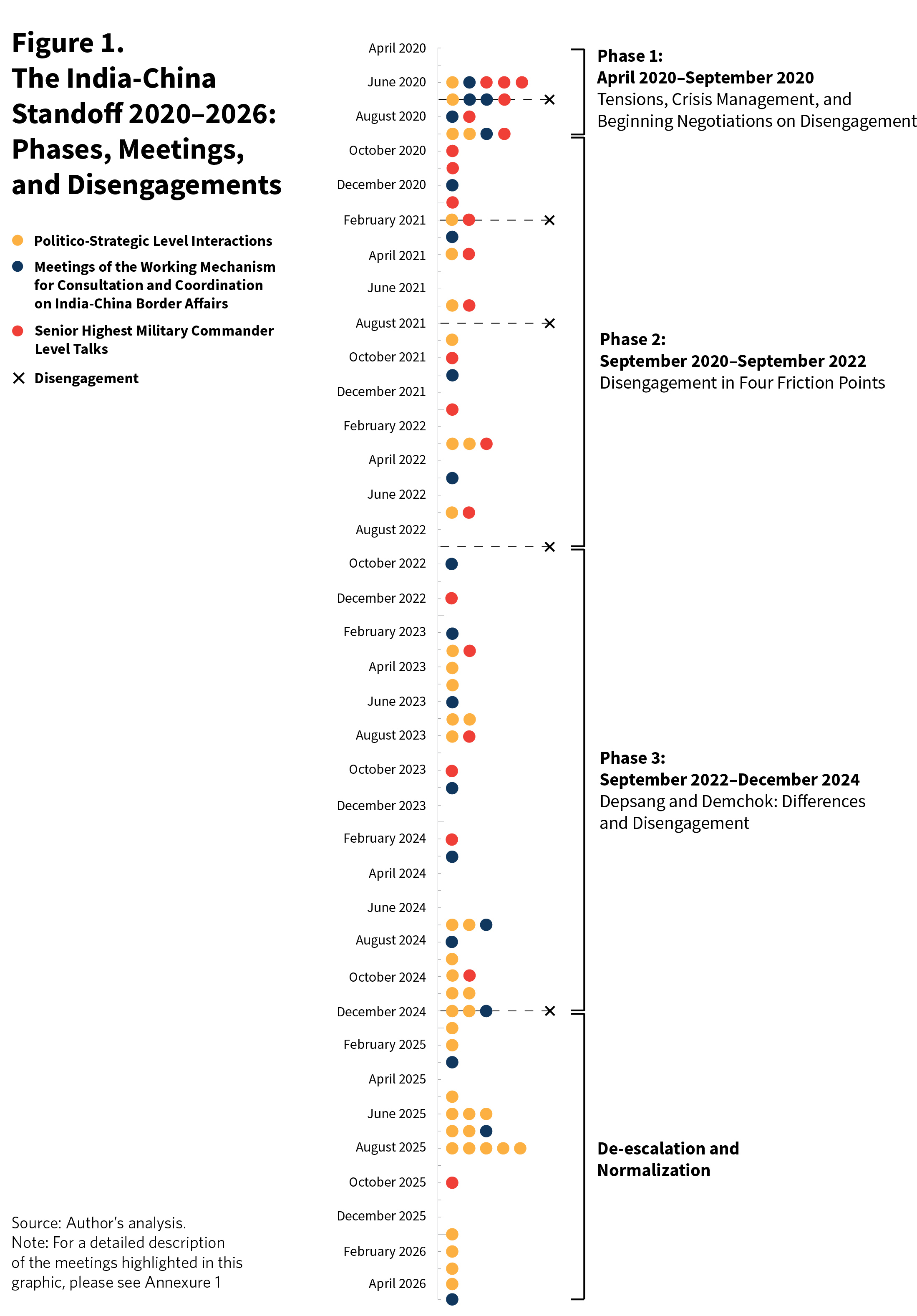
The substance of these conversations matters as much as their frequency. In most meetings between 2020 and 2024, discussions focused primarily on resolving the border standoff. Since October 2024, both sides have discussed matters apart from the standoff, such as border management, the boundary question, economic relations, regional and global geopolitics and their implications for each other. Indian stakeholders inside and outside of government maintain that in the Chinese view, India is incapable of following an independent foreign policy and follows the United States’ lead.148 Perhaps most importantly, India is engaging China on the roots of its misperceptions about India and attempting to acknowledge and clarify these to the extent possible.
At least in the past year, Indian stakeholders have publicly pushed back on these assumptions. In his meeting with Wang on the sidelines of the G20 summit in November 2024, Jaishankar emphasized that India’s “foreign policy has been principled and consistent, marked by independent thought and action. . . India does not view its relationships through the prism of other nations.”149
At the heart of the issue is that India and China’s material capabilities and ambitions have changed significantly over the past three decades, but the communication and understanding between them has not kept pace. Both sides have sought to deploy their increasing military and economic capabilities in service of their respective national interests, without communicating what these capabilities are, to what ends they are being deployed, and the possible impact on each other.150 This has led to misperceptions, the trust deficit and the breakdown of the modus vivendi. The state of play from the Indian perspective is encapsulated by the following remarks from Jaishankar on the day both sides embarked on the path to normalcy in October 2024:
Here is the challenge for us. Which is that we are neighbours. We have unresolved boundary issues. There are, they have been rising, we have also been rising. If two large neighbouring countries rise next to each other in the same time frame; it’s not easy. There are very very few historical parallels for that. So managing this double rise you can say—the two in proximity . . . I think this will require a lot of skill and a lot of deftness and diplomacy. And the truth is our capabilities will change, our influence will change, our ambitions will change. Both of us will naturally want to be bigger and more visible and more effective in the world. So how do we get an equilibrium in our relationship? I think this is one of the big issues, for us and for them.151
Since October 2024, the focus has been on rekindling the political relationship and managing the nascent resumption of high-level dialogue. While this occupies the present agenda, both sides have signaled the direction they intend the political dialogue to take. Since the Modi-Xi meeting in October 2024, both sides have spoken of searching for a new political understanding. Xi noted that the two sides “should maintain a sound strategic perception of each other, and work together to find the right and bright path for big, neighboring countries to live in harmony and develop side by side.”152
India’s relationship with China does not exist in isolation. Regional and global shifts—particularly those involving major powers—bear on the relationship. In the present context, the second Trump administration’s foreign policy and its impact on the United States’ relations with China and India, affects the India-China relationship. The United States’ foreign policy matters especially because India and the U.S. cooperate to balance China in the Indo-Pacific, and because Beijing perceives Indian policy in the region as broadly following Washington’s lead. The following section outlines the state of U.S.-China relations today and its possible trajectories and draws out the implications of these possible paths for India’s engagement with China across the scenarios.
U.S.-China relations are in a state of “fragile calm” and may head toward conflict or “managed rivalry.”153 The possible states of their relationship can be envisioned as two ends of a spectrum, with conflict at one end and a condominium at the other. Evan Medeiros, in “U.S.-China Relations for the 2030s: Toward a Realistic Scenario for Coexistence,” outlines five scenarios for the relationship, the most “positive” being a U.S.-China condominium, and the most dire being a new cold war that at times features kinetic confrontation.154 At any point along the spectrum, imperatives arise for India to engage China. Borrowing from Medeiros’ work, hypothetical scenarios (regardless of probability) at either end of the spectrum are outlined and the consequent imperatives for India are detailed.
The most dire scenario features wide-ranging U.S.-China competition, in the economic, military, and technological domains.155 Both sides accelerate their military buildups, risking conventional and nuclear conflict. Economics and business are increasingly securitized, with selective supply chains and export controls on certain technologies. These are combined with security crises that lead to kinetic conflict, such as “a major U.S.-China military incident over Taiwan or a military confrontation between China and an ally of the United States, likely triggering Washington’s direct involvement.”156
Such a scenario would have several implications for India. In “What Should India Do Before the Next Taiwan Strait Crisis?” Vijay Gokhale notes that a Taiwan contingency “will affect all segments of the economy and . . . the impact of a crisis might be substantial enough to set it back several years. Geopolitically, there will be significant implications for India’s national security, both directly as well as in the broader regional context, if Taiwan is reunified with the PRC.”157
In such a scenario, India would need to undertake extensive diplomacy with China, involving nuanced reassurance while also outlining Indian priorities and red lines. It would need to make clear that it has overlapping, but not identical interests with the United States. For example, while a free and open Indo-Pacific is in India’s interest, it may not directly involve itself in a Taiwan contingency. But it may need to signal to China that it would involve itself, if such a contingency were to spread to the Bay of Bengal, or the Malacca Strait. India may also need to strengthen its military posture along the LAC to forestall a pre-emptive Chinese maneuver aimed at deterring Indian involvement. In the Chinese view, India could involve itself in the Taiwan Strait in support of the United States or open a second front for China along the LAC. In the economic realm, China could restrict or refuse the export of goods, especially advanced technologies, to prevent onward export to the United States. This has been previously reported: China sought a guarantee from India in October 2025 that rare earth magnets exported from China would only be used for India’s domestic needs and not exported onward to the United States.158 Across this range of hypothetical scenarios in the realm of kinetic conflict or other competition, securing India’s interests would require sustained, high-level diplomacy with Beijing.
On the other end of the spectrum is a U.S.-China condominium.159
It envisions broad convergence, rather than full alignment, in economic and security interests and in worldviews. In it, the United States and China actively work together on a variety of regional and global challenges, to substantial positive effect for many countries. They drive global growth and set the terms of trade, investment, and technology development. The U.S. dollar and the renminbi (RMB) are the dominant currencies. . . . This is not simply a bipolar world, but one in which U.S. and Chinese actions define the terms of global politics and economics.160
In the above scenario, China could think that the United States would reduce security cooperation with India and thus that the cost of securing territories along the disputed border with India would be lesser if the United States were not as involved, or at all. This could incentivize Chinese coercion along the border, which would compel India to engage China politically to forestall such a scenario to the extent possible, by perhaps formulating new border management agreements, increasing strategic trust, and/or through a political détente.
Another possibility, however remote in the present context, could be a U.S.-China consensus on South Asia that sidelines Indian interests. It is worth recalling the June 1998 U.S.-China joint statement on South Asia, in which both countries recognized their “responsibility to contribute actively to the maintenance of peace, stability and security in the region.”161 At the time, India noted that it “categorically rejects the notion of these two countries arrogating to themselves, joint or individual responsibility for ‘the maintenance of peace, stability and security in the region.’ This approach reflects the hegemonistic mentality of a bygone era in international relations and is completely unacceptable and out of place in the present day world.”162 In the present context of China’s increasing presence in South Asia, coupled with its deepening cooperation with Pakistan, such a consensus would be even more detrimental to Indian interests. India would need to keep China engaged to manage and secure its economic, political, and security interests in South Asia.
Indian policymakers already worry about the state of the United States’ relationship with China and India. In July 2025, a stakeholder in the Indian government shared that they had expected the second Trump administration to follow a China policy similar to its first term, which would have involved a similar depth of cooperation with India on China.163 The stakeholder then observed that U.S.-India and U.S.-China relations had not panned out the way they expected, and instead, India would likely need to “fight its own battles” with China, possibly “alone.”164 Trump’s remarks in late October–November 2025 referring to his meeting with Xi as a meeting of the “G2,” have not served to lessen these concerns.165 From the recent visit of Trump to Beijing, the enunciations by both sides on “constructive strategic stability” also warrant further inspection from an Indian perspective.166 At any rate, a stakeholder in the Indian government noted that the unpredictability in the United States’ China policy has necessitated that India keep a channel open with China.167 Another government stakeholder shared that while short term trade deals between the United States and China were a matter of concern, the long-term trend in the relationship was one of structural competition.168
A recalibrated U.S. position in the Indo-Pacific, where it either reduces attention to the region or prescribes a diminished role to India, would be detrimental to India. Consensus on India as a balancer to China in the Indo-Pacific is a significant driver of India-U.S. cooperation and has been for the past two decades. Any such recalibration would impinge on this particular set of incentives for the U.S. and may reduce India’s economic and military capabilities to counter the challenge from China. Likewise, a reduced U.S. presence in the Indo-Pacific would create further space for Chinese political, economic, military, and normative influence, which would likely be at odds with Indian interests. Such a scenario would also compel India to engage China to protect its interests.
However, recent policy statements and documents from the United States government indicate a continued emphasis on the Indo-Pacific. The Trump administration’s November 2025 National Security Strategy (NSS) and 2026 National Defense Strategy indicate a focus on fairness and reciprocity in trade with China, as well as a favorable military balance of power in the Indo-Pacific to deter dominance by China or any other actor.169 Remarks by the U.S. Under Secretary of War for Policy Elbridge Colby at the NATO Defense Ministerial in February 2026 indicate that the United States wants allies in Europe to increasingly take responsibility for their own conventional defense so that the United States can focus on its own priorities—homeland defense and deterring China in the Indo-Pacific.170
Neither does there appear to be a reduced emphasis on India’s role in the United States’ Indo-Pacific strategy. The NSS notes that the United States “must continue to improve commercial (and other) relations with India to encourage New Delhi to contribute to Indo-Pacific security, including through continued quadrilateral cooperation with Australia, Japan, and the United States (“the Quad”).”171 Likewise, Colby noted during his visit to New Delhi in March 2026 that in maintaining a free and open Indo-Pacific and a stable balance of power in Asia, “India’s role is indispensable.”172
The above scenarios in the United States’ relationships with China and India are extremes at either end of the spectrum, from conflict and competition to consultation and cooperation. The reality is likely to be less extreme, and simultaneous scenarios may be at play, with cooperation in some domains and competition or even conflict in others.173 Irrespective of likelihood, this exercise illuminates the range of India’s interests and imperatives that would require it to engage in a high-level dialogue with China.
In pursuit of these imperatives, Indian decisionmakers have been in discussions with their Chinese counterparts about issues that are not strictly bilateral, but to do with regional and global geopolitics. During his meeting with Chinese Vice President Han Zheng in Tianjin in July 2025, Jaishankar noted that the “international situation, as we meet today, Excellency, is very complex. As neighboring nations and major economies, an open exchange of views and perspectives between India and China is very important.”174 In August 2025, during Modi’s meeting with Xi in Tianjin, Modi noted that “India and China both pursue strategic autonomy, and their relations should not be seen through a third country lens. The two leaders deemed it necessary to expand common ground on bilateral, regional, and global issues and challenges, like terrorism and fair trade in multilateral platforms.”175 The message from the Indian side to China was that China would be ill-suited to view its relationship with India through the lens of its relationship with the United States.
Lastly, and on the question of regional geopolitical issues, it was also that China should not view the relationship through the lens of Pakistan.176 The India-Pakistan conflict in May 2025, and the depth of China-Pakistan cooperation—real-time, tactically rich, and accurate—was revealing to Indian planners, and as one stakeholder termed it, a “collusion.”177 However, an Indian government stakeholder noted in July 2025 that even if the magnitude of China-Pakistan cooperation was revealing, the fact of China-Pakistan coordination was not a new nor unsurprising development; therefore it was a relatively minute stumbling block in the process of normalizing India-China relations.178 However, this may not be the case in future India-Pakistan crises, if China’s support to Pakistan decisively shifts a future conflict in Pakistan’s favor, or if China operationally or otherwise supports Pakistan engaging in terrorism against India—support that India deems significant.
To understand the likelihood of India’s success in meeting its objectives in engaging Beijing, it is necessary to understand how China presently sees India and the relationship in its worldview. China’s thinking about India in the political domain has not changed, in terms of India being utilized by the United States to contain China in the Indo-Pacific. However, China faces geopolitical compulsions arising out of an uncertain U.S. foreign policy—these being the need to stabilize its periphery and keep threats at bay while it navigates relations with the United States under the second Trump administration. China’s domestic economic imperatives, such as declining consumption, and geo-economic constraints due to tariffs, require Chinese companies to find new markets. However, it does not desire to share advanced technologies with India and enable the economic and technological rise of a competitor. Accordingly, the paper concludes that China will likely extend enough concessions to India politically, economically, and at the border to keep India pacified and interested, but without compromising on its core interests.
For the foreseeable future, China will likely conciliate with India in the political, economic, and security domains, without compromising on China’s core interests.
The following assessment of the view from Beijing is based on primary and secondary sources from China, such as public statements and think tank reports, as well as Indian experts who engage closely with these sources.
In general, China sees its relationship with India through the lens of its relationship with the major powers—in the present context, the United States.179 As this author has previously argued, China believes that the United States is utilizing India to contain China in the continental Indo-Pacific.180 It sees the deep India-U.S. relationship as Washington’s attempt to bring bloc confrontation to Asia and setting geopolitical traps, rather than India’s pursuit of its own national interests of development and security.181 During Jaishankar’s visit to China in July 2025 for the SCO foreign minister’s meeting, Wang asserted that “China-India relations have their own historical logic and internal driving force; their relationship does not target any third party, nor should it be disrupted by any third party.”182 Chinese statements make clear that it is fundamentally distrustful of India due to these reasons.183 As the MFA noted after Modi’s visit to Washington, DC in February 2025, relations between countries “should not target or harm the interests of third parties, but should be conducive to promoting regional peace, stability and prosperity. The Asia-Pacific region is not an arena for geopolitical games. Piecing together a closed and exclusive ‘small circle’ and engaging in bloc politics and camp confrontation will not bring security and is not conducive to peace and stability in the Asia-Pacific region and the world.”184 Relatedly, Beijing also believes in a hierarchical regional and global order, and believes that as the pre-eminent power in Asia, it must be at the top of that hierarchy.185 In this Chinese worldview, there is no room for India as a dominant power or as a pole in Asia. In meetings with Chinese counterparts, Indian statements emphasize the importance of a “multipolar world and a multi-polar Asia befitting the trends of the 21st century;” but Chinese statements make no reference to a multipolar Asia, only a multipolar world.186
How does this attitude manifest in the present moment, in the domains that India is engaging China in—political, economic, geopolitical, and military?
Indian stakeholders in government and outside, including those who have engaged in recent track 1.5 conversations with Chinese officials, opine that despite the events of the last five years, China has not fundamentally rethought its views on India and the relationship.187 It views India as opportunistic and attempting to offset its friction with the United States by reaching out to China. A former senior Indian government official noted that China is aware of India’s shrinking strategic space due to changing U.S. foreign policy, and it is happy to “let India stew.”188 In recent track 1.5 dialogues, the Chinese were frank about India’s power differential with China.189 Though China treats India as inferior, it is also aware that India’s geographic, demographic, economic, and military potential could pose a sincere threat to Chinese interests in the future. Thus, it seeks to hinder India’s rise. Two government stakeholders, one serving and one retired, agreed that China’s policy toward India was one of containment.190 While these reflect sentiments of government professionals, “containment” in the traditional, George Kennan–sense, is perhaps not an accurate term. It implies that India occupies far more space in China’s calculus than is the case. If it were the case, it would also reflect far more Chinese coercion in the military, economic, and other domains. Counterbalancing, in this author’s view, is a far more accurate term.
In the economic realm, the Chinese economy is facing several issues: poor consumption, deflation, excess capacity in industry, declining profits, and a weak job market.191 For Chinese companies, declining consumption and involution within China means a loss of markets.192 Outside of China, U.S. tariffs on Chinese products, increased scrutiny on transshipped goods, and de-risking from Chinese products in American supply chains means that existing markets for Chinese goods are also decreasing.193 Thus, Chinese firms are keen to expand into newer markets.194 India presents an opportunity as a possible market and an investment destination. China is already India’s second-largest trading partner, with $127.7 billion of two-way commerce in 2024–2025.195 As per Chinese customs data from January 2026, bilateral trade surged to an all-time high of $155.62 billion in 2025, with the trade deficit at a record $116.12 billion.196 Chinese firms are also turning to Indian firms to supply goods onward to the United States.197
At the same time, the Chinese government is wary of providing foreign companies access to leading technologies—which Indian companies are vying for—in possible joint ventures and investment deals. According to experts, Chinese companies aim to access the Indian market, rather than share technology or intellectual property.198 It was reported in April 2025 that China was discouraging and restricting employees and specialized equipment meant for high-technology manufacturing in India and Southeast Asia from leaving the country, with the goals of keeping production in China, reducing job cuts, and preventing investor exit.199 In July 2024, Chinese officials advised automobile manufacturers to not make auto-related investments in India and preferred instead that companies manufacture in China and export knocked-down kits to assemble in overseas markets.200 In a nutshell, the CCP wants more access to India’s markets, without enabling the technological and economic rise of a competitor.201 Lastly, if China’s model of engagement in South Asia is taken as a reference point, Beijing’s preference will be to bring in Chinese capital, technology, and labor to build products for export, with little local value addition.202
Off the record, several stakeholders in and outside the Indian government are pessimistic about the prospects of economic engagement with China, and point to the negligible record of Chinese investment in India.203 As the Indian Embassy in Beijing also notes, “Growth in bilateral investment has not kept pace with the expansion in trading volumes between the two countries. While both countries have emerged as top investment destinations for the rest of the world, mutual investment flows are yet to catch up.”204 Industry stakeholders within India recognize that India’s domestic issues around the ease of doing business, and policies toward Chinese investment—welcomed between 2014–2019 but tightly regulated from 2020 onward—have contributed to caution and uncertainty on the part of Chinese investors.205 Regarding the trade deficit, industry stakeholders are also doubtful that India will get enough access to the Chinese market to cause a meaningful reduction. This will require diversifying imports away from China and producing goods domestically.206
Geopolitically, China is focused on its economic, technological, and security competition with the United States, particularly under President Donald Trump. As a result, it has sought to stabilize other relationships, particularly in its periphery. China’s renewed diplomacy with India after June 2024, and the subsequent border disengagement and political restart, were likely motivated by the desire to stabilize that front in anticipation of heightened tensions with a second Trump presidency.207 In April 2025, China convened the Central Conference on Work Related to Neighboring Countries—the first such conference in twelve years, indicating that China’s neighborhood was receiving more attention than usual, from the CCP.208 In particular, China’s statement from the conference noted that “at present, China’s relations with its neighboring countries are . . . entering a critical phase of deep linkage between the regional landscape and the world changes [emphasis added].”209 It noted that it was necessary to “take into account both domestic and international imperatives, and coordinate the two top priorities of development and security.”210 In simple terms, China’s neighborhood presents a security and economic opportunity in the present context. The region is an opportunity for geopolitical stability and security, given China’s strategic competition with the United States. It also presents a growth opportunity for the Chinese economy and its companies, which are affected by declining consumption domestically, and high tariffs that push them out of rich markets overseas. At an event in New Delhi in April 2025 commemorating the seventy-fifth anniversary of the establishment of India-China ties, China’s ambassador to India Xu Feihong noted that “At present, transformation not seen in a century is accelerating across the world, geopolitical conflicts keep escalating, and the mankind is facing unprecedented challenges. As the only two major developing countries and representatives of emerging economies with a population of over 1 billion, China-India relations have become one of the most crucial bilateral relations in the world. The sound and stable development of bilateral relations serves the fundamental interests of the two people, meets the common aspiration of regional countries, and is conducive to world peace, stability, development and prosperity.”211 Likewise, in July 2025 during Jaishankar’s visit to China for the meeting of the SCO foreign ministers, Foreign Minister Wang Yi noted in his bilateral meeting with EAM that “the international landscape is undergoing profound changes, while unilateralism, protectionism, power politics and bullying are posing serious challenges to the world. As two major Eastern civilizations and major emerging economies living adjacent to each other, the essence of China-India relations lies in how to live in harmony and help each other succeed.”212 That China’s renewed attention and calibrated concessions in its neighborhood present an opportunity for India to engage China on its interests was affirmed in July 2025 by a stakeholder in the Indian government as well, who noted that the government too sees an opportunity and is utilizing it.213
Thereafter, China’s perceived success in trade negotiations with the United States since has left it feeling confident in that competition.214 Nevertheless, it will likely continue to stabilize its periphery and pacify possible threats, at least until the end of President Donald Trump’s second term. Wang delivered his annual keynote speech in December 2025, at the Symposium on the International Situation and China’s Foreign Relations.215 These remarks reveal the linkage that China is drawing between the change in global order due to the foreign policy of the United States, stability in its periphery, and India’s significance in this context:
Facing a new environment in its neighborhood, China acted as a pillar of the region. In this changing and turbulent world, Asia is widely recognized as a center of global development and prosperity, and China’s relations with its neighboring countries are at their best since modern times. Meanwhile, as regional dynamics is deeply affected by the changes in the international landscape, maintaining prosperity and stability of this neighborhood requires persistent efforts.
At this crucial juncture in the evolution of regional situation, the CPC Central Committee convened a meeting on work related to neighboring countries, the first of its kind since the founding of the People’s Republic of China. Affirming the important position of the neighboring region in the great rejuvenation of the Chinese nation, the meeting set out the vision of building a ‘peaceful, safe and secure, prosperous, beautiful and amicable home’, and established the overarching goal of building a community with a shared future with neighboring countries. This sent a strategic signal of working together with neighboring countries for a bright future, and injected new and strong momentum into the development of China’s relations with neighboring countries.216
In this context, Wang also noted that “China-India relations showed a good momentum,” and that moving forward, China “will join hands with neighboring countries to build a safe and secure home by actively mediating and cooling down hotspot issues to restore stability, fostering strategic mutual trust between one another, and eliminating the root causes of disputes.”217 China has also utilized India’s friction with the United States to advance its own relationship with India, with the Chinese ambassador noting in September 2025 that both countries must “firmly oppose hegemony, power politics, and any form of tariff and trade wars.”218 Possible changes in Chinese foreign policy, including its approach toward India brought about by heightening U.S.-China competition, are matters worthy of further study.
On the border issue, this author has previously argued that China sees it as a continental front in its competition with the United States in the Indo-Pacific. China links India’s infrastructure build-up at the border with a U.S. strategy to contain China in the Indo-Pacific. It also sees its claim strength declining at the disputed border.219 While India has increased deployment, accelerated infrastructure buildup and force modernization along the border, China’s military capabilities are still superior—it possesses a larger, modernized, force that is better resourced and organized.220 China would prefer to retain this superiority and has consequently sought to coerce India to arrest this decline in claim strength. It has also coerced India at the border to keep it occupied on land, at the expense of its maritime frontier.221 Moreover, China may not limit itself to the gray-zone coercion that India has borne over the past two decades. The large-scale attempt to change the status quo in seven separate locations along the LAC in 2020 already went several steps further than the small-scale attempts that India saw in 2013, 2014, 2015, and 2017. China’s claims to Arunachal Pradesh may seem unrealistic given that India has administered and governed it since India’s independence, and therefore it could be assumed that these claims and maps outlining these claims are narrative-shaping tactics, or statements to infuse tensions at will. However, Indian stakeholders caution that China sincerely views Arunachal Pradesh as sovereign territory; the possibility of large-scale military action cannot be discounted.222 Lastly, according to two former Indian government officials, China is not interested in settling the border dispute in any meaningful way through negotiation, and it believes that in the long run, time is on its side.223
In interpersonal relationships, breadcrumbing may be described as “the act or practice of intermittently expressing interest in someone as a way to maintain power over them.”224 For the foreseeable future, China will likely conciliate with India in the political, economic, and security domains, without compromising on China’s core interests.225 This conciliation is likely to be “cosmetic,” with the intention of preventing India from deepening its partnership with the United States, to China’s detriment.226 As a stakeholder noted, the Chinese are deliberating the questions of how much to “squeeze” India, and how long of a rope to extend.227
Politically, Beijing will advance its narrative of a “dragon and . . . elephant dance together,” as it has over the past year.228 As was the case between 1988–2008, it may reach a tactical political understanding and a new modus vivendi with India that suits China geopolitically, without a fundamental change in its assumptions and thinking about India.229 Economically, it may divulge or purportedly agree to divulge high-end technologies should it desire greater access to India’s markets and portray itself as a credible economic partner. The Ashok Leyland–CALB Co. tie-up mentioned previously is a case in point—the partnership begins with import of lithium-ion battery cells from China following which Ashok Leyland seeks to research, design, and manufacture these domestically in the near future, with support from CALB.230
At the border, China will most certainly continue infrastructure buildup in pursuit of its territorial interests.231 It may be willing to pick the relatively low-hanging fruit and resolve the border dispute in the Sikkim and Central sectors, where it has far lesser disputes as compared to the Western and Eastern sectors. It may engage in the process of formulating new border management protocols and adhere to them for the foreseeable future. As the MFA noted after the twenty-third round of SR talks in December 2024, “The two sides assessed the border situation and agreed to further refine the rules for border area control and strengthen confidence-building measures to achieve sustainable peace and tranquility on the border.”232 There appears to be some willingness on the Chinese side for movement on the boundary question, though it is as yet unclear how this intention will manifest. In the twenty-fourth round of SR talks in August 2025, Wang noted that “The two sides should follow the strategic guidance of the leaders of both countries, and adopt a dual-track approach that promotes mutual advancement and fosters a virtuous cycle in viewing and addressing bilateral relations and boundary questions. Both sides should also enhance mutual trust through dialogue and communication, expand exchanges and cooperation, jointly work to build consensus, clarify directions, and set goals in areas such as boundary management and control, negotiations on boundary delimitation [emphasis added].”233 The “dual-track approach” and “setting goals” is new language, and it is particularly important given that China has previously pushed to delink border issues from the broader relationship, asserting that they should be put in their “proper place” in bilateral ties.234 In practice, from the Indian perspective, this has meant a neglect of India’s concerns at the border.235 China continues to assert this position, including in Modi’s meeting with Xi in Tianjin in August 2025, but the new language is perhaps a recognition that border issues cannot be completely delinked and must be paid attention to, if even cursorily.236
However, in the context of the eastern Ladakh standoff, de-escalation and de-induction of troops may not be achieved. Troops from both sides are still deployed along the border in vast numbers and in a higher state of readiness. The higher readiness exists because both sides do not trust each other to desist from attempts to change the status quo on the ground, and because they do not trust each other at a political level. Thus, de-escalation on the ground will only take place in tandem with increasing strategic trust.237 Without political trust, de-escalation will not be forthcoming. An Indian military stakeholder who served at the strategic level of command during the standoff shared their impression that de-escalation is “hardly possible” in the present context of reduced strategic trust.238
With an eye to the future, India holds the rotating presidency of the BRICS in 2026, and China will assume it in 2027. During Wang’s visit to New Delhi in August 2025, both sides “agreed to support each other in hosting successful diplomatic events. The Chinese side will support India in hosting the 2026 BRICS Summit. The Indian side will support China in hosting the 2027 BRICS Summit.”239 Barring a major black swan event that should interrupt the normalization of India-China relations, these consecutive presidencies present several opportunities for high-level dialogues between the two countries.
This paper explores India’s renewed engagement with China and warming of ties since late 2024 and details the imperatives for the same. It argues that four key imperatives are currently guiding India’s engagement with China. In order of priority, they are the following:
It is a misnomer to expect a “return to normalcy” in the India-China relationship. A new normal is emerging.
The paper then explores the view from Beijing, and the likelihood of India’s success in engagement. It concludes that Beijing remains distrustful of India and its relationship with the United States and will seek to hinder India’s rise but continue to engage for geopolitical and geo-economic reasons. Faced with disruptions caused by U.S. foreign policy and uncertainty in U.S.-China relations, Beijing will try to stabilize its periphery, engaging India politically, at the border, and economically, to prevent it from adopting an adversarial posture toward China. In the process, it will also seek a closer relationship to create opportunities for Chinese businesses.
Several potential stumbling blocks could derail the warming relationship—another India-Pakistan conflict involving Chinese assistance in different forms; a succession crisis in Tibet triggered by the passing of the Dalai Lama; an escalation in the Taiwan Strait or the South China Sea; or an accidental fatal clash on the India-China border, akin to the Galwan incident. The deep political distrust between both sides will compound these challenges.
It is a misnomer to expect a “return to normalcy” in the India-China relationship. A new normal is emerging. China’s actions in eastern Ladakh since 2020 have, for the foreseeable future, dispelled illusions in India about the threat it poses to its interests at the border. China’s export controls have also demonstrated India’s supply chain vulnerabilities and dependencies. Relationship dynamics are unlikely to go back to a pre-2020 situation; there is a deep distrust of China at all levels of government and in the armed forces, especially after China’s assistance to Pakistan during the India-Pakistan conflict in May 2025.
At the same time, neither facts of geography nor economic dependencies can be wished away. India’s goal will likely be to keep border tensions at bay while attempting to reduce economic and technological vulnerabilities and dependencies on China. As a stakeholder in the Indian government noted, India must find a way to work with China, “despite everything.”240 Efforts are underway to diversify or produce domestically, though these will take years to bear fruit.
Then, a question worth asking is whether de-escalation at the border is desirable for India. According to at least one military planner, in the long-term, India would have sought to reach the current military posture, logistics infrastructure, and modernization levels regardless of the Ladakh standoff.241 The crisis merely accelerated the timelines. Second, the cost of re-mobilizing will be far higher for India than for China due to geographical disparities. On the Indian side, the Himalayan terrain is steep and prone to landslides and suffers frequent inclement weather events; higher regions are often snowed in during the winter.242 This makes infrastructure building and force mobilization a challenge. The terrain on the Chinese side is relatively more forgiving; the Tibetan plateau is flat and sandy. As Vijay Gokhale, former foreign secretary of India notes, “The Indian side is also disadvantaged by the north-to-south alignment of the ranges and ridgelines from the main Himalayan watershed, which makes inter-valley (lateral) movement quite difficult in the Middle and Eastern sectors. On the Chinese side, the flat terrain allows for roads to be built parallel (and in close proximity) to the LAC practically all along the India-China border region.”243
Relatedly, the present pause in India-China border tensions is likely just that—a pause. Both sides will use this interregnum, catalyzed by China’s geopolitical and economic compulsions, to strengthen their military capabilities at the border.244 Without arms control and updated border management protocols that incorporate the lessons of 2020, the next crisis along the Line of Actual Control will threaten to cost the two sides far more.
Stakeholders believed that China does not face the same challenging international and domestic situation similar to what it faced in the 1990s, when China reached out in a concessionary manner to neighboring countries to stabilize relations with them.245 In the 1990s, China experienced a domestic political crisis after the Tiananmen Square incident and it faced the collapse of the Soviet Union, a key ideological communist ally in the context of the Cold War. It consequently faced the unipolar moment and a United States that it perceived as attempting to change the character of the communist Chinese state following its apparent success in defeating the Soviet Union in the Cold War. As a result, it stabilized relations with its neighboring countries, including signing several border management agreements with Russia and India. Today, while China’s competition with the United States is deep and structural, China faces no such existential threats or vulnerabilities from within or without and has far more material economic and military capabilities.
Lastly, the current geopolitical moment is brought about by a change in U.S. foreign policy under President Donald Trump. It will last while he is in office and it is worth asking what happens the “day after”—to U.S. foreign policy, to U.S.-India relations, and, consequently, India-China relations. Trump has shifted the Overton window on foreign policy. Future administrations will think harder about returns on their investments across the globe, and the extent to which specific theaters matter for American peace and prosperity. They may continue to adopt relatively narrower conceptions of American interests, as Trump has done.246 This will have consequences for the United States’ India policy and the United States’ expectations of India; cooperation and assistance from the United States may come with more and tighter strings attached. India may also find that the enabling international environment which it has operated in for the past two decades, underwritten by the United States, is dissipating, therefore shrinking India’s strategic space. All of these will have consequences for India-China relations as well.
The author would like to gratefully acknowledge Vijay Gokhale and Srinath Raghavan for their mentorship and feedback, Rudra Chaudhuri for his steadfast support, and the Carnegie editorial team for bringing this paper to fruition. The author also acknowledges the valuable inputs of the stakeholders interviewed.
To access the full annexure of meetings of the three channels of negotiation between India and China from June 2020 to May 2026, please click here.

Former Senior Research Analyst, Security Studies Program
Saheb Singh Chadha was a senior research analyst in the Security Studies Program at Carnegie India. His research focuses on China’s foreign and security policies, India-China relations, and India’s military modernization.
Recent Work
Saheb Singh Chadha
Saheb Singh Chadha
Carnegie India does not take institutional positions on public policy issues; the views represented herein are those of the author(s) and do not necessarily reflect the views of Carnegie, its staff, or its trustees.

In any defense establishment, change is an ongoing process. However, despite the best of intentions, existing bureaucracies, bound by habit and years of socialization, have their limits in implementing transformative change.

Anit Mukherjee

As AI grows more sophisticated, as the supply chains that power it become more contested, and as access to frontier models becomes geopolitically charged, India must begin to ask a different set of questions. Not what applications it can build on someone else’s infrastructure but what the world needs.

Konark Bhandari

The Indian Ocean Region hosts one of the densest concentrations of subsea cables in the world. Yet, despite accounting for a significant share of global internet traffic, India’s participation remains limited.

Charukeshi Bhatt

How is AI reshaping space security, creating governance challenges, and where does international diplomacy stand today?


Tejas Bharadwaj, Almudena Azcárate Ortega

This piece argues that India’s central challenge is not managing a single flashpoint but resolving the underlying tension between expansion and institutional coherency of the BRICS grouping.

Vrinda Sahai