

In The Media
Josh Kurlantzick
{
  "authors": [
    "Josh Kurlantzick"
  ],
  "type": "legacyinthemedia",
  "centerAffiliationAll": "dc",
  "centers": [
    "Carnegie Endowment for International Peace"
  ],
  "collections": [],
  "englishNewsletterAll": "asia",
  "nonEnglishNewsletterAll": "",
  "primaryCenter": "Carnegie Endowment for International Peace",
  "programAffiliation": "AP",
  "programs": [
    "Asia"
  ],
  "projects": [],
  "regions": [
    "China"
  ],
  "topics": []
}
Source: Getty
China has fostered this Chinese amnesia for the Cultural Revolution. Not addressing the Cultural Revolution could be dangerous. Without greater openness, including a public debate on China's history, the kind of "independent innovation" the Chinese government wants to bring about can never flourish.
Source: The New Republic Online

This year marks the fortieth anniversary of the start of China's Great Proletarian Cultural Revolution, which began when a group of Mao's new Red Guards killed three educators. Before it was over, Mao's social experiment, designed to tear apart China's intellectual elite--and to destroy Mao's enemies--had sent nearly 20 million children to work (and sometimes die) in the countryside. It unleashed Nazi-like mass rallies of Red Guards and mob violence against teachers, artists, or simply anyone accused by their enemies of being a "capitalist roader." By the end of the Cultural Revolution in 1976, the chaos and organized violence, all in the name of strengthening China, had killed millions of Chinese, destroyed China's education system, and paralyzed the economy.
Yet the anniversary has been noted mostly by Western writers. New books like Mao's Last Revolution, by Michael Schoenhals and Roderick MacFarquhar, reveal that the Cultural Revolution was even more painful that previously imagined. In China, meanwhile, the country has almost totally ignored the date. And that ignorance of the past, unfortunately, could doom China's future.
Over the last decade, I often have asked friends and scholars in China about the Cultural Revolution. Where were you during the Cultural Revolution? What happened to you and your family? How did the Cultural Revolution change your views of China, or of your fellow Chinese? Almost to a man, I have gotten no response--just avoidance. Many young Chinese know nothing about it at all. By comparison, in nearby Cambodia, where the genocidal Khmer Rouge decimated society in the 1970s, people I meet today pour out their stories of the past.
The state has fostered this Chinese amnesia. Cambodia has never tried its former Khmer Rouge leaders, but at least its government has allowed researchers to amass information about the period of genocide, creating an environment for discussion of the Khmer Rouge time. But Beijing has never tolerated a society-wide debate on the period--the kind of discussion that might open the door to debating other tragedies like the Tiananmen crackdown. As John Pomret, the former Beijing bureau chief for The Washington Post, noted, when a Chinese acquaintance of his tried to insert information about the pain of the Cultural Revolution into a history textbook, censors cut the material. Similarly, a study by the China Media Project at the University of Hong Kong searched 140 mainland Chinese publications this spring for articles about the Cultural Revolution. It found only three pieces making significant reference to the Cultural Revolution. "To do so under the current political [Chinese] climate would mean running a foolish risk," the Media Project noted.
Not addressing the Cultural Revolution could be dangerous. Despite two decades of stunning economic growth, today China is attempting a tougher task--moving from low-end industries like assembling toys into high-value industries requiring invention. As the editors of the China Economic Quarterly, a leading journal, noted, the government wants to turn China into a society based on "independent innovation." Without greater openness, including a public debate on China's history, this kind of innovation can never flourish. Indeed, in a place like Singapore, where debate has been muted for decades, the government also has been trying to build a more innovative society, but it is quickly finding that countries where there is little public debate do not easily produce the kind of rebels--Bill Gates, Steve Jobs--who found innovative companies.
And, without a debate on the Cultural Revolution, some Chinese leaders have interpreted the period as an argument for why China could never democratize. Ding Xueliang, an expert on the Cultural Revolution at Hong Kong University, recently told reporters that China's leaders see the period as a time when Mao called for political participation--and got a national riot. "The lesson for Chinese political leaders should not be that you completely close popular participation in government affairs. That's a bad lesson," Ding said.Worse, not remembering the Cultural Revolution could lead to a reprise. A generation of Chinese who grew up during the Cultural Revolution distrusted their government, which perpetrated horrendous abuses. (One study found that, in the 1980s, some 70 percent of young Chinese trusted Voice of America but 75 percent of them doubted the Chinese press.) When they grew up, they became the university professors and young intellectuals who led the pro-democracy movement of the 1980s.
Without an organized campaign to remember the Cultural Revolution, a younger generation of Chinese has embraced a new kind of nationalism fostered by Beijing. Through new textbooks, public statements, and other tools, the Beijing regime has promoted this nationalism, using it as a rallying point as the appeal of communism has faded.
By contrast, in places like Germany, willful remembrance of past tragedies had the opposite effect. In Germany, average people maintained a high level of distrust of central government--one reason why postwar Germany devolved significant power to each of its states and purposely strengthened German postwar civil society.
China's unchecked nationalism can turn dangerous. After all, unlike their elders, young Chinese do not remember the Cultural Revolution, and so they have no reason to distrust the state's use of power and ideology. The nationalism can erupt into mass protests against the United States or Japan, as happened last year, when young Chinese attacked Japanese companies and consulates across China.
It can also come out in Chinese perceptions of the United States, even at shocking moments. "When the planes crashed into the World Trade Center, I really felt very delighted," one student told Chinese pollsters after September 11. He echoed a broader trend captured in another poll--that "most Chinese college students ... were immediately excited because the United States, an abhorrent, overbearing, and arbitrary country in their minds, suffered an unprecedented heavy strike." And unless China has a debate on its past, its future could be even bleaker.
JOSHUA KURLANTZICK is a special correspondent for The New Republic.

Former Visiting Scholar, China Program
A special correspondent for The New Republic, a columnist for Time, and a senior correspondent for The American Prospect, Kurlantzick assesses China’s relationship with the developing world, including Southeast Asia, Africa, and Latin America.
Recent Work
Josh Kurlantzick
Carnegie India does not take institutional positions on public policy issues; the views represented herein are those of the author(s) and do not necessarily reflect the views of Carnegie, its staff, or its trustees.

After the chill in ties between 2020 and 2024 that brought India–China relations to their lowest point in several decades, the two countries have engaged each other afresh. This paper argues that there are predominantly four imperatives guiding India’s approach to China, and they exist in an order of priority.

Saheb Singh Chadha

This piece argues that India’s central challenge is not managing a single flashpoint but resolving the underlying tension between expansion and institutional coherency of the BRICS grouping.

Vrinda Sahai

This paper examines the evolution of India-China economic ties from 2005 to 2025. It explores the impact of global events, bilateral political ties, and domestic policies on distinct spheres of the economic relationship.

Santosh Pai
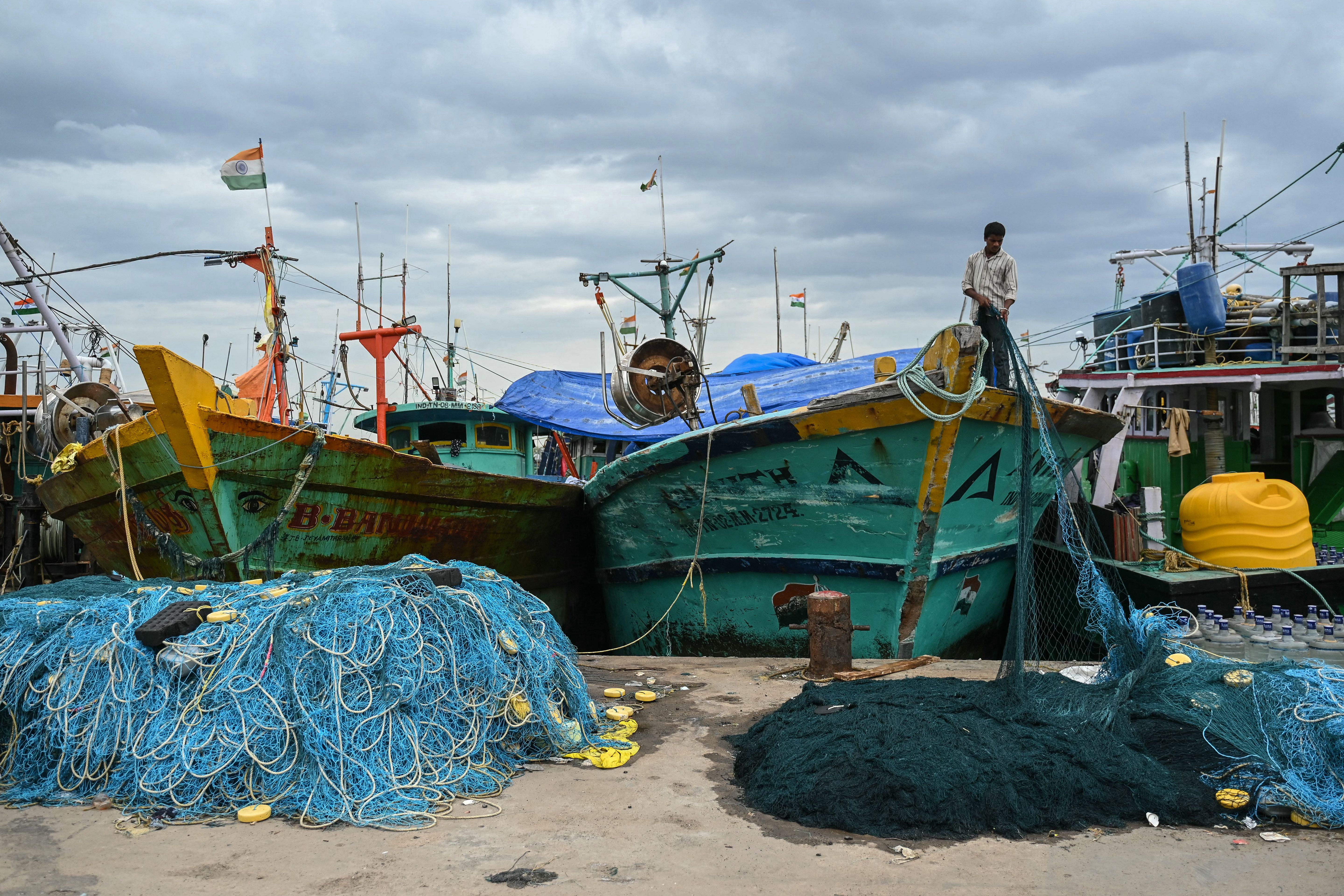
This article examines the scale and impact of Chinese IUU fishing operations globally and identifies the nature of the challenge posed by IUU fishing in the Indian Ocean Region (IOR). It also investigates why existing maritime law and international frameworks have struggled to address this growing threat.


Ajay Kumar, Charukeshi Bhatt
This compendium brings together three essays by scholars who participated in Carnegie India's Security Studies Dialogue in 2024, each examining a different aspect of China’s policies. Drawing on their expertise and research, the authors offer fresh perspectives on key geopolitical challenges.



Vijay Gokhale, Suyash Desai, Amit Kumar, …