

In The Media
John Judis
{
  "authors": [
    "John Judis"
  ],
  "type": "legacyinthemedia",
  "centerAffiliationAll": "",
  "centers": [
    "Carnegie Endowment for International Peace"
  ],
  "collections": [],
  "englishNewsletterAll": "",
  "nonEnglishNewsletterAll": "",
  "primaryCenter": "Carnegie Endowment for International Peace",
  "programAffiliation": "",
  "programs": [],
  "projects": [],
  "regions": [
    "North America",
    "United States"
  ],
  "topics": []
}
REQUIRED IMAGE
To win in November, a Democratic presidential candidate has to carry most of the industrial heartland states that stretch from Pennsylvania to Missouri. That becomes even more imperative if a Democrat can't carry Florida--and because of his relative weakness in South Florida, Obama is unlikely to do so against McCain. Ruy Teixeira and I have calculated that in the heartland states, a Democratic presidential candidate has to win from 45 to 48 percent of the white working class vote. In some states, like West Virginia and Kentucky, the percentage is well over a majority.
Source: The New Republic
Some liberal commentators have downplayed the effect of Barack Obama's fundraising speech at a San Francisco fundraiser last week. But that's wishful thinking. Along with the revelations about Obama's pastor Jeremiah Wright, his remarks in San Francisco will haunt him not only in the upcoming primaries in Pennsylvania, Indiana, Kentucky, and West Virginia, but also in the general election against John McCain, assuming he gets the Democratic nomination.
To win in November, a Democratic presidential candidate has to carry most of the industrial heartland states that stretch from Pennsylvania to Missouri. That becomes even more imperative if a Democrat can't carry Florida--and because of his relative weakness in South Florida, Obama is unlikely to do so against McCain. Ruy Teixeira and I have calculated that in the heartland states, a Democratic presidential candidate has to win from 45 to 48 percent of the white working class vote. In some states, like West Virginia and Kentucky, the percentage is well over a majority.
Some Democrats insist that Obama need not worry about these states because he will be able to make up for a defeat in Ohio or even Pennsylvania with a victory in Virginia or Colorado. But in Virginia, McCain will be able to draw upon coastal suburbanites closely tied to the military. These voters backed Democrats like Chuck Robb and Jim Webb, who are both veterans, but they may not go for Obama. And in the Southwest, McCain will be able to challenge Obama among Hispanics. So to win in November, Obama will have to win almost all of these heartland states. Which is a problem, because even before he uttered his infamous words about these voters "clinging" to guns, religion, abortion, and fears about free trade, Obama looked vulnerable in the region. A look at the white working class's relationship with earlier Democratic candidates underscores the various reasons why.
Many white working class voters in these states used to be loyal Democrats. The last two successful Democratic presidential candidates, Jimmy Carter in 1976 and Bill Clinton in 1992 and 1996, swept Ohio, West Virginia, Kentucky, Pennsylvania, and Missouri. Many of these voters have always been highly patriotic, church-going hunters who were skeptical about the benefits of trade and immigration and--what Obama did not mention--black political assertiveness. But they still distrust Republicans as the defenders of business and look up to Democrats (or at least some Democrats) as being more in tune with average Americans like themselves.
Democrats have won over these voters when their advantage on the economy has come to the fore. And they've lost these voters when their positions on the economy--or national security--were not sufficiently compelling to overcome the Republican advantage on social issues like abortion, gay marriage, or gun control. Why? Because with the exception of a few rabid single-issue voters, the white working class hasn't simply displaced its economic anxiety, or bitterness, onto God, guns, and gay marriage; they're actually quite concerned about the economy.
Historically, there are three circumstances in which Democrats have been able to win over these voters:
The Unacceptable Republican: Republicans have run candidates with whom white working class voters have not been able to identity--either because of their backgrounds, beliefs, or actions. In 2006 that was obviously true of Ohio gubernatorial candidate Ken Blackwell--an African American and a far right zealot--and Montana Senator Conrad Burns, who was linked to former super-lobbyist Jack Abramoff.
The Acceptable Democrat: The Democrats have sometimes run candidates in these states who are sufficiently moderate on guns, abortion, and religion to neutralize the Republican appeal on these issues. That was the case with Pennsylvania pro-life Democratic Senate candidate Bob Casey, who defeated incumbent Rick Santorum in 2006.
The Empathetic Democrat: The Democrats have run a candidate who can connect with these voters in spite of his or her beliefs on abortion and guns. Pollsters try to get at this by asking voters whether a candidate "cares about people like me." Sometimes, voters will think a candidate cares about them because they think he is "one of them." Bill Clinton, of course, was a genius at this. He could be the candidate of Hope, Arkansas, and Yale Law School. Other Democrats have succeeded because they have come off as a father (or mother) figure, who, although from the upper class, still cares about the average American.
If you look at the upcoming presidential election in this light, the Democratic prospects do not appear to be good. McCain is an acceptable Republican--a war hero and a reputed moderate. (His greatest inherent liability, which could make him unacceptable regardless of his ideas or background, is his age.) Both Democratic candidates, whatever their protestations, are seen as coming out of the party's liberal wing on guns and abortion.
That leaves the possibility that these voters will see the Democratic candidate as either "one of them," or as a father or mother figure who understands their plight. Both candidates clearly have problems on these scores, but Obama's may be even more severe than Clinton's. As an African American, he has one strike against him, as has become apparent even in the Democratic primary exit polls. He has tried to appear above race, but he will continually be reminded of his ties to Jeremiah Wright (and his not wearing a flag on his lapel, and his wife's statements about not being "proud" of America) during a general election.
Obama comes from a modest background and has tried to appeal as a candidate of both Harvard Law School and Chicago's Back-of-the-Yards, where he organized laid-off steel workers, but he hasn't been able to pull it off. His manner, his tenor, and his diction are Harvard Law, and when he starts dropping his 'g's," he sounds strained. And Obama is too young, and lacks the stature, to appear as a Franklin Roosevelt-style father figure.
Obama does have an astounding eloquence, and an ability to put a position across, but that eloquence has been reserved largely for anti-war and good-government positions. His stance against the war may resonate (though that will depend on whether McCain's qualification as commander-in-chief trumps his unpopular stance on the war). But where McCain is most vulnerable and where voters are most likely to smile on a Democrat--on everyday economic issues--Obama's heart doesn't appear to be in it.
These difficulties were clear before Obama spoke in San Francisco, but they're much more glaring now. In the speech, Obama appeared to say that Pennsylvania voters' opposition to gun control or abortion or immigration or free trade was pathological--a product of what Marxist philosopher Herbert Marcuse once called "false consciousness." On the other hand, he implied that when he voiced opposition to an issue like free trade--Obama has consistently hammered Clinton on her support for the North American Free Trade Agreement--he was simply pandering to these voters' displaced anxieties. He was saying to these upscale San Francisco Democrats, "I am really one of you, and I am not one of them."
There is even a slight chance that Obama's words in San Francisco could cost him the nomination. Obama is almost certain to have more elected delegates in June than Hillary Clinton, but if he loses Pennsylvania by 15 percentage points (which is not out of the question), that could start a media firestorm around his candidacy that could contribute to other primary defeats and to superdelegate support for Clinton. It's not likely to happen, but after Obama spoke his mind, and, perhaps, lost small-town voters' hearts, in San Francisco, it has suddenly become conceivable.
John B. Judis is a senior editor at The New Republic and a Visiting Scholar at the Carnegie Endowment for International Peace.

Former Visiting Scholar
As a visiting scholar at Carnegie, Judis wrote The Folly of Empire: What George W. Bush Could Learn from Theodore Roosevelt and Woodrow Wilson.
Recent Work
John Judis
John Judis
Carnegie India does not take institutional positions on public policy issues; the views represented herein are those of the author(s) and do not necessarily reflect the views of Carnegie, its staff, or its trustees.

The U.S.–India semiconductor cooperation story is well-stocked with top-level strategic intent. What remains unresolved, however, are some underlying challenges that will determine whether the cooperation actually functions. Three such friction points stand out.

Shruti Mittal

India and the United States are close to concluding a Reciprocal Defense Procurement Agreement (RDPA) that will allow firms from the two countries to sell to each other’s defense establishments more easily. While this may not remedy the specific grievances both sides may have regarding larger bilateral issues, an RDPA could restore some momentum, following the trade deal announcement.

Konark Bhandari

On the last day of the India AI Impact Summit, India signed Pax Silica, a U.S.-led declaration seemingly focused on semiconductors. While India’s accession to the same was not entirely unforeseen, becoming a signatory nation this quickly was not on the cards either.
Konark Bhandari

This piece examines India’s response to U.S. sanctions and tariffs, specifically assessing the immediate market consequences, such as alterations in import costs, and the broader strategic implications for India’s energy security and foreign policy orientation.

Vrinda Sahai
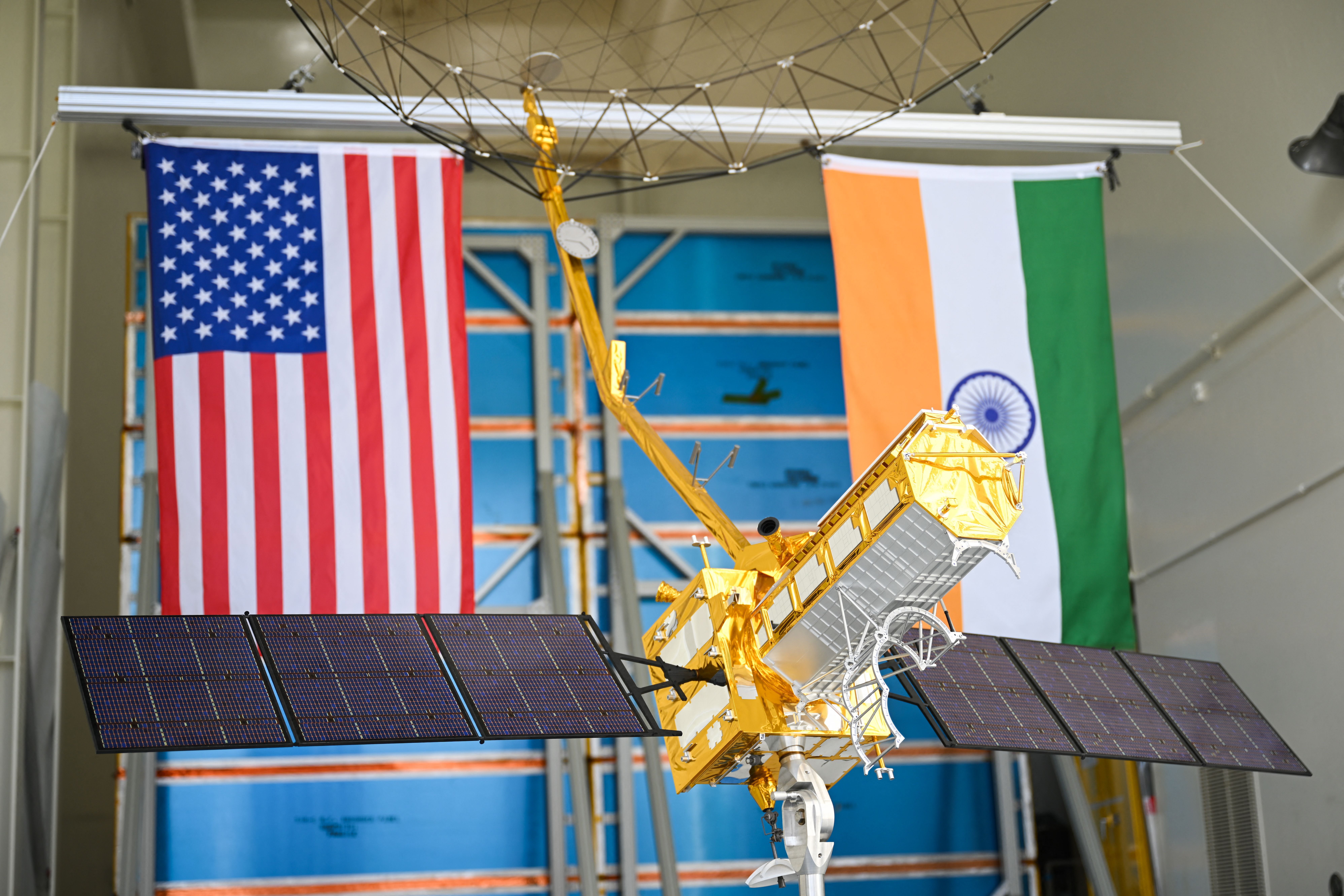
On July 30, 2025, the United States announced 25 percent tariffs on Indian goods. While diplomatic tensions simmered on the trade front, a cosmic calm prevailed at the Sriharikota launch range. Officials from NASA and ISRO were preparing to launch an engineering marvel into space—the NASA-ISRO Synthetic Aperture Radar (NISAR), marking a significant milestone in the India-U.S. bilateral partnership.

Tejas Bharadwaj