

Paper
George Perkovich
{
  "authors": [
    "George Perkovich"
  ],
  "type": "other",
  "centerAffiliationAll": "dc",
  "centers": [
    "Carnegie Endowment for International Peace"
  ],
  "collections": [],
  "englishNewsletterAll": "ctw",
  "nonEnglishNewsletterAll": "",
  "primaryCenter": "Carnegie Endowment for International Peace",
  "programAffiliation": "NPP",
  "programs": [
    "Nuclear Policy"
  ],
  "projects": [],
  "regions": [
    "Middle East",
    "Iran"
  ],
  "topics": [
    "Foreign Policy",
    "Nuclear Policy"
  ]
}
Source: Getty
A new IAEA report says that Iran continues to defy UN Security Council resolutions and enrich uranium while refusing to answer IAEA questions regarding possible weaponization activities. If the United States is to induce Iran to halt enrichment activities, both the costs of defiance and the benefits of cooperation must be greater, warns George Perkovich in a new policy brief.
Source: Carnegie Endowment

Perkovich argues that the United States should pursue a revised strategy showing Iran’s leaders that the more they advance enrichment capabilities, the less valuable cessation of those activities becomes for negotiating incentives packages.
A three-step approach for the next U.S. president:
Anticipating the September IAEA Report, Perkovich notes:
“An underappreciated factor in Tehran’s unwillingness to answer the IAEA’s questions is that Iranian leaders must wonder what would happen if they did ‘come clean,’ perhaps acknowledging that past nuclear activities were related to acquiring at least the option to produce nuclear weapons. The fact that neither the United States nor the Security Council has told Iran how it would react if Iran admitted to past nuclear weaponization violations may pose a genuine quandary in Iran. The UN Security Council could clarify that Iranian admission of past weaponization activities, coupled with willingness to accept that the NPT violation required ‘restitution,’ would not necessarily lead to further sanctions or punitive sanctions.”
About the Author
George Perkovich is vice president for studies–global security and economic development and director of the Nonproliferation Program at the Carnegie Endowment for International Peace. His personal research has focused on nuclear strategy and nonproliferation, with a focus on South Asia and Iran, and on the problem of justice in the international political economy. He is the author of the award-winning book India's Nuclear Bomb, which Foreign Affairs called “an extraordinary and perhaps definitive account of 50 years of Indian nuclear policymaking.” He is coauthor of a major Carnegie report, Universal Compliance: A Strategy for Nuclear Security, a blueprint for rethinking the international nuclear nonproliferation regime.

Japan Chair for a World Without Nuclear Weapons, Senior Fellow
George Perkovich is the Japan Chair for a World Without Nuclear Weapons and a senior fellow in the Carnegie Endowment for International Peace’s Nuclear Policy Program. He works primarily on nuclear deterrence, nonproliferation, and disarmament issues, and is leading a study on nuclear signaling in the 21st century.
Recent Work
George Perkovich
George Perkovich
Carnegie India does not take institutional positions on public policy issues; the views represented herein are those of the author(s) and do not necessarily reflect the views of Carnegie, its staff, or its trustees.

After the chill in ties between 2020 and 2024 that brought India–China relations to their lowest point in several decades, the two countries have engaged each other afresh. This paper argues that there are predominantly four imperatives guiding India’s approach to China, and they exist in an order of priority.

Saheb Singh Chadha

This piece argues that India’s central challenge is not managing a single flashpoint but resolving the underlying tension between expansion and institutional coherency of the BRICS grouping.

Vrinda Sahai

A partnership between India, a country of subcontinental size, and Africa, a continent of fifty-four countries, may seem asymmetric until one notes that both are home to nearly the same number of people—1.4 billion. This essay spells out the existing challenges to the partnership, its optimal potential, and the possible pathways to realize it over the next quarter-century.

Rajiv Bhatia

The India–EU Free Trade Agreement (FTA) is shaping up to be one of the most consequential trade negotiations, both economically and strategically. But, what’s in the agreement, what’s missing, and what will determine its success in the years ahead
Vrinda Sahai, Nicolas Köhler-Suzuki
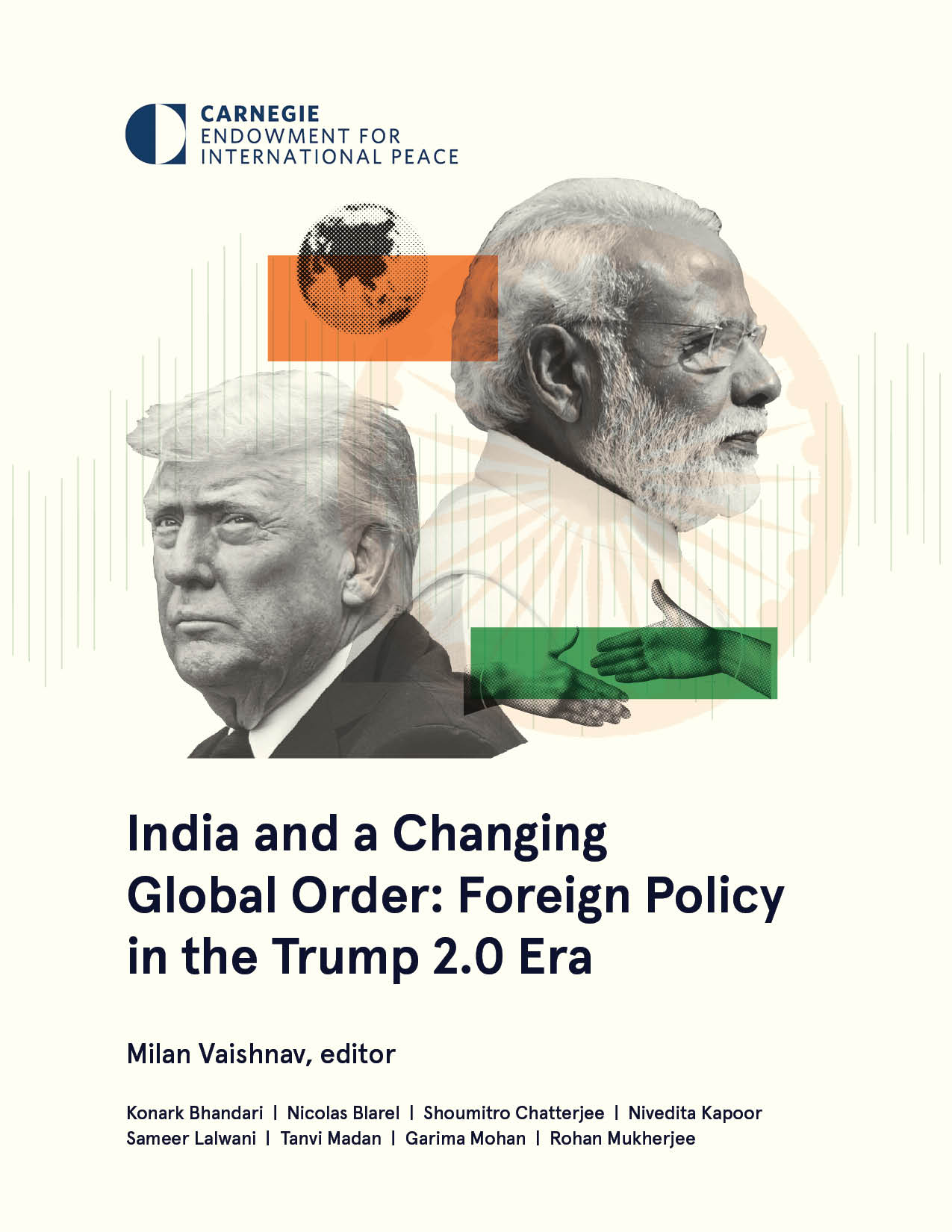
Trump 2.0 has unsettled India’s external environment—but has not overturned its foreign policy strategy, which continues to rely on diversification, hedging, and calibrated partnerships across a fractured order.

Milan Vaishnav, ed., Sameer Lalwani, Tanvi Madan, …