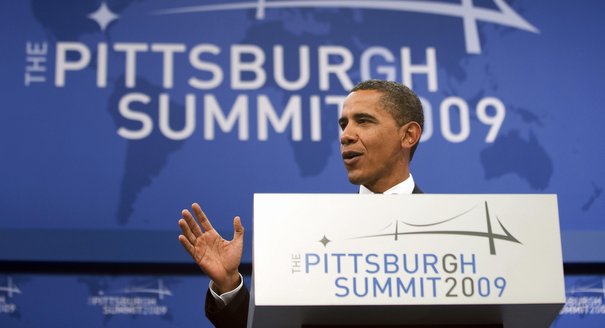
Global depression is not the most likely scenario to result from the financial crisis, but it's foolish to ignore the possibility. At the G-20 meeting this week, leaders must increase domestic stimulus measures, triple the IMF's resources, and renew their commitment to avoid protectionism.
The G20 and Depression RiskOn Monday last week, the World Trade Organization predicted a nine percent drop in world trade volumes for 2009. Two days later, Japan announced that its exports in February were half -- yes, half -- those of February last year. To most economists, who’ve become accustomed to seeing world trade growing twice as fast as world output year after year, numbers like these read like science fiction. Throughout the entire post-World War II period, the only other year that saw a dip in world trade was 1982, when it decreased by no more than two percent. With news this bad, economists have to consider the ‘D’ word: Depression.
Yet at the G-20 summit in London this week, officials representing the world’s largest economies will advance plans that appear based on consensus assumptions of a recovery later this year or in early 2010. They shouldn’t count on it. While a global depression is not the most likely scenario, the wealth destruction of the last year and its enormous effects on demand indicate that it would be foolish to ignore its possibility.
Forecasters resist using the ‘D’ word because depressions have become so rare that we do not have an accepted definition, and because it scares people. Professor Robert Barro of Harvard University and his co-author José Ursúa recently defined depression as a 10 percent multi-year decline in GDP (The Great Depression of the 1930’s saw GDP decline by about one third). By this definition, if GDP continues to decline at the same rate as it did in the fourth quarter of 2008 -- and, as seems likely, the first quarter of 2009 – Japan will be in depression later tthis year and the U.S. will be in depression by some time in the middle of 2010. US unemployment will hit 15%. Under those circumstances, Europe would fare as badly or worse as the US, as would many emerging economies, and conditions in Eastern Europe would almost certainly resemble those of the Great Depression.
A depression scenario may appear unduly alarmist to some, since surely we have learnt from the policy mistakes of the past, we have a more resilient economy, based on more stable service industries, and buttressed by safety nets and automatic stabilizers. So it may be. But on the other side of the ledger are unprecedented levels of household debt, trillions of dollars of complex, difficult-to-price and even to locate securities. We are also confronting a severe downside of globalization: just as growth can benefit everyone, a downturn now hurts everyone, and requires a coordinated international response that is difficult to achieve.
Insofar as they are basing their plans on assumptions of forthcoming recovery, the leaders of the G-20 may once again destined to react frantically to unpleasant surprises in coming months. They must focus their attention on containing the global economic freefall, and leave regulatory reforms, crucial as they are, to future meetings.
Today, with world trade contracting at such an alarming rate, governments of the G-20 should match their denunciations of protectionism with binding international agreements, including a moratorium on new trade restraints and an agreement to report all changes in trade policy to the WTO, which would issue regular reports on new trade measures to the public. This would not eliminate protectionism, but it could deter some of the more egregious instances of it.
The most effective way to reduce protectionist pressures is to reignite growth. Fiscal stimulus packages (currently typically in the 0.5% to 2.5% of GDP range), need to be larger to mitigate the anticipated decline in private demand, and which the (probably unduly optimistic) consensus economic forecast shows falling between 3 and 5 percent of GDP in 2009. Average fiscal stimulus in several G-20 economies that can afford to spend more should probably be at least 50 percent higher than what is currently on the table.
Central banks should pursue aggressive “quantitative easing” policies, buying bonds in the open market. This amounts to printing more money to grease the workings of the economy, stimulating consumer spending and preventing deflation. With interest rates now below one percent, central banks need new ways to create credit. An analysis by Christina Romer, the Chair of the U.S. Council of Economic Advisers, suggests that recovery from the Great Depression began due to a massive increase in the U.S. money supply as gold fled Europe starting in 1933. The Federal Reserve is getting ready to create a lot of new money, as are the UK and Japan, but the European Central Bank remains hesitant, perhaps because it is reluctant to tackle the political challenges of choosing which assets to buy and where in the Eurozone to buy them.
Most importantly, G-20 governments need to undertake much larger efforts to get toxic assets off bank balance sheets. Various schemes are now in place, including governments insuring bad assets as in the UK and Holland. The U.S. plan announced last Monday comes late in the game, and is complicated, but provides a way to price these assets as well as keep them in private hands. The plan provides potentially huge gains to private investors while limiting their downside risks – a large implicit subsidy, and one required for any government scheme to work. Under their “stress test” banks that have or need additional capital from the government will be pressured to sell their bad loans at a significant loss relative to their notional value on balance sheets.. But the scheme, while promising, is unproven, and unless it shows real progress in the next six months, governments must go back to the drawing board. At that point, temporary nationalization of some banks may be the best option.
G-20 economies should also commit to tripling the resources of the International Monetary Fund to $700 billion, a figure representing the financing requirements of developing countries under a pessimistic scenario in 2009, though one that falls well short of depression. This will significantly reduce the risk that dozens of developing countries will go belly-up as they confront falling trade and disappearing credit, causing another wave of bank failures and declining demand. The U.S., Europe and Japan have already expressed willingness to contribute more, but reserve-rich China, Saudi Arabia, and others in similar positions must do the same in exchange for promises that the vote count of the governing bodies of the Bretton Woods Institutions will be rebalanced in their favor in the future.
But depression is not inevitable. The leaders of the G-20 still have time to recognize the magnitude of the problem before us, and take commensurate measures.
Former Senior Associate, International Economics Program
Dadush was a senior associate at the Carnegie Endowment for International Peace. He focuses on trends in the global economy and is currently tracking developments in the eurozone crisis.
Carnegie India does not take institutional positions on public policy issues; the views represented herein are those of the author(s) and do not necessarily reflect the views of Carnegie, its staff, or its trustees.
India and the United States are close to concluding a Reciprocal Defense Procurement Agreement (RDPA) that will allow firms from the two countries to sell to each other’s defense establishments more easily. While this may not remedy the specific grievances both sides may have regarding larger bilateral issues, an RDPA could restore some momentum, following the trade deal announcement.
On the last day of the India AI Impact Summit, India signed Pax Silica, a U.S.-led declaration seemingly focused on semiconductors. While India’s accession to the same was not entirely unforeseen, becoming a signatory nation this quickly was not on the cards either.
This piece examines India’s response to U.S. sanctions and tariffs, specifically assessing the immediate market consequences, such as alterations in import costs, and the broader strategic implications for India’s energy security and foreign policy orientation.
This paper examines the evolution of India-China economic ties from 2005 to 2025. It explores the impact of global events, bilateral political ties, and domestic policies on distinct spheres of the economic relationship.
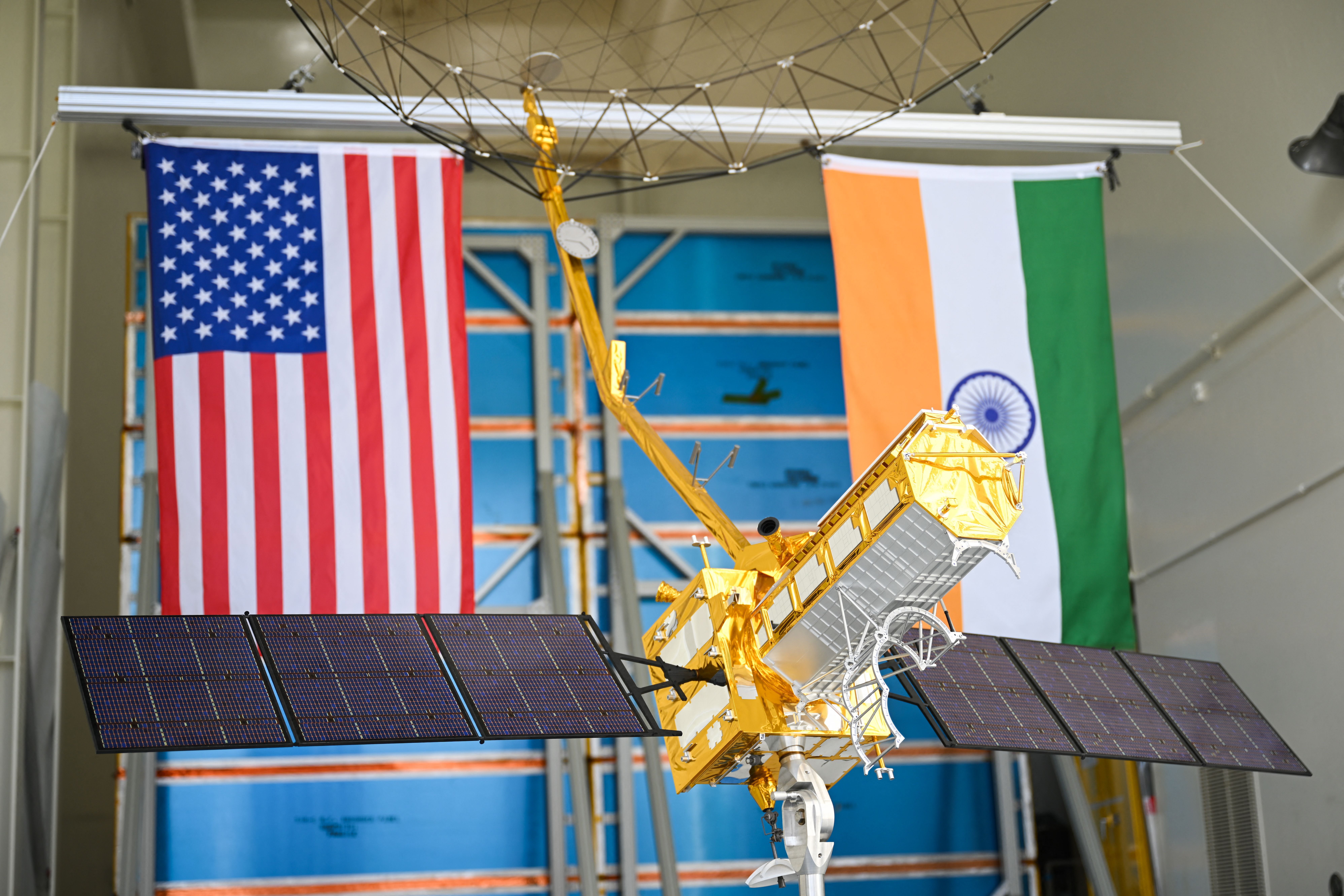
On July 30, 2025, the United States announced 25 percent tariffs on Indian goods. While diplomatic tensions simmered on the trade front, a cosmic calm prevailed at the Sriharikota launch range. Officials from NASA and ISRO were preparing to launch an engineering marvel into space—the NASA-ISRO Synthetic Aperture Radar (NISAR), marking a significant milestone in the India-U.S. bilateral partnership.