

Commentary
Uri Dadush
{
  "authors": [
    "Uri Dadush"
  ],
  "type": "legacyinthemedia",
  "centerAffiliationAll": "",
  "centers": [
    "Carnegie Endowment for International Peace",
    "Carnegie Europe"
  ],
  "collections": [
    "Brexit and UK Politics"
  ],
  "englishNewsletterAll": "",
  "nonEnglishNewsletterAll": "",
  "primaryCenter": "Carnegie Endowment for International Peace",
  "programAffiliation": "",
  "programs": [],
  "projects": [],
  "regions": [
    "Western Europe",
    "United Kingdom",
    "France",
    "Germany",
    "Europe",
    "North America"
  ],
  "topics": [
    "Economy"
  ]
}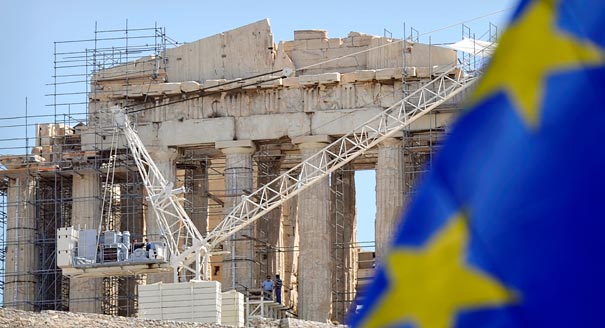
Source: Getty
The plan recently announced by European leaders to support Greece leaves many questions unanswered, and markets will likely withhold judgment on the agreement until a more credible rescue package is developed.
Source: European Voice

A thin veil was deployed to provide legal cover, stating that loans to Greece would not come at subsidised interest rates. But why, then, are EU and IMF loans needed?
The markets' refusal to accept anything less than a 300 basis point spread on Greek debt, despite assurances that help was forthcoming, forced this remarkable 180 degree turn. At these spreads, with debt at well over 100 percent of gross domestic product (GDP) and with GDP in an austerity-driven freefall, Greece is headed directly to the bankruptcy courts—and, in the process, the problems of Portugal, Spain, Italy and others facing a similar plight, including counties outside the eurozone, will intensify.
The euro has enjoyed a rally. But it remains to be seen whether the agreement goes far enough to bring Greek spreads down to a manageable level in the coming weeks. I fear that it will not, for four reasons.
First, it failed to specify the size of the loan pool, and the rumoured figure of €20-25 billion would not go nearly far enough. It would barely cover Greece's funding needs over the next few months, and represents some 11-13 percent of Greece's GDP. By way of comparison, loans from the EU and the IMF to Latvia represent 46 percent of its GDP—and Latvia has brought wages down around 17 percent as part of its loan programme, while in Greece riot police are busy quelling protests over cuts that are a small fraction of that. The smaller the support package, the tougher the austerity measures Greece must take.
Second, the conditions for disbursing the loans—‘ultima ratio' or as a last resort—are nebulous and will require a unanimous decision by the 16 members of the eurozone. This holds the bail-out hostage to as many separate legal processes, beginning with Germany's and its constitutional court, and involving assorted parliaments.
Third, the agreement does not specify who is in charge of leading the bail-out. It states only that the ECB and the European Commission will decide on the conditions and loans subject to agreement by leaders, and that the IMF will be involved. Will the IMF, the only institution that has the instruments, expertise and track record to evaluate whether and how much Greece can pay and what steps Greece can realistically take to fix its problems, be free to operate? Most importantly, will the IMF be allowed to conduct an objective analysis of whether Greece needs to restructure or reschedule its debt?
Fourth, the agreement lacked any mention of EU-wide changes in macroeconomic policy that are needed to deal with the problems of the vulnerable countries.
In a standard IMF rescue, countries have the capacity to make changes in fiscal, structural, monetary and exchange-rate policies. Because individual members of the eurozone have no control over the latter two, they will be forced into even greater austerity and more rapid structural adjustment. But the eurozone as a whole can—and should—deploy a more expansive monetary policy over the many years that such policy will be needed, and countries with a surplus can help stimulate demand across the zone as a whole.
A credible recovery plan must include these measures, and it implies a lower euro, but enacting them would require a different mindset at the ECB and a degree of collaboration across states that we have yet to see. And, in any event, the IMF's capacity to influence its largest shareholders is limited, at best.
Until these questions are answered, markets will withhold judgment on the credibility of the whole rescue package, and continue to demand higher yields.
The Brussels meeting did have one positive outcome: the temporary shelving of expensive distractions, namely the proposals to form a European Monetary Fund and other arrangements to build European safety nets. These ten-year projects, which require treaty changes, will be delegated to a task force.
The Brussels agreement is clearly a case of ‘too little', but perhaps not one of ‘too late'. There is still a little time for politicians to act.

Former Senior Associate, International Economics Program
Dadush was a senior associate at the Carnegie Endowment for International Peace. He focuses on trends in the global economy and is currently tracking developments in the eurozone crisis.
Recent Work
Uri Dadush
Uri Dadush
Carnegie India does not take institutional positions on public policy issues; the views represented herein are those of the author(s) and do not necessarily reflect the views of Carnegie, its staff, or its trustees.

The ASML MoU with Tata Electronics is an indicator of how far the Indian semiconductor ecosystem has come. This ecosystem has been years in the making and represents real commercial logic.

Konark Bhandari

The India–EU Free Trade Agreement (FTA) is shaping up to be one of the most consequential trade negotiations, both economically and strategically. But, what’s in the agreement, what’s missing, and what will determine its success in the years ahead

Vrinda Sahai, Nicolas Köhler-Suzuki

On March 10, 2026, India’s Union Cabinet approved amendments to Press Note 3, a regulation that mandated government approval on all foreign direct investment (FDI) from countries sharing a land border with India. This amendment raises questions primarily about whether its stated benefits will materialize and if the risks have been adequately weighed. This piece will address the same.
Konark Bhandari

This piece examines India’s response to U.S. sanctions and tariffs, specifically assessing the immediate market consequences, such as alterations in import costs, and the broader strategic implications for India’s energy security and foreign policy orientation.
Vrinda Sahai

This paper examines the evolution of India-China economic ties from 2005 to 2025. It explores the impact of global events, bilateral political ties, and domestic policies on distinct spheres of the economic relationship.

Santosh Pai