

Commentary
Michael Pettis
{
  "authors": [
    "Michael Pettis"
  ],
  "type": "legacyinthemedia",
  "centerAffiliationAll": "dc",
  "centers": [
    "Carnegie Endowment for International Peace"
  ],
  "collections": [],
  "englishNewsletterAll": "asia",
  "nonEnglishNewsletterAll": "",
  "primaryCenter": "Carnegie Endowment for International Peace",
  "programAffiliation": "AP",
  "programs": [
    "Asia"
  ],
  "projects": [],
  "regions": [
    "North America",
    "United States",
    "East Asia",
    "China"
  ],
  "topics": [
    "Economy",
    "Trade"
  ]
}
Source: Getty
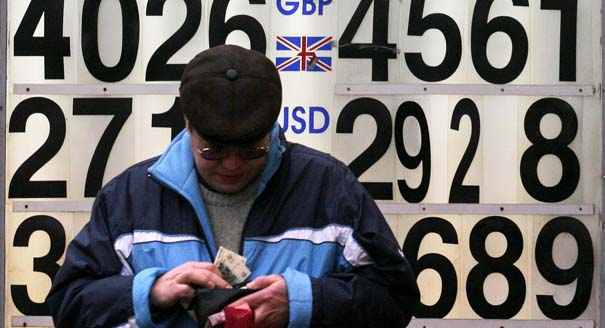
If countries with large trade surpluses weaken their currency, countries with large trade deficits are likely to retaliate through reciprocal currency manipulation or trade tariffs.
Source: The Economist

And we know how that game ends. In 1930, following France’s very successful 1928 devaluation and Britain’s tightening of trade conditions within the Commonwealth, the world’s leading trade-surplus nation passed the Smoot-Hawley tariffs in a transparent attempt to gain a greater share of dwindling global demand. This would have been a great strategy for the US had no one noticed or retaliated, but of course the rest of world certainly noticed, and all Smoot-Hawley did was accelerate a collapse in global trade which, not surprisingly, hurt trade surplus countries like the US most.
We seem to be following the same path, and in a beggar-thy-neighbor world any country that does not participate in retaliatory policies will suffer. The only question is which retaliatory policy. I suspect that countries that can intervene in the currency and manipulate domestic interest rates will select those polices as the most efficient way of intervening in trade. Countries that cannot will almost certainly resort to trade tariffs. And it is probably too late for global policy coordination to make much of a difference. It would be very difficult for policy coordination to limit all the many ways countries can and do cheat, and in the end the trade-deficit countries will probably find it easier to retaliate openly and directly. And why not? Diversified countries with large trade-deficits have most of the best cards in any trade dispute. Simple game theory suggests that a sub-optimal result is almost inevitable absent a policeman to bully participants into good behaviour.

Nonresident Senior Fellow, Carnegie China
Michael Pettis is a nonresident senior fellow at the Carnegie Endowment for International Peace. An expert on China’s economy, Pettis is professor of finance at Peking University’s Guanghua School of Management, where he specializes in Chinese financial markets.
Recent Work
Michael Pettis
Michael Pettis
Carnegie India does not take institutional positions on public policy issues; the views represented herein are those of the author(s) and do not necessarily reflect the views of Carnegie, its staff, or its trustees.

How is AI reshaping space security, creating governance challenges, and where does international diplomacy stand today?


Tejas Bharadwaj, Almudena Azcárate Ortega

After the chill in ties between 2020 and 2024 that brought India–China relations to their lowest point in several decades, the two countries have engaged each other afresh. This paper argues that there are predominantly four imperatives guiding India’s approach to China, and they exist in an order of priority.

Saheb Singh Chadha

This piece argues that India’s central challenge is not managing a single flashpoint but resolving the underlying tension between expansion and institutional coherency of the BRICS grouping.

Vrinda Sahai

The U.S.–India semiconductor cooperation story is well-stocked with top-level strategic intent. What remains unresolved, however, are some underlying challenges that will determine whether the cooperation actually functions. Three such friction points stand out.

Shruti Mittal

On March 10, 2026, India’s Union Cabinet approved amendments to Press Note 3, a regulation that mandated government approval on all foreign direct investment (FDI) from countries sharing a land border with India. This amendment raises questions primarily about whether its stated benefits will materialize and if the risks have been adequately weighed. This piece will address the same.

Konark Bhandari