

Commentary
Dmitri Trenin
{
  "authors": [
    "Dmitri Trenin"
  ],
  "type": "legacyinthemedia",
  "centerAffiliationAll": "",
  "centers": [
    "Carnegie Endowment for International Peace",
    "Carnegie Russia Eurasia Center"
  ],
  "collections": [],
  "englishNewsletterAll": "",
  "nonEnglishNewsletterAll": "",
  "primaryCenter": "Carnegie Russia Eurasia Center",
  "programAffiliation": "",
  "programs": [],
  "projects": [],
  "regions": [
    "Middle East",
    "Iran"
  ],
  "topics": [
    "Foreign Policy"
  ]
}
Source: Getty
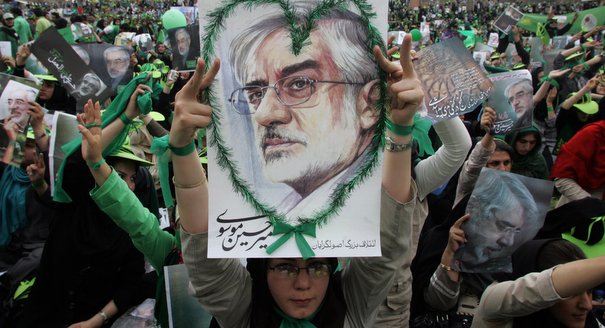
In order to convince Iran to use its eventual nuclear weapons arsenal only for deterrence and regional power politics, the Obama administration must work to empower the moderates in the Iranian leadership.
Source: Foreign Policy

Obama essentially has two options: He can provoke the Iranian leadership, or he can seek to influence it, tipping the balance in favor of the moderates. The options mentioned in policy circles so far include striking Iran, supporting an Israeli attack, or imposing ever more stringent sanctions. None will work, however, and each will backfire -- empowering the regime's most radical elements by offering them a pretext to attack Israel or the West. The president must resist the temptation to use highly visible, but blunt instruments of power.
Instead, the Obama administration must work to isolate the religious fanatics and their allies among the Revolutionary Guards, empowering the moderates. Elements of such a strategy include: increasing economic and cultural openness toward Iran; coordinating closely with foreign partners, from Europe and Turkey to Russia and China; and aligning NATO's missile-defense plans with its erstwhile rival, Moscow. There is no guarantee, of course, that this strategy will succeed. What it does ensure is -- at the very least -- that the United States will not make matters worse by throwing a public-relations softball to Iran's radical fanatics. Iran's bomb may be inevitable; its use is still preventable.
Former Director, Carnegie Moscow Center
Trenin was director of the Carnegie Moscow Center from 2008 to early 2022.
Recent Work
Dmitri Trenin
Dmitri Trenin
Carnegie India does not take institutional positions on public policy issues; the views represented herein are those of the author(s) and do not necessarily reflect the views of Carnegie, its staff, or its trustees.

After the chill in ties between 2020 and 2024 that brought India–China relations to their lowest point in several decades, the two countries have engaged each other afresh. This paper argues that there are predominantly four imperatives guiding India’s approach to China, and they exist in an order of priority.

Saheb Singh Chadha

This piece argues that India’s central challenge is not managing a single flashpoint but resolving the underlying tension between expansion and institutional coherency of the BRICS grouping.

Vrinda Sahai

A partnership between India, a country of subcontinental size, and Africa, a continent of fifty-four countries, may seem asymmetric until one notes that both are home to nearly the same number of people—1.4 billion. This essay spells out the existing challenges to the partnership, its optimal potential, and the possible pathways to realize it over the next quarter-century.

Rajiv Bhatia

The India–EU Free Trade Agreement (FTA) is shaping up to be one of the most consequential trade negotiations, both economically and strategically. But, what’s in the agreement, what’s missing, and what will determine its success in the years ahead
Vrinda Sahai, Nicolas Köhler-Suzuki
Trump 2.0 has unsettled India’s external environment—but has not overturned its foreign policy strategy, which continues to rely on diversification, hedging, and calibrated partnerships across a fractured order.



Milan Vaishnav, ed., Sameer Lalwani, Tanvi Madan, …