

Q&A
Suzanne Maloney, Aaron David Miller, Karim Sadjadpour
{
  "authors": [
    "Karim Sadjadpour"
  ],
  "type": "legacyinthemedia",
  "centerAffiliationAll": "dc",
  "centers": [
    "Carnegie Endowment for International Peace",
    "Carnegie Europe",
    "Malcolm H. Kerr Carnegie Middle East Center"
  ],
  "collections": [],
  "englishNewsletterAll": "menaTransitions",
  "nonEnglishNewsletterAll": "",
  "primaryCenter": "Carnegie Endowment for International Peace",
  "programAffiliation": "MEP",
  "programs": [
    "Middle East"
  ],
  "projects": [],
  "regions": [
    "Middle East",
    "Iran",
    "Gulf"
  ],
  "topics": [
    "Political Reform",
    "Foreign Policy"
  ]
}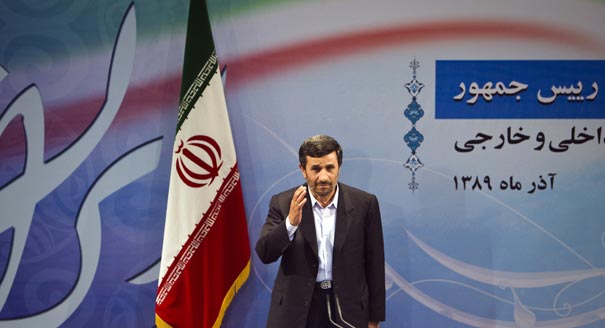
Source: Getty
The confidential documents released by WikiLeaks reveal that Arab officials distrust the government in Tehran, which effectively uses soft power and political influence to maintain a significant role on the regional and global stage.
Source: The Financial Times

So far, the Obama administration has admirably eschewed their advice. Instead it has used a recent $60bn arms deal with Saudi Arabia, along with further multi-billion-dollar deals with the United Arab Emirates, Oman and Kuwait, to develop a strategy of military containment.
Yet such an approach ignores the fact that Iran’s strength lies primarily in its political influence, not its military prowess. Tehran’s military budget is less than a quarter of regional rival Saudi Arabia’s. But its soft power, along with it support for militias, can undermine governments with vastly superior armies, as has been evidenced by the US in Iraq.
The WikiLeaks revelations make clear that Arab officials believe Iran to be inherently dishonest and dangerous. The feeling is probably mutual. But they hide perhaps a more interesting issue, namely what type of Iranian government would actually best serve Gulf Arab interests.
President Mahmoud Ahmadi-Nejad and the Islamic Republic may be loathed, but equally the advent of a more progressive, democratic Iran would enable Tehran to emerge from its largely self-inflicted isolation and begin to realise its enormous potential. In the zero-sum game of Middle Eastern politics, a democratic Iran would pose huge challenges to Persian Gulf sheikhdoms.
Today Iran is not, of course, a global superpower by any metric. Its economy suffers from endemic mismanagement; its military budget is less than 2 per cent that of the US. Apart from North Korea, Venezuela and Syria, it has few reliable strategic allies.
Indeed, while its international profile has been rising, however, Iran’s internal decay has seemingly been accelerating. The palpable disaffection of its youth clearly came to a head after the contested 2009 presidential elections. Further deep internal fissures have forced the regime to rely on coercion and intimidation in order to maintain power.
Nonetheless, without Iran’s co-operation it is going to be difficult to bring long-term stability to Iraq, Afghanistan, the Levant or the Holy Land. At the same time, a peaceful and prosperous region seems inimical to the interests of the current Islamic Republic.
Anxious Gulf Arab countries, therefore, have little to fear: the US and Iran will not be friends anytime soon. As one Iranian diplomat once told me, “Iran derives its popularity in the region and the Muslim world based on our defiance towards the US and Israel.”
A US general once said that Iran only offers to help resolve problems that it itself helps to create. But he might also have reflected that it is at times of crisis and carnage in the region, and especially those linked to either the US or Israel, when Iran’s soft power and ideology gains most purchase.

Senior Fellow, Middle East Program
Karim Sadjadpour is a senior fellow at the Carnegie Endowment for International Peace, where he focuses on Iran and U.S. foreign policy toward the Middle East.
Recent Work


Suzanne Maloney, Aaron David Miller, Karim Sadjadpour

Aaron David Miller, Karim Sadjadpour, Robin Wright
Carnegie India does not take institutional positions on public policy issues; the views represented herein are those of the author(s) and do not necessarily reflect the views of Carnegie, its staff, or its trustees.

After the chill in ties between 2020 and 2024 that brought India–China relations to their lowest point in several decades, the two countries have engaged each other afresh. This paper argues that there are predominantly four imperatives guiding India’s approach to China, and they exist in an order of priority.

Saheb Singh Chadha

This piece argues that India’s central challenge is not managing a single flashpoint but resolving the underlying tension between expansion and institutional coherency of the BRICS grouping.

Vrinda Sahai

A partnership between India, a country of subcontinental size, and Africa, a continent of fifty-four countries, may seem asymmetric until one notes that both are home to nearly the same number of people—1.4 billion. This essay spells out the existing challenges to the partnership, its optimal potential, and the possible pathways to realize it over the next quarter-century.

Rajiv Bhatia

The India–EU Free Trade Agreement (FTA) is shaping up to be one of the most consequential trade negotiations, both economically and strategically. But, what’s in the agreement, what’s missing, and what will determine its success in the years ahead
Vrinda Sahai, Nicolas Köhler-Suzuki
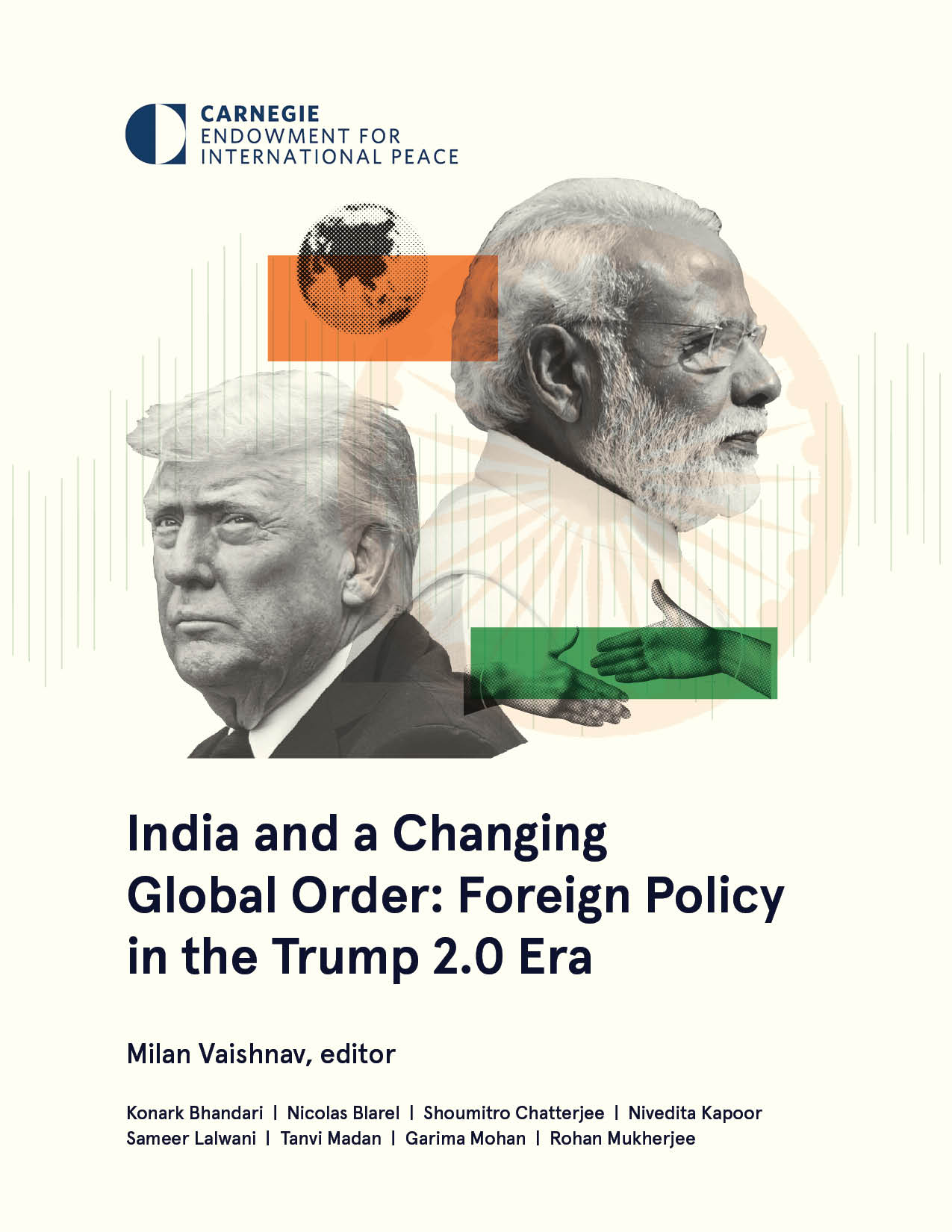
Trump 2.0 has unsettled India’s external environment—but has not overturned its foreign policy strategy, which continues to rely on diversification, hedging, and calibrated partnerships across a fractured order.

Milan Vaishnav, ed., Sameer Lalwani, Tanvi Madan, …