

Commentary
Dmitri Trenin
{
  "authors": [
    "Dmitri Trenin"
  ],
  "type": "legacyinthemedia",
  "centerAffiliationAll": "",
  "centers": [
    "Carnegie Endowment for International Peace",
    "Carnegie Russia Eurasia Center"
  ],
  "collections": [],
  "englishNewsletterAll": "",
  "nonEnglishNewsletterAll": "",
  "primaryCenter": "Carnegie Russia Eurasia Center",
  "programAffiliation": "",
  "programs": [],
  "projects": [
    "Eurasia in Transition"
  ],
  "regions": [],
  "topics": []
}
Source: Getty
In the past 20 years, there has been a major, and positive, turnaround in the Russo-Turkish bilateral relationship.
Source: Aspenia online

It is energy, however, that is the linchpin of the Russo-Turkish economic relationship. In the 1990s, Gazprom found a market in Turkey and laid the Blue Stream pipeline to supply it with natural gas. It now seeks Turkish approval for its other, more ambitious project, South Stream, which would pump Russian gas across the Black Sea – traversing the Turkish economic zone – and the Balkans to southern and central Europe. Rosatom, for its part, has undertaken a project to build a nuclear power station in Turkey, an important deal which could mean a breakthrough for the Russian government-owned company into the global nuclear energy market. Turkey, for its part, sees itself as an energy hub between Europe to the west, the Middle East to the south, Iran and the Caspian to the east, and Russia to the north.
Politically, the relationship has warmed up after the Cold War. Early Russian fears of Turkey rising to dominance in the Turkic-speaking world, which includes Azerbaijan and most of Central Asia, have been put to rest. Turkey is certainly a player there, but it is neither a hegemon nor an anti-Russian force. With separatism in the North Caucasus replaced by radical jihadism, and terrorism, there is less support from the Turkey-based descendants of the Muhajirs – North Caucasus 19th century expellees from the Russian empire – for the “cause”. This has been taken up by al Qaeda and other similar groups. Nowadays the Russian government even welcomes Turkish initiatives to bring stability to the South Caucasus, and has supported Ankara’s recent effort to achieve reconciliation with Armenia, Russia’s only formal ally in the region. Gone are the days when, in order to protect Armenia, as he thought, a Russian defense minister threatened a “third world war” on Turkey.
Russians have learned to respect their erstwhile enemy. They were impressed by Turkey’s 2003 refusal to grant the United States the right to use Turkish territory to attack Saddam Hussein’s Iraq from the north – no easy matter for a country allied with Washington. They are even more impressed by the current Turkish foreign policy strategy, conceived by Foreign Minister Ahmet Davutoglu, which posits Turkey as an independent power center at the crossroads of Europe and the Middle East. Some are relieved that the chances of Turkey joining the EU are receding, which gives Russia more space for maneuver. All are pleased that Turkey is not an instrument of Washington’s foreign policy. Like Russia itself, Turkey is a free agent in a multipolar world order. Again like Russia, it is led by a nationalist, yet pragmatic leadership.
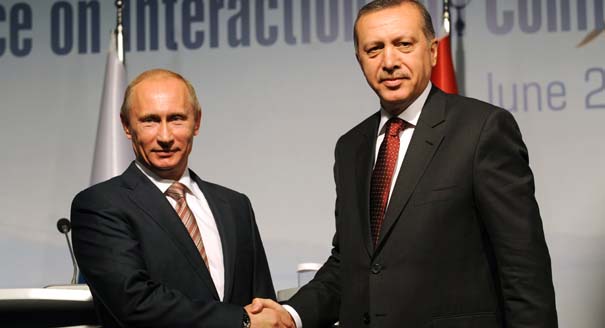
Recep Tayyip Erdoğan is often compared, in the Western media, to Vladimir Putin. Normally this is a reference to authoritarian features of the Turkish Prime Minister’s leadership. But the two men, who obviously enjoy being seen as strong leaders, have also built confidence in each other. From the Russian perspective, this extends to Mr. Erdoğan’s AK party. Moscow is not overly concerned with the increasingly Muslim character of Turkey as a state. To begin with, it was never enamored by the secularist, military-dominated, pro-Western elite, ever-eager to do Washington’s bidding. The Russians have also learned to distinguish between moderate Muslims and radical Islamists. The former are perceived to be the best possible allies against the latter. And finally, Moscow sees Turkey as a far more effective force for stability in the Greater Middle East (along Russia’s southern flank) than the heavy-handed United States or the dysfunctional European Union. Post-imperial Russia has few problems with neo-Ottoman Turkey.
All this should not suggest that the Russo-Turkish relationship is entirely problem-free, or even properly balanced. Russia-Turkey watchers grumble that Ankara has gotten the better of Moscow. It did not live up to all its obligations under the Blue Stream project, and is yet to make good on its promises on the South Stream project. It is by no means Russia’s energy ally, and might well be its competitor. Russians know that Turks will only be guided by their own interest. However, this is precisely how Russia positions itself on the world scene. Moscow does not need to like Ankara; it is enough to just understand it.
Russians, as a state, have seen their own fortunes rise and fall. In the last quarter of a century, they managed a steep imperial decline and fall; a state of near-prostration and virtual irrelevance that followed; and a slow consolidation as an independent strategic player. They have gone over the hump, survived, and are now moving on. They have learned to see their own – and other nations’ – failings as well as strengths. They know Turkey’s resources are not unlimited; they know a thing or two about the Kurdish issue which Moscow sought to exploit in the past; and they know that the Middle East is not exactly crying for the new Ottomans. Thus, they can relax and come to Turkey’s beaches to enjoy the sun and the sea which they miss at home.
Former Director, Carnegie Moscow Center
Trenin was director of the Carnegie Moscow Center from 2008 to early 2022.
Recent Work
Dmitri Trenin
Dmitri Trenin
Carnegie India does not take institutional positions on public policy issues; the views represented herein are those of the author(s) and do not necessarily reflect the views of Carnegie, its staff, or its trustees.