

Commentary
Nikolay Petrov
{
  "authors": [
    "Nikolay Petrov"
  ],
  "type": "legacyinthemedia",
  "centerAffiliationAll": "",
  "centers": [
    "Carnegie Endowment for International Peace",
    "Carnegie Russia Eurasia Center"
  ],
  "collections": [],
  "englishNewsletterAll": "",
  "nonEnglishNewsletterAll": "",
  "primaryCenter": "Carnegie Russia Eurasia Center",
  "programAffiliation": "",
  "programs": [],
  "projects": [],
  "regions": [],
  "topics": []
}
Source: Getty
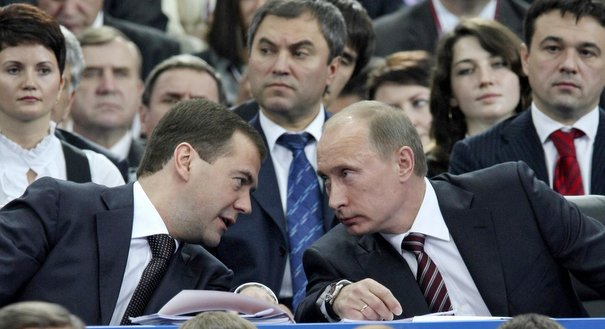
The All-Russia People’s Front, a creation of Prime Minister Vladimir Putin, may succeed in bringing fresh faces into Russian government, but its primary role is to reinforce Putin’s role as national leader.
Source: The Moscow Times

Today, 16 national organizations and more than 400 regional, interregional and municipal organizations have signed onto the front, and 200 other organizations are expected to follow suit. The invitation to join is open to almost everyone.
The more enthusiastic local organizers report that practically everybody in their districts is ready to join the group. The math is simple. If every war veteran and member of a union, women’s organization or other interest group were to join, more people would be reported as belonging to Putin’s front than actually live in a region since many will be double-counted.
The directors of Putin’s public liaison offices in the regions, mostly second-tier United Russia functionaries, provide basic organizational support. This demonstrates the largely auxiliary role that these newly created structures play.
By mid-June, the front’s regional councils must complete all the paperwork and choose their candidates for primaries that will be held from Aug. 1 to Sept. 10. After this, one-fourth of the United Russia list will be filled by people’s front members, which will dramatically intensify the internal struggle for a place on the party lists.
This may help bring fresh faces into the deputy corps of the party of power, something United Russia badly needs. The party has already announced the criteria by which it will “cleanse” its lists. It will only take deputies who have not served more than two or three terms in the State Duma, who have not been involved in any public scandals and who have contributed in some way to the party.
Although the people’s front exists, it lacks a program. The nongovernmental organizations that have come on board will make their recommendations for that program in mid-June. The Institute for Social, Economic and Political Research — created a couple of weeks ago and headed by former Justice Minister and former long-time Chuvashia leader Nikolai Fyodorov — has been charged with developing that program. The institute has promised to present its “five-year plan for the transformation of Russian society” to the newly elected Duma in December.
Despite its amorphous form, the people’s front has already accomplished a number of important tasks by bringing countless individuals and groups under its auspices, diverting the focus away from “the party of crooks and thieves” and reinforcing Putin’s role as national leader. It is also undermining the already extremely weak party system.
The front might even manage to pull in a significant percentage of the growing protest vote that the Communist Party had, until now, been gaining. According to a VTsIOM poll, more than 25 percent of the Communist electorate believes that the Communist Party should join the All-Russia People’s Front.
This article originally appeared in The Moscow Times.
Former Scholar-in-Residence, Society and Regions Program, Moscow Center
Nikolay Petrov was the chair of the Carnegie Moscow Center’s Society and Regions Program. Until 2006, he also worked at the Institute of Geography at the Russian Academy of Sciences, where he started to work in 1982.
Recent Work
Nikolay Petrov
Nikolay Petrov
Carnegie India does not take institutional positions on public policy issues; the views represented herein are those of the author(s) and do not necessarily reflect the views of Carnegie, its staff, or its trustees.