This resource was published on 09/22/2011 and is not updated to reflect changing circumstances.
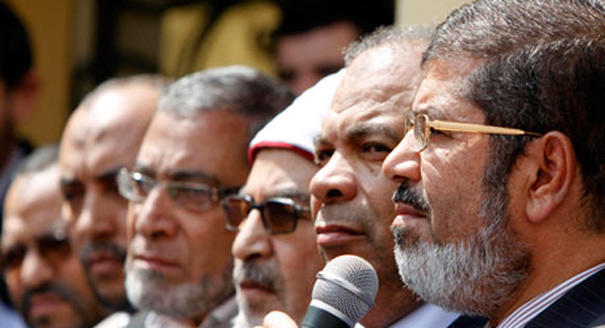
The Freedom and Justice Party was formed by the Muslim Brotherhood in May 2011 and is the dominant Islamist party in Egypt. Aware of the fears that surround its participation, the party defines itself as a “civil” party rather than an Islamic one and has formed the Democratic Alliance with a number of liberal and leftist parties.
Major Party Figures
Mohammed Morsi: President
Rafiq Habib: Vice president
Essam al-Arian: Vice president and spokesman
Saad al-Katatny: Secretary-General
Background
The Egyptian Muslim Brotherhood underwent a long period of ideological transformation as Egypt returned to multiparty elections under President Anwar Sadat and then President Hosni Mubarak. Under the influence of younger, reform-minded leaders, the Brotherhood came to accept that democratic processes were compatible with Islam.
Beginning with the parliamentary elections of 1984, the Muslim Brotherhood even began presenting some candidates. Banned from forming a political party, it was forced to present its candidates either under the auspices of other parties or as independent candidates. The high point of the Muslim Brotherhood electoral participation came in 2005, when its members, running as independents, won 20 percent of the lower house seats. Strong repression by the government ensured that such success was never repeated.
After the 2011 uprising, the law on political parties was modified. Although the registration of political parties with a religious identity was still banned, the Muslim Brotherhood was able to register the Freedom and Justice Party, presenting it as a “civil” party.
Controversy continues to surround the party. Fear of an Islamist victory is rife in many sectors of Egyptian society. More specifically, an extremely controversial platform for a political party floated by the Muslim Brotherhood in 2007 alarmed many by proposing the creation of a clerical committee to review legislation for compliance with Islamic law and another to prohibit women and non-Muslims from running for president. Although the organization later repudiated the most extreme features of the platform, doubts still remain about the new party’s real intentions.
Platform
Political Issues
- Supporting a civil state, defined as one that is neither run by the military nor a theocracy, with Islam as the state religion and Islamic law as the source of legislation covering all aspects of human life
- Granting the Supreme Constitutional Court the right to oversee legislation in order to ensure its compatibility with Islamic principles of justice
- Supporting the goals of Islamic law in governance with the understanding that non-Muslims will be under their own laws in terms of personal status and religious worship
- Affirming the belief in nondiscrimination among citizens in rights and duties
- Guaranteeing freedom of expression while maintaining the fundamental values of society
- Supporting women’s rights by passing legislation that criminalizes favoritism towards men
- Strengthening local governments by giving them the power to approve their own budgets for spending on their own projects and by holding periodic local elections
- Protecting the freedom of belief and worship for Muslims and non-Muslims
- Calling for a parliamentary system for Egypt with a government headed by a prime minister and only a symbolic role for the president
- Supporting judicial independence and maintaining the principle that the executive branch is accountable to the legislative branch
- Calling for the abolition of all special courts and supporting the exclusive jurisdiction of civil courts
- Building state institutions and the rule of law
Socioeconomic Issues
- Supporting a market economy with social justice under the framework of Islamic law
- Developing a national plan for integrated development by a “Higher Council of Planning” to achieve balanced, sustainable, and comprehensive economic growth and human development
- Stressing the responsibility of the state to maximize economic growth through cooperation with the private sector and civil society
- Securing citizens’ basic needs and services including food, clothing, housing, health care, education, transportation, security, and entertainment
- Eliminating poverty, unemployment, fraud, corruption, and monopolies
- Raising the standards of education and scientific research
- Supporting environmental conservation and sustainability and reducing pollution and the depletion of resources
- Spreading and deepening of the concepts and values of Islamic law in Egyptian society
- Focusing on Arabic language training in the early years of education
Foreign Policy Issues
- Strengthening national security and restoring Egypt to its leadership role in Islamic, Arab, African, and global affairs
- Building a new pattern of international relations which achieves cooperation between peoples and international institutions, and opposing all forms of domination
- Calling for the public release of national security documents after twenty-five years
- Acknowledging the Islamic principle of justice and nonaggression in international relations and upholding international treaties including the Geneva Conventions
- Opposing the neoliberal policy of interference in other nations’ affairs through promoting free markets and democracy
- Reforming the United Nations to increase its impartiality
- Strengthening the Organization of the Islamic Conference and the Arab League and promoting unity between all Islamic and Arab countries
- Securing the sources of the Nile River
- Building a strong Egyptian army to increase national power
- Affirming the need to confront the aggressive and expansionist Zionist entity
- Upholding the principle that all peace treaties with Egypt can only be valid if passed by a referendum of the people
- Supporting the Palestinian right to self-determination, including the right of return for all refugees and Jerusalem as the capital of a Palestinian state
- Opposing tyranny all over the world and supporting the right of self-determination for all peoples