

Commentary
Nikolay Petrov
{
  "authors": [
    "Nikolay Petrov"
  ],
  "type": "legacyinthemedia",
  "centerAffiliationAll": "",
  "centers": [
    "Carnegie Endowment for International Peace",
    "Carnegie Russia Eurasia Center"
  ],
  "collections": [],
  "englishNewsletterAll": "",
  "nonEnglishNewsletterAll": "",
  "primaryCenter": "Carnegie Russia Eurasia Center",
  "programAffiliation": "",
  "programs": [],
  "projects": [],
  "regions": [],
  "topics": []
}
Source: Getty
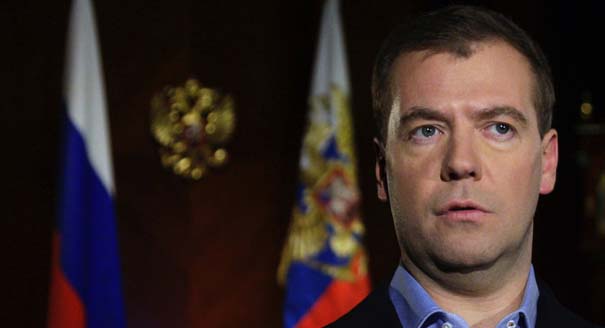
When Prime Minister Vladimir Putin and President Dmitry Medvedev switch places in March, Putin will have the opportunity to consolidate his leadership as president, while the prime minister will be forced to take responsibility for unpopular decisions by the next government.
Source: The Moscow Times

The new Putin-Medvedev configuration would not be a repetition of the old one. This is because Putin would consolidate and perhaps strengthen his leadership as president, while the prime minister would be forced to take responsibility for budget cuts to the public sector and long-delayed pension and tax reforms. These decisions by the next government will be very painful for most people and extremely unpopular. Under such conditions, Medvedev will become a convenient fall guy and will probably not last as prime minister to the end of Putin’s first presidential term.
The agenda for the presidential election campaign consists of little more than what was presented at the convention: the desire to become one of the world’s five largest economies. Putin’s speech at the convention was essentially campaign rhetoric about major achievements and promises to pensioners, state employees and the new middle class. What’s more, Putin claimed that the economy he is passing to the next prime minister is in outstanding condition, and he made an enormous number of promises for future economic achievements that will be impossible to fulfill.
Heightened attention was paid to the top names on the lists of State Duma candidates, eclipsing the remaining 599. In 50 regions, the party list is headed by governors, and in the Kaliningrad and Tula regions the governors are second only to Deputy Prime Minister Alexander Zhukov and State Duma Speaker Boris Gryzlov, who serve as the “federal locomotives” pulling the rest of the candidate list behind them.
Governors were not trusted to serve this role in only three places — Adygeya, Altai and Karelia. Government officials head a number of other party lists as well: First Deputy Prime Minister Viktor Zubkov in the Volgograd region, Deputy Prime Minister Vyacheslav Volodin in Saratov and Deputy Prime Minister Dmitry Kozak in St. Petersburg.
Characteristically, United Russia found few of its own party officials to head regional groups and relied almost exclusively on government officials to fulfill that function. This shows once again that United Russia is not an independent party but simply an electoral extension of the executive branch.
Former Scholar-in-Residence, Society and Regions Program, Moscow Center
Nikolay Petrov was the chair of the Carnegie Moscow Center’s Society and Regions Program. Until 2006, he also worked at the Institute of Geography at the Russian Academy of Sciences, where he started to work in 1982.
Recent Work
Nikolay Petrov
Nikolay Petrov
Carnegie India does not take institutional positions on public policy issues; the views represented herein are those of the author(s) and do not necessarily reflect the views of Carnegie, its staff, or its trustees.