

Commentary
Dmitri Trenin
{
  "authors": [
    "Dmitri Trenin"
  ],
  "type": "legacyinthemedia",
  "centerAffiliationAll": "",
  "centers": [
    "Carnegie Endowment for International Peace",
    "Carnegie China",
    "Carnegie Russia Eurasia Center"
  ],
  "collections": [
    "China’s Foreign Relations",
    "U.S.-China Relations"
  ],
  "englishNewsletterAll": "",
  "nonEnglishNewsletterAll": "",
  "primaryCenter": "Carnegie Endowment for International Peace",
  "programAffiliation": "",
  "programs": [],
  "projects": [
    "Eurasia in Transition"
  ],
  "regions": [
    "East Asia",
    "China",
    "Caucasus",
    "Russia",
    "North America",
    "United States"
  ],
  "topics": [
    "Foreign Policy"
  ]
}
Source: Getty
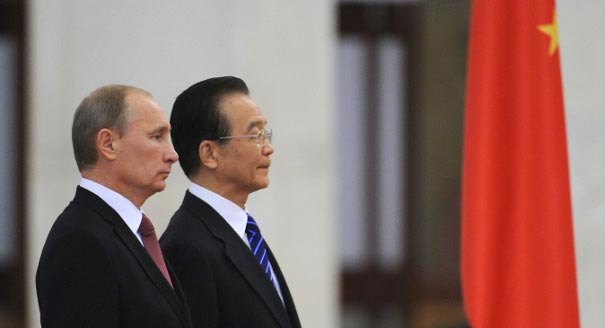
As China's power continues to grow, Russians need to rediscover themselves as a Euro-Pacific nation and strengthen ties to East Asia in order to avoid becoming Beijing's junior partner.
Source: Public Service Europe

The remarkable thing is that, given the enormity of the change and its swiftness, Moscow and Beijing managed to end their 30-year-long Cold War in 1989 and moved toward a generally peaceful and collaborative arrangement. The thorny border issue, a fulcrum of tension in the past, has been resolved. And the border itself has been largely demilitarised. China has become Russia's biggest foreign trade partner, ahead of Germany. Russian arms sales over the past 20 years have helped the PLA to narrow the gap with the world's top militaries. With a number of smaller Central Asian states, China and Russia have formed the Shanghai Cooperation Organisation, which helps mitigate their regional rivalry and functions as a platform for dialogue involving much of continental Asia. Finally, on the global arena, Moscow and Beijing speak the language of multilateralism and insist on the sanctity of national sovereignty - and the principle of non-interference in domestic affairs. ...
Full text of the article in Public Service Europe
Former Director, Carnegie Moscow Center
Trenin was director of the Carnegie Moscow Center from 2008 to early 2022.
Recent Work
Dmitri Trenin
Dmitri Trenin
Carnegie India does not take institutional positions on public policy issues; the views represented herein are those of the author(s) and do not necessarily reflect the views of Carnegie, its staff, or its trustees.

How is AI reshaping space security, creating governance challenges, and where does international diplomacy stand today?


Tejas Bharadwaj, Almudena Azcárate Ortega

After the chill in ties between 2020 and 2024 that brought India–China relations to their lowest point in several decades, the two countries have engaged each other afresh. This paper argues that there are predominantly four imperatives guiding India’s approach to China, and they exist in an order of priority.

Saheb Singh Chadha

This piece argues that India’s central challenge is not managing a single flashpoint but resolving the underlying tension between expansion and institutional coherency of the BRICS grouping.

Vrinda Sahai

A partnership between India, a country of subcontinental size, and Africa, a continent of fifty-four countries, may seem asymmetric until one notes that both are home to nearly the same number of people—1.4 billion. This essay spells out the existing challenges to the partnership, its optimal potential, and the possible pathways to realize it over the next quarter-century.

Rajiv Bhatia

The U.S.–India semiconductor cooperation story is well-stocked with top-level strategic intent. What remains unresolved, however, are some underlying challenges that will determine whether the cooperation actually functions. Three such friction points stand out.

Shruti Mittal