

Commentary
Uri Dadush
{
  "authors": [
    "Uri Dadush"
  ],
  "type": "legacyinthemedia",
  "centerAffiliationAll": "",
  "centers": [
    "Carnegie Endowment for International Peace"
  ],
  "collections": [],
  "englishNewsletterAll": "",
  "nonEnglishNewsletterAll": "",
  "primaryCenter": "Carnegie Endowment for International Peace",
  "programAffiliation": "",
  "programs": [],
  "projects": [],
  "regions": [
    "Western Europe",
    "Germany",
    "North America"
  ],
  "topics": [
    "Economy"
  ]
}
Source: Getty
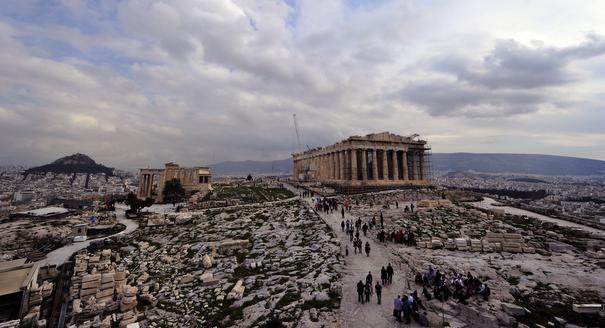
As concerns rise over a potential exit by Greece and a possible bailout for Spain, the eurozone remains in a very difficult predicament, with few good options for moving forward.
Source: BBC World News

Speaking on BBC News, Carnegie's Uri Dadush noted both the importance of the eurozone to the global economy and the acute position its member countries find themselves in, as the euro debt crisis wears on. The eurozone is the largest trading bloc in the world—larger, as a single entity, than the United States. It could potentially withstand the departure of smaller economies, including Ireland, Portugal, and Greece (which financial markets have, to a large extent, written off already). But it would likely not remain intact if the fiscal and financial situation in Italy and Spain, among the five largest economies in the eurozone, deteriorated significantly. Dadush argued that troubled periphery countries in the eurozone have little choice but to muddle through austerity in the short and medium-term, as markets will not lend to them otherwise. The eurozone core, including Germany, and the European Central Bank, however, could do more—for example, accept somewhat higher inflation—to support the periphery’s transition.

Former Senior Associate, International Economics Program
Dadush was a senior associate at the Carnegie Endowment for International Peace. He focuses on trends in the global economy and is currently tracking developments in the eurozone crisis.
Recent Work
Uri Dadush
Uri Dadush
Carnegie India does not take institutional positions on public policy issues; the views represented herein are those of the author(s) and do not necessarily reflect the views of Carnegie, its staff, or its trustees.

On March 10, 2026, India’s Union Cabinet approved amendments to Press Note 3, a regulation that mandated government approval on all foreign direct investment (FDI) from countries sharing a land border with India. This amendment raises questions primarily about whether its stated benefits will materialize and if the risks have been adequately weighed. This piece will address the same.

Konark Bhandari

This piece examines India’s response to U.S. sanctions and tariffs, specifically assessing the immediate market consequences, such as alterations in import costs, and the broader strategic implications for India’s energy security and foreign policy orientation.

Vrinda Sahai

This paper examines the evolution of India-China economic ties from 2005 to 2025. It explores the impact of global events, bilateral political ties, and domestic policies on distinct spheres of the economic relationship.

Santosh Pai

The India-U.S. relationship currently appears buffeted between three “Ts”—TRUST, Tariffs, and Trump.

Arun K. Singh
This article argues that the geopolitical circumstances have never been more conducive, not merely for the early conclusion of the free trade agreement (FTA) between India and the EU, but also for crafting a substantive and comprehensive strategic partnership.

Mohan Kumar