• Research
  • About
  • Experts
Carnegie India logoCarnegie lettermark logo
AI
{
  "authors": [
    "Dmitri Trenin",
    "Feng Shaolei"
  ],
  "type": "legacyinthemedia",
  "centerAffiliationAll": "",
  "centers": [
    "Carnegie Endowment for International Peace",
    "Carnegie China",
    "Carnegie Russia Eurasia Center"
  ],
  "collections": [
    "China’s Foreign Relations"
  ],
  "englishNewsletterAll": "",
  "nonEnglishNewsletterAll": "",
  "primaryCenter": "Carnegie Russia Eurasia Center",
  "programAffiliation": "",
  "programs": [],
  "projects": [
    "Eurasia in Transition"
  ],
  "regions": [],
  "topics": []
}

Source: Getty

In The Media
Carnegie Russia Eurasia Center

Russian President Comes to Beijing

Putin’s visit to China is important for both China and Russia, but if the two countries wish to strengthen their bilateral relations, Moscow and Beijing need to work to enhance trust and build a long-term strategy of mutual cooperation.

Link Copied
By Dmitri Trenin and Feng Shaolei
Published on Jun 5, 2012
Project hero Image

Project

Eurasia in Transition

Learn More

Source: China Radio International's People In the Know

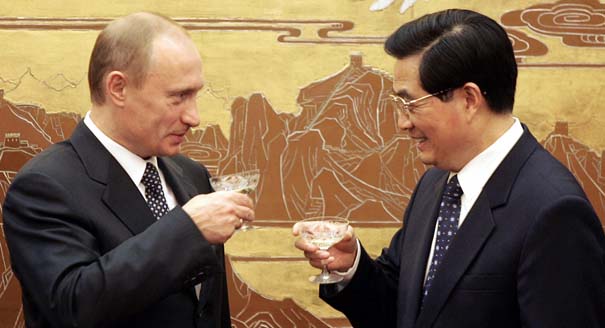
Russian President Vladimir Putin is on a three-day state visit to China, his first visit to China since being reelected in March. During his visit, he will attend the annual Summit for the Shanghai Cooperation Organization, a forum that brings together China, Russia, Kazakhstan, Kyrgyzstan, Tajikistan, and Uzbekistan. He is also expected to sign a series of cooperative agreements with China, especially in the field of energy.

China and Russia have enjoyed good momentum in the development of their bilateral relations and President Putin's visit is widely expected to take Sino-Russian relations to a new level.

On the China Radio International, Carnegie Moscow Center’s Dmitri Trenin spoke about Putin’s trip to China. He was joined by Feng Shaolei, director of the Center for Russian Studies at East China Normal University. Trenin said that Putin’s visit to China is important for both China and Russia, as the two countries face a number of shared problems. The two countries can cooperate in different spheres because the Chinese and Russian leaderships have the same political philosophy based on the principles of sovereignty and non-interference. However, Trenin added, Russia and China shouldn't be seen as an opposition to the West, as the relations with the European Union and the United States are among top priorities of the both countries. Trenin stressed that to strengthen bilateral relations, the Russian and Chinese authorities need to enhance trust and build up a long-term strategy of cooperation between the two countries.

About the Authors

Dmitri Trenin

Former Director, Carnegie Moscow Center

Trenin was director of the Carnegie Moscow Center from 2008 to early 2022.

Feng Shaolei

Authors

Dmitri Trenin
Former Director, Carnegie Moscow Center
Feng Shaolei

Carnegie India does not take institutional positions on public policy issues; the views represented herein are those of the author(s) and do not necessarily reflect the views of Carnegie, its staff, or its trustees.

More Work from Carnegie India

  • Commentary
    How Are Various Countries Responding to China’s Belt and Road Initiative?

    Pitched as a new Silk Road sweeping from Asia to Europe, China’s enormous Belt and Road Initiative is an ambitious, multinational infrastructure project. Experts from four Carnegie global centers explain other countries’ perspectives.

      • Alexander Gabuev
      • +4

      Paul Haenle, Dmitri Trenin, Alexander Gabuev, …

  • Commentary
    Raja Mandala: India and China—Rebuild the Trust

    Without a return to genuine bilateralism that takes into account the interests of both parties, Beijing will find that the chasm with New Delhi continues to deepen.

      C. Raja Mohan

  • Commentary
    Xi, Trump, Asian Disorder

    The rise of China and the turbulence in U.S. domestic politics have created great disorder, but they have also opened up room for creative Indian diplomacy in Asia.

      C. Raja Mohan

  • Paper
    India’s Strategic Choices: China and the Balance of Power in Asia

    China’s rise poses a strategic challenge to India on multiple fronts. The best way for New Delhi to respond is to pursue a deeper partnership with the United States.

      Rajesh Rajagopalan

  • Commentary
    Three Decades of Mistrust

    New Delhi’s current challenge is not about undoing Beijing’s new economic weight in the region. It is about building on its own natural geo-economic advantages in the region.

      C. Raja Mohan

Get more news and analysis from
Carnegie India
Carnegie India logo, white
Unit C-4, 5, 6, EdenparkShaheed Jeet Singh MargNew Delhi – 110016, IndiaPhone: 011-40078687
  • Research
  • About
  • Experts
  • Projects
  • Events
  • Contact
  • Careers
  • Privacy
  • For Media
Get more news and analysis from
Carnegie India
© 2026 Carnegie Endowment for International Peace. All rights reserved.