

Commentary
How is AI reshaping space security, creating governance challenges, and where does international diplomacy stand today?
Tejas Bharadwaj, Almudena Azcárate Ortega
{
  "authors": [
    "Mykola Siruk",
    "Matthew Rojansky",
    "Steven Pifer"
  ],
  "type": "legacyinthemedia",
  "centerAffiliationAll": "dc",
  "centers": [
    "Carnegie Endowment for International Peace",
    "Carnegie Russia Eurasia Center"
  ],
  "collections": [],
  "englishNewsletterAll": "ctw",
  "nonEnglishNewsletterAll": "",
  "primaryCenter": "Carnegie Endowment for International Peace",
  "programAffiliation": "russia",
  "programs": [
    "Russia and Eurasia"
  ],
  "projects": [],
  "regions": [
    "North America",
    "United States"
  ],
  "topics": [
    "Political Reform",
    "Foreign Policy"
  ]
}
Source: Getty
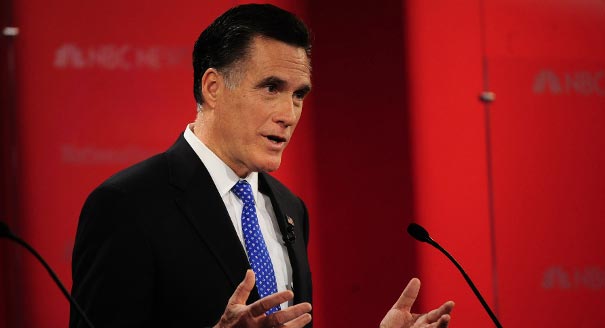
Mitt Romney’s tour of Great Britain, Poland, and Israel is unlikely to change the U.S. presidential campaign’s pace because the economy, not the foreign policy, is the main issue in the campaign.
Source: Day

“The visit to Poland perhaps fits in with the efforts to play in ‘common values’ with our allies. George Bush Jr. once focused his attention on Poland as a role model of ‘Western values,’ although that country has not-so-easy relations with its neighbors. But, on the other hand, Poland is taking good advantage of the fact that many ethnic Polish voters live in the US Middle West.”
Steven Pifer: “Governor Romney’s tour of Britain, Israel, and Poland very much resembles foreign trips by other candidates in the summer before the US presidential elections. The aim of Romney’s team is to show that he is knowledgeable about foreign-policy matters on the whole. They are trying to project the image of an individual who, if elected to the White House, will be able to really manage the US foreign policy, especially taking into account that President Obama is generally rated as a strong leader in foreign-policy matters. The governor’s visit to London to take part in the Olympic Games opening ceremony was planned to remind US voters of the role the governor played in the successful organization of the 2002 winter Olympics in the state of Utah. In the course of his visit to Israel, he will be emphasizing his support for that country.”
M.R.: “In my view, this trip can also be of benefit for Romney. But it is wrong to think that Obama’s tour of Europe in 2008 was a decisive factor for his victory. In reality, he was subjected to a lot of criticism and told that a candidate should pay more attention to domestic problems. In all probability, the same will occur in the case of Romney. I doubt that foreign policy may be one of the key issues in the election campaign. There has not been a precedent like this in history. Besides, Romney has already harshly criticized Obama in foreign-policy matters. But this does not change the fact that the coverage of the campaign, advertising materials, and speeches mainly focus on the economy.”
S.P.: “Governor Romney should exercise caution during this trip. A candidate may criticize the incumbent president’s foreign policy as much as he pleases. Therefore, the US electorate is taking a dim view of the candidates who express criticism from abroad.”
M.R.: “I think the margin between the two candidates will be slim. I doubt that Romney’s taxes, the Bain situation, and the country’s financial condition under Obama’s presidency will be a crucial issue. What will really matter is the economic situation in the fall of 2012 as well as which of the candidates is better prepared, in the opinion of voters, to improve the overall situation in the country.”
S.P.: “As for the trip’s impact on the presidential campaign in general, I cannot say I am an expert in the question of US politics, but I suspect that the campaign will focus on the domestic problems that will most strongly influence the voters’ choice. Foreign policy will be a secondary issue when the Americans go to the polls in November.”
Mykola Siruk

Former Deputy Director, Russia and Eurasia Program
Rojansky, formerly executive director of the Partnership for a Secure America, is an expert on U.S. and Russian national security and nuclear-weapon policies.
Steven Pifer
Carnegie India does not take institutional positions on public policy issues; the views represented herein are those of the author(s) and do not necessarily reflect the views of Carnegie, its staff, or its trustees.

How is AI reshaping space security, creating governance challenges, and where does international diplomacy stand today?


Tejas Bharadwaj, Almudena Azcárate Ortega

After the chill in ties between 2020 and 2024 that brought India–China relations to their lowest point in several decades, the two countries have engaged each other afresh. This paper argues that there are predominantly four imperatives guiding India’s approach to China, and they exist in an order of priority.

Saheb Singh Chadha

This piece argues that India’s central challenge is not managing a single flashpoint but resolving the underlying tension between expansion and institutional coherency of the BRICS grouping.

Vrinda Sahai

A partnership between India, a country of subcontinental size, and Africa, a continent of fifty-four countries, may seem asymmetric until one notes that both are home to nearly the same number of people—1.4 billion. This essay spells out the existing challenges to the partnership, its optimal potential, and the possible pathways to realize it over the next quarter-century.

Rajiv Bhatia

The U.S.–India semiconductor cooperation story is well-stocked with top-level strategic intent. What remains unresolved, however, are some underlying challenges that will determine whether the cooperation actually functions. Three such friction points stand out.

Shruti Mittal