

Q&A
Suzanne Maloney, Aaron David Miller, Karim Sadjadpour
{
  "authors": [
    "Karim Sadjadpour"
  ],
  "type": "questionAnswer",
  "centerAffiliationAll": "dc",
  "centers": [
    "Carnegie Endowment for International Peace"
  ],
  "collections": [],
  "englishNewsletterAll": "menaTransitions",
  "nonEnglishNewsletterAll": "",
  "primaryCenter": "Carnegie Endowment for International Peace",
  "programAffiliation": "MEP",
  "programs": [
    "Middle East"
  ],
  "projects": [],
  "regions": [
    "Middle East",
    "Iran"
  ],
  "topics": [
    "Political Reform",
    "Foreign Policy"
  ]
}
Source: Getty
The outcome of Iran’s election will not have much of an impact on Tehran’s foreign policy and nuclear strategy—the supreme leader, not the president, makes those decisions.
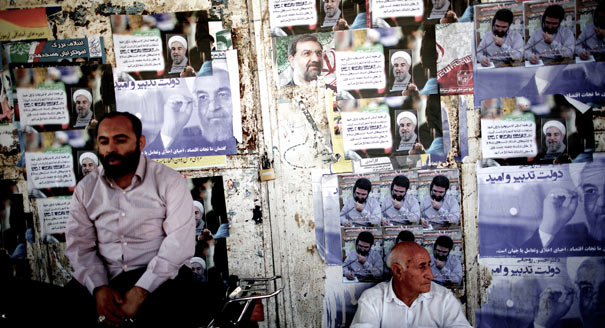
Iranians head to the polls to vote for a new president on June 14. With the current firebrand leader, Mahmoud Ahmadinejad, out of the running thanks to term limits, they will choose among a group of decidedly conservative candidates that have already been vetted by the country’s supreme leader, Ayatollah Ali Khamenei.
In a Q&A, Karim Sadjadpour explains that with no obvious front-runner, it is not clear whether the people or the supreme leader will have the decisive vote in the end. Either way, the international community is likely to see more of the same when it comes to Iran’s nuclear and foreign policies.
The position of president in the Islamic Republic of Iran is somewhat unique in that it’s neither authoritative nor ceremonial. The vast majority of constitutional authority rests with the supreme leader. Regardless of who wins the election, Ayatollah Khamenei will continue to have the final say on issues like the nuclear program and relations with the United States.
But the president can play an important role in managing—and often mismanaging—Iran’s economy, its domestic atmosphere, and its international image. Since Khamenei hasn’t left Iran since 1989, the president is often the public face of Iran to the world.
As in Washington, a new president in Tehran brings different personnel to the country’s bureaucracies. And that affects the nation’s overall tenor.
During the era of reformist president Mohammad Khatami there was an atmosphere of greater political and social tolerance than there has been during Ahmadinejad’s tenure.
Whereas Khatami is most remembered for his slogan calling for a dialogue of civilizations, Ahmadinejad will be remembered for his Holocaust revisionism and diatribes against Israel. This helped earn Iran six UN Security Council resolutions and a robust international sanctions regime.
Given that Khamenei is now seventy-three years old, the next president of Iran could also play an important role during a political transition in the event that the leader dies during his tenure.
There are now six candidates remaining in the race—two recently dropped out. Five of them are fairly well-known figures, while one (Mohammad Gharazi) is seemingly kept around for entertainment purposes.
A decade ago, all of these candidates would have been considered conservatives, but given the Iranian political spectrum’s rightward shift, analysts have come up with new terms to differentiate among them, like “hardline conservative,” “traditional conservative,” and “pragmatic conservative.”
The five well-known candidates are:
Jalili was previously head of Khamenei’s office, and his campaign slogans—which preach Islamic principles coupled with political and economic resistance against hegemonic powers (that is, the United States)—align closely with Khamenei’s worldview. He and Velayati represent the so-called “principleist” camp, although Velayati projects a more urbane image.
While Ghalibaf is nominally a member of the “principleist” camp and pays lip service to Khamenei and revolutionary values, his main focus is to portray himself as a strong manager who can improve the country’s moribund economy. Several opinion polls—which admittedly should be taken with a large chunk of salt—show Ghalibaf in the lead. Rezai’s message is similar to that of Ghalibaf, but, like Velayati, he tries to play the role of a wise elder statesman.
Rowhani, an acolyte of former president Hashemi Rafsanjani (who was prohibited from running), is the lone “reformist” in the race, which is a reflection of the Iranian political spectrum’s shift to the right. A decade ago, many of the reformists who dominated Iran’s elected institutions—namely the presidency and the parliament—would have considered Rowhani more a rival than an ally.
If none of the candidates gets 50 percent of the vote in the first round, there will be a second-round runoff on June 21 between the top two vote-getters. Given that there are no runaway front-runners at the moment, a runoff appears likely.
The biggest question mark is whose vote will be more decisive, that of the people or that of the supreme leader. Khamenei has already engineered the election by rejecting—via the Guardian Council—candidates he deemed unpalatable (such as his old rival Rafsanjani and Ahmadinejad’s chief adviser Esfandiar Rahim Mashaei). It would be uncharacteristic of Khamenei and the Revolutionary Guards to refrain from trying to micromanage the results of such an important political institution in Iran.
At the moment there are no signs of impending popular unrest. The Green Movement no longer exists as a cohesive entity (if it ever did). Its nominal leadership—2009 opposition presidential candidates Mir Hossein Mousavi and Mehdi Karroubi—have been under house arrest for the last three years. The movement’s brain trust has been either exiled, imprisoned, or intimidated into silence.
Nonetheless the same political, social, and above all economic frustrations that compelled people to take to the streets in 2009 still very much exist, but this time around there is no organizing principal or common cause. In contrast to opposition movements in the Arab world in which the aspiration was and is to bring down regimes, the disgruntled masses in Iran still haven’t coalesced around a common goal. People are understandably reluctant to take to the streets when it’s not clear what they’re risking their lives for.
It’s often been noted that popular uprisings occur when people’s expectations are suddenly raised and then abruptly dashed. This is what happened in Iran’s 2009 election. This time around, I don’t think people have any illusions about the election, so a disillusioning outcome isn’t likely to animate folks the way it did in 2009.
Iran’s foreign policy in the Middle East is controlled not by the Iranian Ministry of Foreign Affairs but by the Islamic Revolutionary Guard Corps, which reports to Khamenei, not Iran’s president.
The presidential candidates haven’t really challenged this setup. They have voiced only mild criticism, if any, about Iran’s regional policies. In fact, all of them have made clear they understand that it is Khamenei, not the president, who makes major foreign policy decisions in Iran.
As such, a different president will have little impact on Iran’s regional policies, be it Tehran’s hostility toward Israel or its deep commitment to keeping the Assad regime in power in Syria. Tehran has spent billions of dollars arming and financing the Assad regime, and I don’t see that resolve wavering.
Of course, presidents do have some impact. And the individual who may well miss Mahmoud Ahmadinejad the most is Israeli Prime Minister Benjamin Netanyahu. Ahmadinejad’s bluster—particularly his Holocaust revisionism and vitriol toward Israel—was a factor in bringing about Iran’s unprecedented international economic isolation. It would have been much tougher to subject Iran to this degree of coercion under a more moderate president.
Several of the presidential candidates have critiqued Jalili’s diplomatic ineptitude, but they refrain from calling into question the wisdom of the nuclear program itself. In other words, their critique is focused primarily on Jalili’s tactics, not Khamenei’s strategy.
Like Iran’s foreign policy in the Middle East, the nuclear program is run by the Revolutionary Guards and Khamenei is widely thought to have the last word on nuclear decisions. A different president could bring about some cosmetic changes in Iran’s nuclear posture and could impact negotiating dynamics. But I don’t see that altering Khamenei’s entrenched strategy and his worldview that Iran should never compromise in response to pressure.

Senior Fellow, Middle East Program
Karim Sadjadpour is a senior fellow at the Carnegie Endowment for International Peace, where he focuses on Iran and U.S. foreign policy toward the Middle East.
Recent Work


Suzanne Maloney, Aaron David Miller, Karim Sadjadpour

Aaron David Miller, Karim Sadjadpour, Robin Wright
Carnegie India does not take institutional positions on public policy issues; the views represented herein are those of the author(s) and do not necessarily reflect the views of Carnegie, its staff, or its trustees.

After the chill in ties between 2020 and 2024 that brought India–China relations to their lowest point in several decades, the two countries have engaged each other afresh. This paper argues that there are predominantly four imperatives guiding India’s approach to China, and they exist in an order of priority.

Saheb Singh Chadha

This piece argues that India’s central challenge is not managing a single flashpoint but resolving the underlying tension between expansion and institutional coherency of the BRICS grouping.

Vrinda Sahai

A partnership between India, a country of subcontinental size, and Africa, a continent of fifty-four countries, may seem asymmetric until one notes that both are home to nearly the same number of people—1.4 billion. This essay spells out the existing challenges to the partnership, its optimal potential, and the possible pathways to realize it over the next quarter-century.

Rajiv Bhatia

The India–EU Free Trade Agreement (FTA) is shaping up to be one of the most consequential trade negotiations, both economically and strategically. But, what’s in the agreement, what’s missing, and what will determine its success in the years ahead
Vrinda Sahai, Nicolas Köhler-Suzuki

Trump 2.0 has unsettled India’s external environment—but has not overturned its foreign policy strategy, which continues to rely on diversification, hedging, and calibrated partnerships across a fractured order.



Milan Vaishnav, ed., Sameer Lalwani, Tanvi Madan, …