

Commentary
Dmitri Trenin
{
  "authors": [
    "Dmitri Trenin"
  ],
  "type": "legacyinthemedia",
  "centerAffiliationAll": "",
  "centers": [
    "Carnegie Endowment for International Peace",
    "Carnegie Russia Eurasia Center"
  ],
  "collections": [],
  "englishNewsletterAll": "",
  "nonEnglishNewsletterAll": "",
  "primaryCenter": "Carnegie Russia Eurasia Center",
  "programAffiliation": "",
  "programs": [],
  "projects": [],
  "regions": [
    "North America",
    "United States",
    "Russia"
  ],
  "topics": [
    "Foreign Policy"
  ]
}
Source: Getty
It remains to be seen whether the Russian and American presidents can establish a productive relationship for the remainder of Obama’s term and what role Susan Rice, the new U.S. national security advisor, will have in shaping U.S. policy toward Russia.
Source: Foreign Policy
The recent appointments of Susan Rice as the U.S. national security advisor and Samantha Power as the U.S. ambassador to the United Nations have generated a good deal of attention, a signal of a new direction in a second-term administration -- one that reflects President Barack Obama's personal preferences and establishes a new balance within the foreign and security policy division of his administration. When transitions of this magnitude happen, outside countries take note. And even though policy on important issues is made personally by the president, nuances and personal flavor can be important enough to affect the practical diplomacy with other countries, Russia in particular.
Obama's early reset policy toward Russia was crafted by Michael McFaul, then special advisor to the president and senior director for Russia on the National Security Council (NSC) staff. While McFaul formally reported to Gen. Jim Jones, Obama's first national security advisor, it was his direct interaction with the president that allowed Washington to walk out of the woods where President George W. Bush's policy had abandoned Russia, and steer the relationship toward achieving key U.S. policy goals on Afghanistan, Iran, and nuclear disarmament.During Obama's first administration, Russia policy was very much driven by the NSC, with McFaul as its principal architect. This created some problems with the secretary of state: Hillary Clinton was not really part of Russia policymaking, and though she was a loyal implementer of the reset approach, her heart was never in it. This, alongside some personality issues, complicated her relations with Russian Foreign Minister Sergei Lavrov. Not that Clinton cared much, apparently.
John Kerry's appointment as Clinton's successor at the State Department has improved the atmosphere of U.S.-Russia diplomacy. Caustic exchanges, in which Clinton always sought to have the last word, have already become a thing of the past. Kerry, whose portfolio includes the U.S.-Russia dialogue on Syria, is very focused on the main subject and leaves no time for side orders or the general philosophy of international relations. Kerry's interaction with Lavrov is as good as can be hoped for, at least in the current context of the political relationship between Washington and Moscow.
Thomas Donilon, who succeeded Jones in 2010 and is now departing, has been seen by Moscow as a serious counterpart. While the relationship between the national security advisor at the White House and the secretary of Russia's Security Council has not been close for many years (with the exception of the early 2000s when Sergei Ivanov managed to build a rapport with Condoleezza Rice), Donilon's visit to Moscow this April was pronounced a success. It effectively ended the long pause in high-level U.S.-Russia dialogue that had lasted during the election seasons in both countries. Those who had met Donilon before, like Dmitry Rogozin, Russia's former NATO ambassador and current deputy prime minister, appreciated his personality and his style.
Donilon's successor, however, presents different issues in the relationship. Susan Rice is best known in Russia for her role in persuading Obama to change, rather abruptly, his policy course on Libya in 2011. The U.S. decision to support military intervention in support of the anti-Qaddafi rebels -- contradicting the advice of then Defense Secretary Robert Gates -- came as an unwelcome surprise to Moscow. To perform that feat, Rice joined forces with Samantha Power, then a senior member of the NSC staff and now Rice's successor as U.S. ambassador to the United Nations. Together, Rice and Power stand for a more muscular policy of humanitarian interventionism, which the Kremlin sees as a means to promote U.S. global domination.
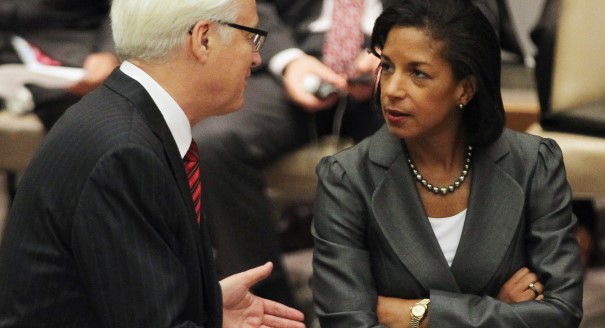
After Obama's reelection, Moscow was bracing for the potential elevation of Rice as secretary of state, but now it has to deal with her as national security advisor. Unlike her near namesake Condoleezza Rice, Susan Rice never delved in Soviet or Russian studies, and the Cold War is history as far as she is concerned. On the other hand, during her time at the United Nations, Rice often had to argue with the Russian envoy to the world body, Vitaly Churkin, but at least she knows the Kremlin's position on world issues firsthand. She is herself a known quantity to the Russian delegation. At the White House, Russia-related issues will probably take only a moderate amount of Rice's time, but on issues such as Syria or ballistic missile defense she will surely weigh in.
This may well complicate things in U.S.-Russia diplomacy. Historically, under Obama, Russia policy has been generated in the White House, but more recently Kerry and the State Department have regained ground. Compared with Jones and Donilon, Rice looks more ambitious, more active, and more publicity-prone. She is also the president's clear favorite and has his ear. In the U.S. national security elite -- a virtually all-male, somewhat older team -- she stands out as someone who might want to emerge on top. Of course, Obama is the decider in his administration, but as the Libya episode has demonstrated, Rice may provide him with the key ingredients for decision-making.
At this juncture, these are just expectations. The U.S.-Russia relationship stands at a crucial point. The meeting between Obama and Russian President Vladimir Putin, on the margins of the G-8 summit in Northern Ireland, is only a few days away. Between that summit and the next one planned in conjunction with the G-20 gathering in early September in St. Petersburg, it will be made clear whether the two leaders can establish a productive relationship to last through the remainder of Obama's term. Rice will have a role in achieving the outcome. As to Samantha Power, Vitaly Churkin will continue to have a worthy sparring partner at the United Nations.
Former Director, Carnegie Moscow Center
Trenin was director of the Carnegie Moscow Center from 2008 to early 2022.
Recent Work
Dmitri Trenin
Dmitri Trenin
Carnegie India does not take institutional positions on public policy issues; the views represented herein are those of the author(s) and do not necessarily reflect the views of Carnegie, its staff, or its trustees.

How is AI reshaping space security, creating governance challenges, and where does international diplomacy stand today?


Tejas Bharadwaj, Almudena Azcárate Ortega

After the chill in ties between 2020 and 2024 that brought India–China relations to their lowest point in several decades, the two countries have engaged each other afresh. This paper argues that there are predominantly four imperatives guiding India’s approach to China, and they exist in an order of priority.

Saheb Singh Chadha

This piece argues that India’s central challenge is not managing a single flashpoint but resolving the underlying tension between expansion and institutional coherency of the BRICS grouping.

Vrinda Sahai

A partnership between India, a country of subcontinental size, and Africa, a continent of fifty-four countries, may seem asymmetric until one notes that both are home to nearly the same number of people—1.4 billion. This essay spells out the existing challenges to the partnership, its optimal potential, and the possible pathways to realize it over the next quarter-century.

Rajiv Bhatia

The U.S.–India semiconductor cooperation story is well-stocked with top-level strategic intent. What remains unresolved, however, are some underlying challenges that will determine whether the cooperation actually functions. Three such friction points stand out.

Shruti Mittal