

Article
C. Raja Mohan, Darshana M. Baruah
{
  "authors": [
    "C. Raja Mohan"
  ],
  "type": "legacyinthemedia",
  "centerAffiliationAll": "dc",
  "centers": [
    "Carnegie Endowment for International Peace",
    "Carnegie India"
  ],
  "collections": [],
  "englishNewsletterAll": "ctw",
  "nonEnglishNewsletterAll": "",
  "primaryCenter": "Carnegie India",
  "programAffiliation": "SAP",
  "programs": [
    "South Asia"
  ],
  "projects": [],
  "regions": [
    "South Asia",
    "Afghanistan",
    "Pakistan"
  ],
  "topics": [
    "Security",
    "Foreign Policy"
  ]
}
Source: Getty
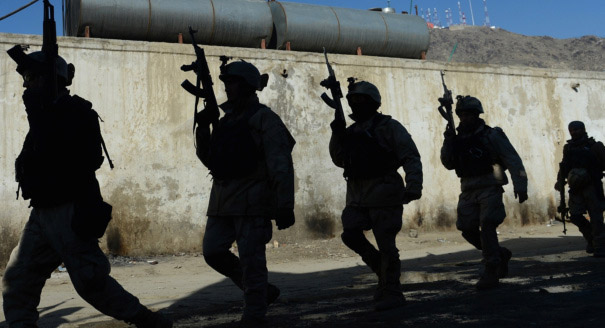
Pakistan’s leverage over the Taliban is driving negotiations over Afghanistan’s future.
Source: Indian Express
As tensions between Kabul and Islamabad threaten the fragile peace process in Afghanistan, the Taliban's role as a proxy for Pakistan's interests has come back into sharp focus this week.
Gen. Sher Mohammad Karimi, the head of the Afghan armed forces told the BBC in an interview that the prolonged war in his country can come to an end "within a week" if Pakistan stops supporting the Taliban.
On the face of it, Gen. Karimi's statement is not a shocking revelation. Despite repeated Pakistani that it controls the Taliban, few in the world question the reality of the Pakistan army's extraordinary influence on the militancy in Afghanistan.The doubts, if any, have disappeared as Pakistan in recent months orchestrated the process of political reconciliation, by selectively releasing some Taliban leaders from detention, promoted the opening of their office in Qatar, and managed their communication and contact with the United States.
Karimi's decision to reaffirm the well-known truth about Pakistan's control over the Taliban comes amidst the reports that Islamabad is pushing for a power sharing arrangement in which the Taliban will control the eastern and southern provinces in Afghanistan.
Although Islamabad has denied these allegations, Kabul says that Sartaj Aziz, foreign policy adviser to the Pakistan Prime Minister Nawaz Sharif, put across the proposal to the Afghan ambassador in Islamabad, Umer Daudzai in a meeting last week.
The Afghan Deputy Foreign Minister, Ershad Ahmadi pointed to "the elements within the Pakistan government who have a grand design for using the peace process as a means to undermine the Afghan state and establish little fiefdoms around the country in which the Taliban--its most important strategic asset in Afghanistan--play an influential role".
Ahmadi expressed his deep disappointment that the newly elected Nawaz Sharif government might be buying into the attempts by the ISI to weaken the Afghan state. He said federalising Afghanistan is part of an effort to win at the peace table what the ISI could not achieve on the battlefield with its proxy, the Taliban.
Interestingly, the Afghan Taliban too expressed its opposition to any form of federalism in Afghanistan. Cynics would say this is mere posturing. They argue that the Taliban in any case has no incentive to abide by any arrangement to share power once the international forces withdraw from Afghanistan and will seek to establish an Islamic Emirate in the nation.
Former Nonresident Senior Fellow, Carnegie India
A leading analyst of India’s foreign policy, Mohan is also an expert on South Asian security, great-power relations in Asia, and arms control.
Recent Work

C. Raja Mohan, Darshana M. Baruah


Alexander Gabuev, Paul Haenle, C. Raja Mohan, …
Carnegie India does not take institutional positions on public policy issues; the views represented herein are those of the author(s) and do not necessarily reflect the views of Carnegie, its staff, or its trustees.

In any defense establishment, change is an ongoing process. However, despite the best of intentions, existing bureaucracies, bound by habit and years of socialization, have their limits in implementing transformative change.

Anit Mukherjee

After the chill in ties between 2020 and 2024 that brought India–China relations to their lowest point in several decades, the two countries have engaged each other afresh. This paper argues that there are predominantly four imperatives guiding India’s approach to China, and they exist in an order of priority.

Saheb Singh Chadha

This piece argues that India’s central challenge is not managing a single flashpoint but resolving the underlying tension between expansion and institutional coherency of the BRICS grouping.

Vrinda Sahai

A partnership between India, a country of subcontinental size, and Africa, a continent of fifty-four countries, may seem asymmetric until one notes that both are home to nearly the same number of people—1.4 billion. This essay spells out the existing challenges to the partnership, its optimal potential, and the possible pathways to realize it over the next quarter-century.

Rajiv Bhatia

The India–EU Free Trade Agreement (FTA) is shaping up to be one of the most consequential trade negotiations, both economically and strategically. But, what’s in the agreement, what’s missing, and what will determine its success in the years ahead
Vrinda Sahai, Nicolas Köhler-Suzuki