

Research
- +5
Alper Coşkun, Fatih Ceylan, Tacan İldem, …
{
  "authors": [
    "Sinan Ülgen"
  ],
  "type": "commentary",
  "centerAffiliationAll": "",
  "centers": [
    "Carnegie Endowment for International Peace",
    "Carnegie Europe",
    "Carnegie Russia Eurasia Center"
  ],
  "collections": [],
  "englishNewsletterAll": "",
  "nonEnglishNewsletterAll": "",
  "primaryCenter": "Carnegie Europe",
  "programAffiliation": "",
  "programs": [],
  "projects": [],
  "regions": [],
  "topics": []
}
Source: Getty
There is doubt whether the protests will have an imminent impact on Turkey’s parliamentary politics. But what is clear is that Turkish democracy has reached a new level of maturity by consolidating the peaceful right to dissent.
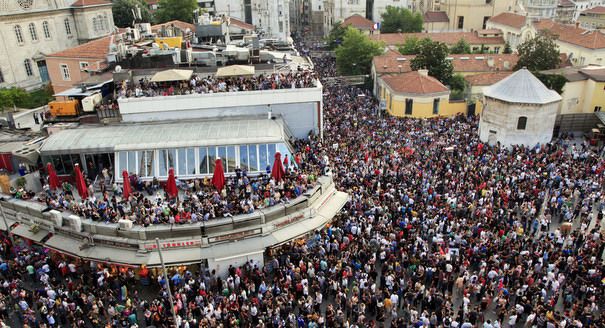
The protests that broke out in Istanbul in early June and very rapidly spread out to many corners of the country came as a surprise to many. After all Turkey had a stable government, a popular prime minister, and a well-run economy. It was gradually enhancing its regional profile and raising its visibility in global affairs.
But against this backdrop, there was also an increasing disaffection with the prime minister Erdogan’s non-inclusive, paternalistic, and polarizing style of leadership. Erdogan’s fallacy has been to believe that just because he won three rounds of elections, he could impose his policies without taking into consideration the minority view. The Turkish protests are to be interpreted as a reaction to this type of a majority rule.
From this perspective, they are also a turning point for Turkey’s own democracy. The protests have been largely peaceful. Unlike the mass rallies witnessed in the past that had been organized by mass membership institutions such as political parties or trade unions, this time around the protests were also largely leaderless. They have been a focal point for many different parts of the Turkish society ranging from hard core seculars to Kurdish nationalists, even uniting the many die-hard fans of Istanbul’s top football clubs. They have also been greatly facilitated by the widespread use of social media. In a country where the press has failed to fulfill its primary role of timely and objective reporting, the influence of the social media has been even greater. There is doubt whether these protests will have an imminent impact on Turkey’s parliamentary politics. In other words, it is unclear whether the activism of the street can actually be translated into institutionalized politics. But what is clear is that Turkish democracy has reached a new level of maturity by consolidating the peaceful right to dissent. This is the one message that all future governments in Turkey should take into consideration. The country will never go back to the morning of May 31 when these protests started. What has been learned will not be unlearned. There is now a proven method for alleviating the weakness of the checks and balances of the Turkish system of governance. Hopefully it will remain an exceptional method and the body politic will decide to heed the message of the crowds.

Senior Fellow, Carnegie Europe
Sinan Ülgen is a senior fellow at Carnegie Europe in Brussels, where his research focuses on Turkish foreign policy, transatlantic relations, international trade, economic security, and digital policy.
Recent Work

Alper Coşkun, Fatih Ceylan, Tacan İldem, …
Carnegie India does not take institutional positions on public policy issues; the views represented herein are those of the author(s) and do not necessarily reflect the views of Carnegie, its staff, or its trustees.