

In The Media
Petr Topychkanov
{
  "authors": [
    "Petr Topychkanov"
  ],
  "type": "commentary",
  "centerAffiliationAll": "",
  "centers": [
    "Carnegie Endowment for International Peace",
    "Carnegie Russia Eurasia Center"
  ],
  "collections": [],
  "englishNewsletterAll": "",
  "nonEnglishNewsletterAll": "",
  "primaryCenter": "Carnegie Russia Eurasia Center",
  "programAffiliation": "",
  "programs": [],
  "projects": [],
  "regions": [],
  "topics": []
}
Source: Getty
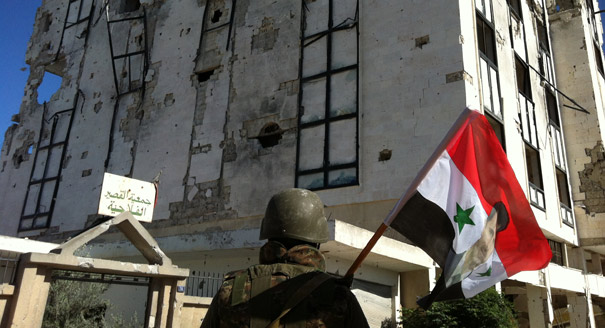
The Syrian case has proved the existence of a very serious problem in international relations. Russia and the United States, which used to regard themselves as great powers, have no capability to be such powers.
This week I have received a number of emails and calls with the question: How Russia would react to a U.S. strike on Syria? I tried to explain possible Russian reactions. Yet in my mind I was in total disagreement with this very question. When this is the tragedy of Syria, why should we be thinking about Moscow or Washington? When every day innocent people in Syria lose their lives in that bloodbath, do multiple statements of Vladimir Putin and Barack Obama really matter?
The Syrian case has proved the existence of a very serious problem in international relations. Two countries, which used to regard themselves as great powers, have no capability to be such powers. Russia and the United States cannot take on this most difficult challenge in the Middle East. Instead of playing a leading role in the resolution of the Syrian conflict, they made a decision to play a rather passive role in its prolongation. Instead of stopping the violence in Syria, they made a decision to indirectly sponsor it by providing arms and resources to conflicting groups in that country.
It is hard to understand why the members of the United Nations Security Council (UNSC) failed to agree on measures which are ordinarily applied in conflicts, such as arms embargo and/or no fly zone? The answers that could be offered do not provide a satisfactory explanation. Some members of the UNSC feared consequences for the Assad regime, other members did not want to restrain the armed opposition. Both groups inside the UNSC put their interests first. They did not care about the people of Syria.
The use of chemical weapons, which was considered a red line, confirmed the lack of responsibility and weakness of the so-called great powers and a deep crisis of the UNSC. Victims of the use of weapons of mass destruction had to experience it themselves.
Former Fellow, Nonproliferation Program, Moscow Center
Topychkanov was a fellow in the Carnegie Moscow Center’s Nonproliferation Program.
Recent Work
Petr Topychkanov
Petr Topychkanov
Carnegie India does not take institutional positions on public policy issues; the views represented herein are those of the author(s) and do not necessarily reflect the views of Carnegie, its staff, or its trustees.