

In The Media
Lilia Shevtsova
{
  "authors": [
    "Lilia Shevtsova"
  ],
  "type": "commentary",
  "centerAffiliationAll": "",
  "centers": [
    "Carnegie Endowment for International Peace",
    "Carnegie Russia Eurasia Center"
  ],
  "collections": [],
  "englishNewsletterAll": "",
  "nonEnglishNewsletterAll": "",
  "primaryCenter": "Carnegie Russia Eurasia Center",
  "programAffiliation": "",
  "programs": [],
  "projects": [],
  "regions": [],
  "topics": []
}
Source: Getty
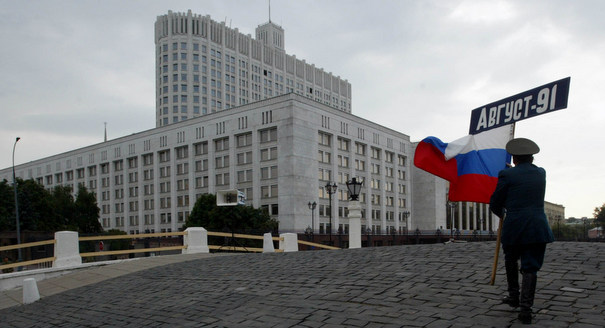
The August revolution put an end to the Soviet Union, but nowadays the Kremlin sees the Soviet Union’s collapse as a disaster and looks back to the Soviet past in an attempt to build continuity. This explains why August 1991 in Russia is an unwanted anniversary that no one wants to remember.
The anniversary of the 1991 August coup and of the defeat of the putsch organizers is an ambiguous date in Russian history, both in the perceptions of public and the ruling class. Looking at the public’s attitudes toward August 1991, people remember it as the moment when civic activeness and democratic spirit reached a peak among hundreds of thousands of people, though mostly in Moscow. These people came out to defend the White House, the building that housed Russian Federation’s government (as opposed to the USSR’s central government )—which they considered the legitimate authority. They rose up against the communist nomenklatura’s attempts to drag the country back into the past. This was mass resistance against the old system. Yet today people also remember how this resistance to the putsch ended. The victory achieved in August 1991 dealt the final blow to communism and the Soviet Union, but out of the “August revolution” a new government based once again on personalized power emerged, headed by Boris Yeltsin. The regime reproduced its old model, only this time without the communist rhetoric, and smaller on the geographical scale. The Soviet Union’s collapse was the price to pay for keeping authoritarianism in place.
August 1991 showed that Russia had fallen into the old trap of the personalized leadership model. People again believed that it would be a leader that would bring them freedom and prosperity.
As for how the elite view August 1991, they recall those events reluctantly and with prejudice.
This is understandable, after all, it was a popular revolt against a hated government. We can hardly expect Putin’s regime to approve such an attitude toward the authorities. Moreover, the August revolution put an end to the Soviet Union, but nowadays the Kremlin sees the Soviet Union’s collapse as a disaster and looks back to the Soviet past in an attempt to build continuity. Putin personally is hardly likely to recall Yeltsin as the hero of those days, despite receiving power from Yeltsin’s hands. The current authorities do not want to be seen as the successors to Yeltsin, who is associated with the wild 1990s and the country’s degradation.
This explains why August 1991 in Russia is an unwanted anniversary that no one wants to remember.
Russia has yet to learn how to separate the people’s noble surge of civic spirit from the actions of the authorities that used this surge in their own interests. That the political class used the popular victory in August 1991 in order to take power for themselves does not in any way lessen the significance of the victory achieved and the heroism of those who came out into the streets in those days.
In remembering these events, Russia needs to learn a lesson from that time, namely, that revolution ends in victory for the people only if the public takes to the streets to defend principles and not another leader with sights set on the Kremlin.

Former Senior Associate, Russian Domestic Politics and Political Institutions Program, Moscow Center
Shevtsova chaired the Russian Domestic Politics and Political Institutions Program at the Carnegie Moscow Center, dividing her time between Carnegie’s offices in Washington, DC, and Moscow. She had been with Carnegie since 1995.
Recent Work
Lilia Shevtsova
Lilia Shevtsova
Carnegie India does not take institutional positions on public policy issues; the views represented herein are those of the author(s) and do not necessarily reflect the views of Carnegie, its staff, or its trustees.