

Commentary
Dmitri Trenin
{
  "authors": [
    "Dmitri Trenin"
  ],
  "type": "commentary",
  "centerAffiliationAll": "",
  "centers": [
    "Carnegie Endowment for International Peace",
    "Carnegie Russia Eurasia Center"
  ],
  "collections": [],
  "englishNewsletterAll": "",
  "nonEnglishNewsletterAll": "",
  "primaryCenter": "Carnegie Russia Eurasia Center",
  "programAffiliation": "",
  "programs": [],
  "projects": [],
  "regions": [
    "Western Europe",
    "Germany"
  ],
  "topics": []
}
Source: Getty
For Europe as a whole to play a strategic role in global affairs it needs to be more integrated internally. A sense of direction will be required, alongside a will to be an independent actor on the world stage, and pay the price.
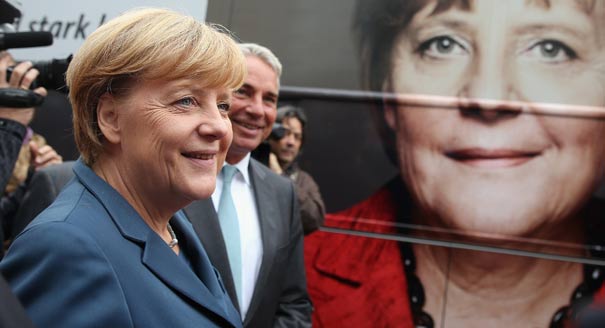
Just before the German elections on Sunday, the main theme of international commentary was leadership—Angela Merkel’s in Germany, and Germany’s in Europe. Indeed, Merkel, the most powerful German politician since Helmut Kohl, has predictably won her third term as chancellor and can rule, in theory, till 2017. Germany itself, long Europe’s most powerful economy, has emerged from the euro crisis also politically peerless—its historical tandem with France consigned to history books. As a result, there have been plenty of expectations and recommendations as to what Merkel and Germany, both seemingly sovereign, could and should do.
These expectations and recommendations need to be tempered. Merkel has lost her Christian Democratic Union’s preferred partner in the governing coalition, the Free Democrats, and will have to seek alliance either with her main rival, the Social Democrats, or the Greens. The way it is constructed, the German political system abhors one-party rule, even for a four-year term. The only time a party (also CDU) was allowed to govern alone was in 1957. Even more fundamentally, the German democracy makes sure that its leaders, on important policy issues, are closely bound by the prevailing popular views. Thus, Germany’s strategic abstention, which my colleague Jan Techau mentioned in his brilliant New York Times piece, is not just Merkel’s choice: it is the current attitude of the German people.
Germany itself is, more than ever before, towering over its partners in the European Union. In Merkel’s second term, which coincided with the euro crisis, Berlin has successfully led the charge toward more financial integration within the EU. Yet, achieving more integration also on the political side, which certainly makes sense, is hampered by a plethora of factors—from the pushback against the unloved Brussels bureaucracy to resilience of the nation state (see Sunday’s success of the new party, Alternative fuer Deutschland, which has polled almost twice as many votes as the unlucky Free Democrats) to national phobias, including anti-German sentiments in parts of Southern Europe.
For Europe as a whole to play a strategic role in global affairs it needs to be more integrated internally, but not only that. A sense of direction will be required, alongside a will to be an independent actor on the world stage, and pay the price. Neither is available, for the time being. As the recent worries, no less so in Germany, about the United States’ pivot to Asia suggest, remaining America’s partner and ward is still the preferred alternative in Europe.
Former Director, Carnegie Moscow Center
Trenin was director of the Carnegie Moscow Center from 2008 to early 2022.
Recent Work
Dmitri Trenin
Dmitri Trenin
Carnegie India does not take institutional positions on public policy issues; the views represented herein are those of the author(s) and do not necessarily reflect the views of Carnegie, its staff, or its trustees.
Foreign ministers from India, France, and Australia recently met (virtually) at the Raisina Dialogue, India’s flagship annual conference on geopolitics and geoeconomics. What can they get done if they work together?


Rudra Chaudhuri, Shibani Mehta
Europe’s huge stakes in the economic stability of Asia, the sea lines of communication connecting Europe and Asia through the Indo-Pacific, and threat of U.S. retrenchment may force Europe to reconsider its role in Asia. Asia needs a robust European contribution to connectivity and security.
C. Raja Mohan, John J. Vater
Pitched as a new Silk Road sweeping from Asia to Europe, China’s enormous Belt and Road Initiative is an ambitious, multinational infrastructure project. Experts from four Carnegie global centers explain other countries’ perspectives.


Paul Haenle, Dmitri Trenin, Alexander Gabuev, …
The period known as the “Emergency” in India—June 1975 to March 1977—is widely recognized as one of the darkest episodes in the nation’s 70-year history.
Rudra Chaudhuri
With an assertive China and uncertainty of U.S. policy under the Trump administration, Europe and India have realized they have much to offer each other.
Garima Mohan