

In The Media
David Rothkopf
{
  "authors": [
    "David Rothkopf"
  ],
  "type": "legacyinthemedia",
  "centerAffiliationAll": "",
  "centers": [
    "Carnegie Endowment for International Peace"
  ],
  "collections": [],
  "englishNewsletterAll": "",
  "nonEnglishNewsletterAll": "",
  "primaryCenter": "Carnegie Endowment for International Peace",
  "programAffiliation": "",
  "programs": [],
  "projects": [],
  "regions": [
    "North America",
    "United States"
  ],
  "topics": [
    "Political Reform"
  ]
}
Source: Getty
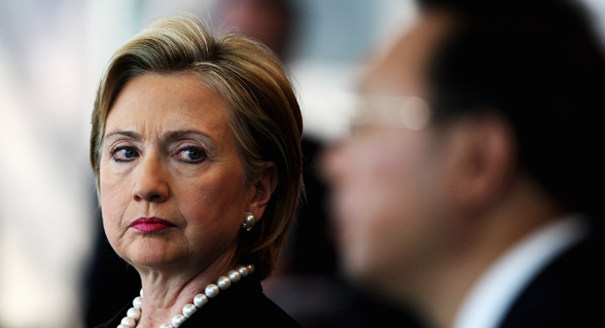
Speculation among political pundits has recently heated up around the idea that newly minted Sen. Elizabeth Warren of Massachusetts might pose a real challenge to Hillary Clinton for the 2016 Democratic presidential nomination.
Source: CNN
Speculation among political "analysts" has recently heated up around the idea that newly minted Sen. Elizabeth Warren of Massachusetts might pose a real challenge to Hillary Clinton for the 2016 Democratic presidential nomination.
Never mind that Warren has zero executive experience, has been in Washington for the blink of an eye and has spent much of her life as an academic -- because of course, that's a formula that seems to have worked for the current occupant of the Oval Office (if not, as at least half the rabid commenters beneath this column will also argue, for the country.)Never mind that she has expressed no interest in the job. Never mind that the election of 2016 is three full years away and that almost anything can happen in that time including, according to a recent study in the journal Nature, many more asteroid strikes than we originally believed possible.
Facts and sound reasoning be damned. Birds gotta fly and pundits gotta pundit. So off we go.
Facts and probabilities don't matter in this kind of demented parlor game.
It's about as useful as debating whether Justin Bieber -- if he were a scientific genius -- would devote himself to particle physics or mapping the human genome. It is a mania driven by the existential anxieties of the commentariat whose "I chatter therefore I am" philosophy implies that if they shut up they cease to exist.
The result is a discussion about nothing, meaning precious little, and with not much to recommend other than its negligible entertainment value. But heck, Twitter reportedly is now worth more than $20 billion; investors have got to have people tweeting about something. It might as well be the debate about whether Warren's anti-Wall Street stance would be tough for Clinton to combat because she may be seen as too close to the establishment or, conversely, whether Warren's financial reform agenda would motivate the fat cats in the financial community to start writing fat checks for Clinton.
Speaking of which, this kind of speculation has not been limited to the Democratic Party. This week, aside from Time magazine's cheap shot on its cover about New Jersey Gov. Chris Christie's girth, we had a nasty comment from the ever-thoughtful Sarah Palin suggesting Christie's weight was an issue because "it's been extreme," and the party of Lincoln locked in a debate over whether one of its most successful governors was too tubby to be president.
No one apparently remembers that William Howard Taft was not only America's only president to be so fat he got stuck in the White House bathtub, but he was also our only chief executive to go on to become the head of a second branch of government as the chief justice.
Of course, I have to admit, Palin once again revealing her intellectual deficits while taking a shot at a fellow Republican's physical attributes is more entertaining than many new shows on television this fall ("Sean Saves the World" and "We Are Men" come to mind), but her remarks are still otherwise without redeeming social value.
So, let's take a collective chill pill, shall we?
Let's admit that all we know about 2016 is that those of us lucky to make it that far will be three years older and that can't be good news for hairlines or waistlines.
Let's admit that it is how the economy is doing, the state of the world and how we feel about outgoing President Barack Obama, and not carefully reasoned arguments by the people who gave us President Hillary Clinton in 2008 that will ultimately decide who the candidates are.
Let's admit that being able to run against Washington will be an advantage, as it has been for every candidate since the 1970s, and that the candidate offering the most optimistic view of America's future is likely to win -- as he or she typically does.
Let's admit that that probably means the Republican candidate will be a current or former governor.
And finally, let's admit that sometimes just because the pundits say something is going to happen doesn't mean it isn't true.
Which is why when all is said and done I still think Hillary Clinton will be the Democratic nominee and the next President of the United States.
This article was originally published by CNN.

Former Visiting Scholar
David Rothkopf was a visiting scholar at the Carnegie Endowment as well as the former CEO and editor in chief of the FP Group.
Recent Work
David Rothkopf
David Rothkopf
Carnegie India does not take institutional positions on public policy issues; the views represented herein are those of the author(s) and do not necessarily reflect the views of Carnegie, its staff, or its trustees.

How is AI reshaping space security, creating governance challenges, and where does international diplomacy stand today?


Tejas Bharadwaj, Almudena Azcárate Ortega

The U.S.–India semiconductor cooperation story is well-stocked with top-level strategic intent. What remains unresolved, however, are some underlying challenges that will determine whether the cooperation actually functions. Three such friction points stand out.

Shruti Mittal

India and the United States are close to concluding a Reciprocal Defense Procurement Agreement (RDPA) that will allow firms from the two countries to sell to each other’s defense establishments more easily. While this may not remedy the specific grievances both sides may have regarding larger bilateral issues, an RDPA could restore some momentum, following the trade deal announcement.

Konark Bhandari

On the last day of the India AI Impact Summit, India signed Pax Silica, a U.S.-led declaration seemingly focused on semiconductors. While India’s accession to the same was not entirely unforeseen, becoming a signatory nation this quickly was not on the cards either.
Konark Bhandari

This piece examines India’s response to U.S. sanctions and tariffs, specifically assessing the immediate market consequences, such as alterations in import costs, and the broader strategic implications for India’s energy security and foreign policy orientation.

Vrinda Sahai