

Commentary
Dmitri Trenin
{
  "authors": [
    "Dmitri Trenin"
  ],
  "type": "legacyinthemedia",
  "centerAffiliationAll": "",
  "centers": [
    "Carnegie Endowment for International Peace",
    "Carnegie Russia Eurasia Center"
  ],
  "collections": [],
  "englishNewsletterAll": "",
  "nonEnglishNewsletterAll": "",
  "primaryCenter": "Carnegie Russia Eurasia Center",
  "programAffiliation": "",
  "programs": [],
  "projects": [],
  "regions": [
    "Russia"
  ],
  "topics": [
    "Foreign Policy"
  ]
}
Source: Getty
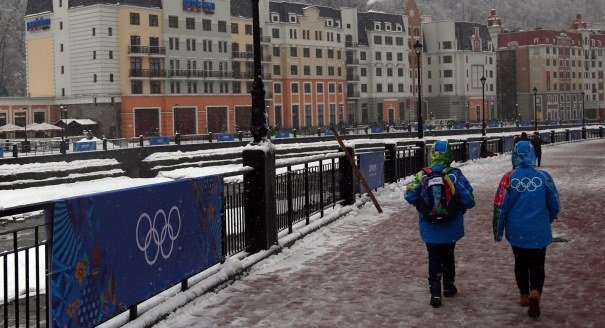
The Sochi Olympics expose the rift between Moscow and the West. At the same time, they highlight Russia’s pivot to Asia and Eurasia.
Source: Global Times
The fact that the Olympic Games can be politicized is not new. However, few such events have been politicized more than the competition now under way in Sochi, Russia.
Led by US President Barack Obama, a number of European leaders have stayed away. The global LGBT community is up in arms against "Putin's Russia." The media in the US and Europe are attacking anything from the Russian penal system to the technical hiccup that has prevented US yoghurt from being shipped to Russia.
The only appropriate parallel is with the Moscow Summer Olympic Games of 1980 which were boycotted by scores of countries in protest of the Soviet invasion of Afghanistan. Yet, the situation now is quite different.Then, the USSR was locked in a superpower confrontation with the US, which permanently threatened world peace. The Soviet Union lorded over Eastern Europe, supported friendly regimes in what was known then as the Third World, and was in the state of a cold war with China.
Yet it was a closed society disciplined by rigorous ideology and a system of internal repression. It feared exposure and was on the defensive. It was led by gerontocrats who looked like they were on loan from Madame Tussaud's. It was a country which had stopped winning and was dreading the coming rendezvous with history.
Present-day Russia is anything but a superpower. It has just gone through the trauma of a regime change, a dissolution of the empire, and a brutal stratification of society. It is still a country in search of a nation.
Its economy is dominated by oil and gas. It has an authoritarian political system albeit legitimized by regular, if often flawed, elections. It is beset by a myriad of problems which the attention geared to the Games has brought under the spotlight: sluggish growth; negative demographics; rampant corruption; terrorism, to name but a few. Russia probably has the worst public image of any major country in the world.
Yet, Russia is also something else. Once it allowed its former borderlands to be on their own, it has managed to stay in one piece.
Terrorism is a problem, but the decade-long insurgency in the Northern Caucasus is history. Russians may largely live off oil and gas, but their standard of living is higher than in several countries now in the EU.
Even more stunningly, Russia has again become active internationally. It does not have huge military presence abroad, keeps no more than a couple of clients, Abkhazia, South Ossetia and Transnistria would probably be the full list, and does not engage in regime change. Still, it managed to halt US efforts at intervention in Syria, through support for both the regime and a diplomatic coup.
President Vladimir Putin has probably relished in being named, last year, the world's most influential politician. He is also the one who is openly defiant of the power of the US. He allowed Edward Snowden to stay in Moscow, when others were eager to hand him off or would close their doors to him. He makes no secret of his worldview which stresses competition, also as a basis for future cooperation.
Russia is also not shy to imply that it listens in on US government officials' conversations, and to post the more colorful exchanges on YouTube.
RT, Russia's TV station for foreign audiences, seeks to do what the Voice of America and others successfully did in the days of the Cold War: expose the flaws of the target country's system.
As for Sochi, it exposes not only the rift between Moscow and the West, but also Russia's pivot to Asia and Eurasia. Putin's senior guests include Chinese President Xi Jinping and Japanese Prime Minister Shinzo Abe.
The presence of a senior North Korean delegation highlights the focus on Asia.
Putin will also be flanked by his neighbors from Belarus and Kazakhstan, which are Russia's partners in the future EU, as well as from Ukraine, which is torn between Russia and Europe.
Putin has his own games in mind, and these will not be over when the Sochi Games comes to an end later this month.
Former Director, Carnegie Moscow Center
Trenin was director of the Carnegie Moscow Center from 2008 to early 2022.
Recent Work
Dmitri Trenin
Dmitri Trenin
Carnegie India does not take institutional positions on public policy issues; the views represented herein are those of the author(s) and do not necessarily reflect the views of Carnegie, its staff, or its trustees.

After the chill in ties between 2020 and 2024 that brought India–China relations to their lowest point in several decades, the two countries have engaged each other afresh. This paper argues that there are predominantly four imperatives guiding India’s approach to China, and they exist in an order of priority.

Saheb Singh Chadha

This piece argues that India’s central challenge is not managing a single flashpoint but resolving the underlying tension between expansion and institutional coherency of the BRICS grouping.

Vrinda Sahai

A partnership between India, a country of subcontinental size, and Africa, a continent of fifty-four countries, may seem asymmetric until one notes that both are home to nearly the same number of people—1.4 billion. This essay spells out the existing challenges to the partnership, its optimal potential, and the possible pathways to realize it over the next quarter-century.

Rajiv Bhatia

The India–EU Free Trade Agreement (FTA) is shaping up to be one of the most consequential trade negotiations, both economically and strategically. But, what’s in the agreement, what’s missing, and what will determine its success in the years ahead
Vrinda Sahai, Nicolas Köhler-Suzuki

Trump 2.0 has unsettled India’s external environment—but has not overturned its foreign policy strategy, which continues to rely on diversification, hedging, and calibrated partnerships across a fractured order.



Milan Vaishnav, ed., Sameer Lalwani, Tanvi Madan, …