
• Research
  • About
  • Experts
Carnegie India logoCarnegie lettermark logo
AI
{
  "authors": [
    "Alexandra McLees"
  ],
  "type": "commentary",
  "centerAffiliationAll": "",
  "centers": [
    "Carnegie Endowment for International Peace",
    "Carnegie Russia Eurasia Center"
  ],
  "collections": [],
  "englishNewsletterAll": "",
  "nonEnglishNewsletterAll": "",
  "primaryCenter": "Carnegie Endowment for International Peace",
  "programAffiliation": "",
  "programs": [],
  "projects": [],
  "regions": [
    "Russia",
    "Eastern Europe",
    "Ukraine"
  ],
  "topics": [
    "Political Reform",
    "Economy",
    "Trade",
    "Foreign Policy"
  ]
}

Source: Getty

Commentary

Extreme Makeover: Ukraine Oligarch Edition

Ukrainian oligarchs face a very real threat of seeing parts of their business empires disrupted by a political crisis over which they have no control.

Link Copied
By Alexandra McLees
Published on Mar 20, 2014

It’s a tough time to be a Ukrainian oligarch.

The March 13 arrest of Dmytro Firtash, a prominent Ukrainian oligarch, in response to a request from FBI, has been portrayed in dramatic terms. “An absolutely seismic event,” explained Standard Bank’s Tim Ash. Thanks to his central role in the country’s lucrative and shadowy gas trade, Firtash has been a key player in Ukraine’s notoriously corrupt political scene for more than a decade.

Two other oligarchs, Serhiy Taruta of Donetsk and Ihor Kolomoysky of Dnipropetrovsk, have been appointed as governors to help the new authorities contend with the dual threat of separatism and a possible Russian invasion. These jobs probably sounded a lot better on paper: following riots that left two dead and a dozen critically injured in Donetsk, the City Council called last weekend for a referendum on the status of the future of the Donbas region.

After the fall of President Victor Yanukovych’s government, most of Ukraine’s oligarchs were quick to change their tune, making sweeping statements appealing to the general public about the need for unity, strong anti-corruption measures, and rule of law. Two of Ukraine’s two wealthiest men, Rinat Akhmetov and Viktor Pinchuk, have tried to demonstrate their loyalty to the revolution and to portray the interdependence of business and government in a positive light. (Pinchuk caveated his comments a bit, saying “in such times in Ukraine big business can play a role temporarily in government.”)

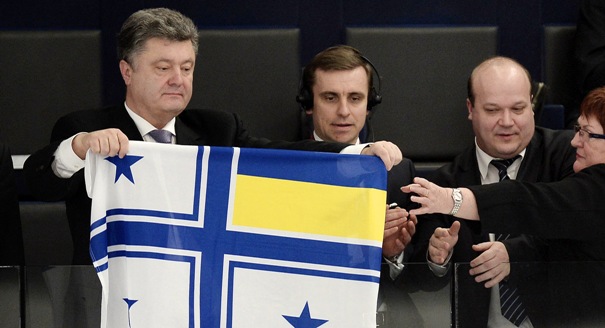
The sharp deterioration in ties with Moscow puts these figures in a very awkward spot. Several Ukrainian oligarchs depend on access to the Russian market for their livelihood. When Moscow tried to apply pressure on Kyiv last year not to sign the Association Agreement and DCFTA with the European Union, it picked its targets very carefully. First Pinchuk’s steel company Interpipe was singled out via the cancellation of favorable import quotas that limited access to the Russian market. Then there was the ban on popular sweets from factories owned by Petro Poroshenko, a possible candidate in the upcoming presidential election set for May.

Now, with Moscow fomenting instability and inter-ethnic tensions in the country’s most economically dynamic regions, things could get even worse. Ukrainian oligarchs face a very real threat of seeing parts of their business empires disrupted by a political crisis over which they have no control. The regulatory body of the Russian-controlled Customs Union is hiking import tariffs for a range of pipes, a move that could cost Pinchuk hundreds of millions of dollars in new losses. (The Russian market accounted for 25-30 percent of Interpipe’s output last year). While no hard data has been released, it seems likely that two-way trade between Russia and Ukraine will be among the first casualties of the recent breakdown in relations. The game is also changing in Kyiv where sweeping lustration proposals could completely exclude figures who served under Yanukovych from government positions.

Deep-seated corruption and a fractious political culture have given Ukraine’s oligarchs plenty of room to survive and even thrive. The sudden disappearance of Viktor Yanukovych and his rapacious “Family” has created new political space and opportunities for these figures to exploit. But the growing gap between Kyiv and Moscow is a different matter entirely. Ukraine’s oligarchs may yet be able once again to protect their financial and political interests. Or the conflict may rip them in half. Only time will tell.

About the Author

Alexandra McLees

Former Junior Fellow, Russia and Eurasia and Energy and Climate Programs

Alexandra McLees
Former Junior Fellow, Russia and Eurasia and Energy and Climate Programs
Political ReformEconomyTradeForeign PolicyRussiaEastern EuropeUkraine

Carnegie India does not take institutional positions on public policy issues; the views represented herein are those of the author(s) and do not necessarily reflect the views of Carnegie, its staff, or its trustees.

More Work from Carnegie India

  • Article
    India’s Press Note 3 Gamble: Opening the FDI Door to China

    On March 10, 2026, India’s Union Cabinet approved amendments to Press Note 3, a regulation that mandated government approval on all foreign direct investment (FDI) from countries sharing a land border with India. This amendment raises questions primarily about whether its stated benefits will materialize and if the risks have been adequately weighed. This piece will address the same.

      Konark Bhandari

  • Commentary
    The Impact of U.S. Sanctions and Tariffs on India’s Russian Oil Imports

    This piece examines India’s response to U.S. sanctions and tariffs, specifically assessing the immediate market consequences, such as alterations in import costs, and the broader strategic implications for India’s energy security and foreign policy orientation.

      Vrinda Sahai

  • Paper
    India-China Economic Ties: Determinants and Possibilities

    This paper examines the evolution of India-China economic ties from 2005 to 2025. It explores the impact of global events, bilateral political ties, and domestic policies on distinct spheres of the economic relationship.

      Santosh Pai

  • Commentary
    NISAR Soars While India-U.S. Tariff Tensions Simmer

    On July 30, 2025, the United States announced 25 percent tariffs on Indian goods. While diplomatic tensions simmered on the trade front, a cosmic calm prevailed at the Sriharikota launch range. Officials from NASA and ISRO were preparing to launch an engineering marvel into space—the NASA-ISRO Synthetic Aperture Radar (NISAR), marking a significant milestone in the India-U.S. bilateral partnership.

      Tejas Bharadwaj

  • Commentary
    TRUST and Tariffs

    The India-U.S. relationship currently appears buffeted between three “Ts”—TRUST, Tariffs, and Trump.

      Arun K. Singh

Get more news and analysis from
Carnegie India
Carnegie India logo, white
Unit C-4, 5, 6, EdenparkShaheed Jeet Singh MargNew Delhi – 110016, IndiaPhone: 011-40078687
  • Research
  • About
  • Experts
  • Projects
  • Events
  • Contact
  • Careers
  • Privacy
  • For Media
Get more news and analysis from
Carnegie India
© 2026 Carnegie Endowment for International Peace. All rights reserved.