

In The Media
Lilia Shevtsova
{
  "authors": [
    "Lilia Shevtsova"
  ],
  "type": "legacyinthemedia",
  "centerAffiliationAll": "",
  "centers": [
    "Carnegie Endowment for International Peace",
    "Carnegie Russia Eurasia Center"
  ],
  "collections": [],
  "englishNewsletterAll": "",
  "nonEnglishNewsletterAll": "",
  "primaryCenter": "Carnegie Russia Eurasia Center",
  "programAffiliation": "",
  "programs": [],
  "projects": [],
  "regions": [
    "Russia",
    "Eastern Europe",
    "Ukraine"
  ],
  "topics": [
    "Political Reform",
    "Foreign Policy"
  ]
}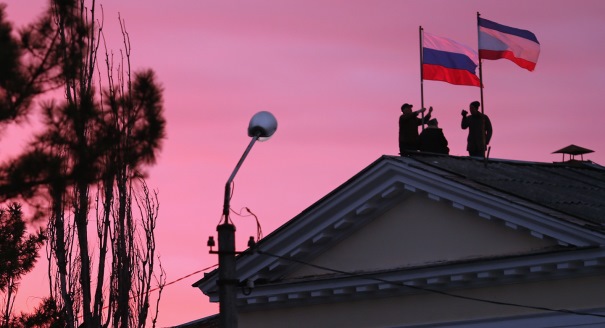
Source: Getty
All of Putin’s actions, such as annexation of Crimea, trying to suffocate Ukraine, and trying to contain the United States and West in general, are a response to his domestic agenda. To survive, Putin wants to return to the old militaristic Russia and to become a war president.
Source: NPR’s All Things Considered
ROBERT SIEGEL, HOST: What motivates Vladimir Putin? And how should the West respond to him? Well, we're going to pose the first question now to political scientist Lilia Shevtsova. She's with the Carnegie Moscow Center, and she's in Washington this week. Welcome to the program.
LILIA SHEVTSOVA: Thank you for having me.
SIEGEL: In a nutshell, how do we best understand Vladimir Putin's annexation of Crimea?
SHEVTSOVA: Well, Robert, I would say that everything Putin does - annexation of Crimea, trying to suffocate Ukraine, trying to contain the United States and West in general - everything is a servant to domestic agenda. The problem is that he wants to survive, and he understands that he cannot survive when Russia has a dissent within the society, when Russia has Internet community. So he would like to return to the old, traditional metrics and to Russia turning into the war nation and him turning into a war president.SIEGEL: Into a militaristic society.
SHEVTSOVA: Absolutely.
SIEGEL: But how do you square that with what we hear as his popularity in Russia? He seems to be as secure as any leader of a major country in the world today.
SHEVTSOVA: And this is natural. And he understands. He's very savvy. He's very shrewd. And he's a great political technologist. He is rational, despite of the fact that Angela Merkel allegedly said that he's out of this world. He understands that war can make him really popular.
SIEGEL: Well, here are two possibilities. Number one, Crimea was, as they say, low-hanging fruit. It had only been connected to Ukraine for a few decades. There weren't that many Ukrainians there and it was already an autonomous republic within Ukraine. Other parts of Ukraine would be much more difficult to annex. So he'll stand pat with Crimea. Or will he try to take more of Ukraine?
SHEVTSOVA: Well, it seems to me that Crimea for him is not that important, and land grab is not that important. Even Ukraine is not that important. What is important is to create a permanent zone instability around and to have, constantly, enemies whom he would like to contain, to restrain. That means he cannot stop. He is in a bobsled mode. He has to run down without thinking about the consequences.
SIEGEL: If, in fact, Putin is, as you say, now in bobsled mode, he's headed down the track, you're saying that doesn't necessarily mean he will invade Ukraine. It means he will endeavor to destabilize the region around him in such a way so that a powerful Russia is the only force that can be counted on for relative stability. Do I have that right?
SHEVTSOVA: Yes. You have it right. And there are other means to destabilize the whole system of the international relations. In fact, he has unraveled post-Cold War settlement. And he cannot return the world to the post-Yalta settlement because his major goal is there are no rules of the game, or I am allowed to break the rules of the game.
SIEGEL: Lilia Shevtsova of the Carnegie Moscow Center. Thank you very much for talking with us.
SHEVTSOVA: Thank you.
Former Senior Associate, Russian Domestic Politics and Political Institutions Program, Moscow Center
Shevtsova chaired the Russian Domestic Politics and Political Institutions Program at the Carnegie Moscow Center, dividing her time between Carnegie’s offices in Washington, DC, and Moscow. She had been with Carnegie since 1995.
Recent Work
Lilia Shevtsova
Lilia Shevtsova
Carnegie India does not take institutional positions on public policy issues; the views represented herein are those of the author(s) and do not necessarily reflect the views of Carnegie, its staff, or its trustees.

After the chill in ties between 2020 and 2024 that brought India–China relations to their lowest point in several decades, the two countries have engaged each other afresh. This paper argues that there are predominantly four imperatives guiding India’s approach to China, and they exist in an order of priority.

Saheb Singh Chadha

This piece argues that India’s central challenge is not managing a single flashpoint but resolving the underlying tension between expansion and institutional coherency of the BRICS grouping.

Vrinda Sahai

A partnership between India, a country of subcontinental size, and Africa, a continent of fifty-four countries, may seem asymmetric until one notes that both are home to nearly the same number of people—1.4 billion. This essay spells out the existing challenges to the partnership, its optimal potential, and the possible pathways to realize it over the next quarter-century.

Rajiv Bhatia

The India–EU Free Trade Agreement (FTA) is shaping up to be one of the most consequential trade negotiations, both economically and strategically. But, what’s in the agreement, what’s missing, and what will determine its success in the years ahead
Vrinda Sahai, Nicolas Köhler-Suzuki

Trump 2.0 has unsettled India’s external environment—but has not overturned its foreign policy strategy, which continues to rely on diversification, hedging, and calibrated partnerships across a fractured order.



Milan Vaishnav, ed., Sameer Lalwani, Tanvi Madan, …