Source: Politico
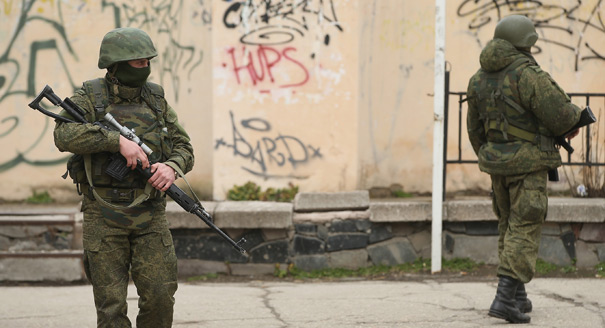
Vladimir Putin’s surprise decision to ask for a Russian-style War Powers resolution from his parliament dramatically ups the ante in the Ukraine crisis and positions Russia for full-scale military action. It also signals Putin’s commitment to use all necessary means—many of which have already been in use in Crimea—to keep Ukraine in Russia’s orbit. If Putin follows through on his threat to invade Ukraine, he will signal yet again that the post-Cold War era that began with the “Velvet Revolutions” of 1989 has ended. The damage to Russia’s relations with the West will be deep and lasting, far worse than after the Russian-Georgian war. Think 1968, not 2008.
President Barack Obama’s handling of the Western response to the Ukraine crisis is now arguably the biggest test of his presidency. It is a crisis that no one anticipated and that the West has been frustratingly divided over since the European Union’s original, misguided attempt to force Ukraine to make an either-or choice about going east or west. For too long we have heard U.S. officials says repeatedly, “The Europeans are taking the lead.” That needs to stop.
Russia rolled over tiny Georgia with ease and the military phase of the crisis ended quickly. Ukraine will pose a much bigger challenge to Russia militarily, and the crisis will be more protracted and take a far less predictable path. The country is badly divided, of course, but anti-Russian sentiments are strong and undoubtedly growing in many parts of Ukraine. The forces of Ukrainian nationalism are on the rise throughout much of the country, provoked by Moscow’s disregard for Ukrainian sovereignty and irresponsible attempts to portray the Maidan revolution as a fascist triumph—patently offensive to a nation that suffered so much during World War II.
We should not take for granted that even in Ukraine’s east and south, where so many ethnic Russians live, that a military occupation will be a cakewalk. Many local residents surely do not want to become Russia’s 90th province. In Ukraine’s west, where the Soviet Army had to fight a protracted counterinsurgency campaign after WWII against Ukrainian nationalist guerrillas, armed resistance is certain to be strong. During the revolution, many army depots and armories were overrun so there are more weapons floating around Ukraine than at any point since 1991. And the leadership of the main instruments of coercion – the Army, the Interior Ministry, and the intelligence service – are all in the hands of political leaders with strong Ukrainian nationalist credentials.
Any invasion—which is what it would be—of a vast country of 46 million in the heart of Europe, sharing borders with NATO allies Poland, Hungary, Slovakia and Romania, would pose a major security challenge for the United States and other key European powers. Even without further Russian action, allies such as the Baltic countries will be seeking U.S. reassurance. Lithuania has already asked for Article IV consultations under the NATO Treaty in response to a clear threat to its security. These countries likely will also ask for hard reassurances—such as deployments of U.S. and other allied troops and equipment on their territory—as Turkey did in 2012 when Syria shot down a Turkish jet. They will also need help to shore up their eastern borders and prepare for possible flows of refugees from Ukraine. The Baltic states will probably ask for similar reassurances. One can also expect cyber attacks and intrusions, false alarms and an atmosphere of tension the likes of which have not been seen since the worst days of the Cold War.
Post-revolutionary Ukraine is in bad shape. Its economy is wrecked. Government institutions broke down completely after the Yanukovych government disappeared overnight. Corruption and criminality, Ukraine’s twin scourges, remain basically intact. Thanks to Russia’s unexpected moves in Crimea, the West will now have to put Humpty Dumpty back together on its own. These tasks demand that the president designate a senior point-person for coordinating Ukraine policy in all its complexity. Deputy Secretary of State William Burns, one of America’s ablest diplomats and an old Russia hand, is the obvious choice.
The break in the West’s relations with Russia is bound to be deep and lasting. The G-8 will be its first casualty with the Western powers likely to reconstitute the G-7 in its original form as a direct rebuff to Putin. Other important international mechanisms —the U.N. Security Council, ad hoc diplomatic efforts on Syria, the P5+1 process on Iran, the Six-Party talks on North Korea, and so on—will be filled with renewed acrimony and dysfunction. Some may break down entirely. Inevitably, there will be congressional calls for sanctions against Russia, which the White House will be hard-pressed to resist no matter how much it may want to preserve the shreds of cooperation with Russia on Iran, Syria or Afghanistan. The West and Russia are in uncharted waters.
This article was originally published in Politico.