

Research
- +10
Rosa Balfour, Frances Z. Brown, Yasmine Farouk, …
{
  "authors": [
    "Moisés Naím"
  ],
  "type": "legacyinthemedia",
  "centerAffiliationAll": "",
  "centers": [
    "Carnegie Endowment for International Peace"
  ],
  "collections": [],
  "englishNewsletterAll": "",
  "nonEnglishNewsletterAll": "",
  "primaryCenter": "Carnegie Endowment for International Peace",
  "programAffiliation": "",
  "programs": [],
  "projects": [],
  "regions": [
    "North America",
    "United States"
  ],
  "topics": [
    "Economy",
    "Trade",
    "Climate Change"
  ]
}
Source: Getty
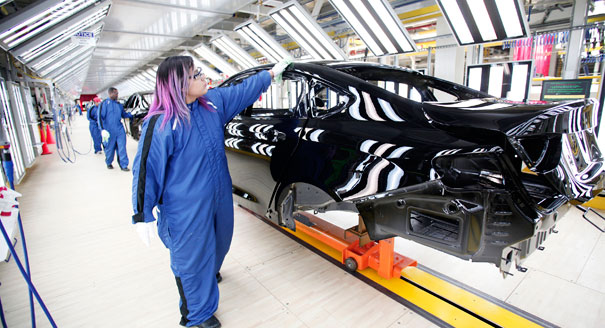
The combination of lower energy prices, innovative information technologies, and advances in robotics and materials science are powering a manufacturing revolution that will reinvigorate the U.S. economy and make many of its industrial sectors the most competitive in the world.
Source: Atlantic
Hardly a day goes by without an article predicting, lamenting, or celebrating America's decline. The turmoil in Crimea and Syria, the polarized and frequently gridlocked U.S. political system, the deepening income and wealth inequalities in the United States, and the growing clout of rivals like China and Russia are all offered as proof of waning American power.
These weaknesses surely exist, and some—like mounting economic inequality—are truly alarming. But the doomsayers often fail to see the ways in which America is gaining rather than losing global influence. And nowhere is this truer than the manufacturing sector. The combination of lower energy prices, innovative information technologies, and advances in robotics and materials science are powering a manufacturing revolution that will reinvigorate the U.S. economy and make many of its industrial sectors the most competitive in the world.
According to Martin Baily and Barry Bosworth of the Brookings Institution, for the past 50 years industrial production in the U.S. has grown at the same rate or even faster than the economy as a whole. This means that contrary to conventional wisdom, manufacturing has not lost ground in terms of its importance in the U.S. economy. Until 2011, when China inched slightly ahead, the United States boasted the world’s largest manufacturing sector, and it continues to be an industrial powerhouse. The general impression that factories in America are disappearing may be true for some sectors and in some regions and cities, but it is inaccurate in the aggregate. We perceive an industry in decline because the great strides that have been made in efficiency and productivity have not generated a proportional increase in jobs. More is being produced, and fewer workers are needed. Between 2000 and 2010, the United States lost 5.7 million manufacturing jobs.One reason for these job losses is the economic crisis that began in 2008. But another, more fundamental explanation is the manufacturing industry’s uneven growth. Most of the expansion of U.S. manufacturing has taken place in one specific sector: computers and electronics, while the 90 percent of manufacturing outside this branch—automobiles, aviation, appliances or chemicals, for example—is showing slower growth.
Another issue is the trade deficit. Since the early 1980s, the United States has been importing more manufactured goods than it exports. And in the past decade, most of these imports have come from Asia, and mainly from China. The numbers are striking. In 2000, more than 75 percent of the total U.S. trade deficit in manufactured goods was comprised of the gap between what it imported and exported to Asia. By 2012, this difference represented roughly 100 percent of the deficit—meaning that Asia is the only region in the world from which the U.S. imports more manufactured goods than it exports. Furthermore, while in 2000 trade with China accounted for one-third of America’s manufacturing trade deficit with Asia, by 2012 that share had ballooned to an enormous 72 percent.
The good news is that American manufacturing is on the verge of dramatic change. According to Baily and Bosworth, major revolutions are underway in energy, robotics, materials, and applied information technology.
The changes taking place in the energy sector are huge. The United States has the second-largest shale-gas reserves in the world and has pioneered the development of new technologies to exploit it. Fracking, in which gas and oil is extracted from shale rocks by fracturing them, is driving an energy boom in the U.S. that will soon lower natural-gas prices to well below the world average, thus giving American manufacturers a unique competitive advantage.
The automation and robotization of manufacturing plants will further increase efficiency and precision. As robotic capabilities continue to expand, the cost to produce them is shrinking. The downside, of course, is that this will have serious repercussions for job creation, as these machines are likely to displace many workers. America's dominance in computing and electronics gives it a unique edge in the automation of manufacturing processes.
The emergence of new materials that combine nanotechnology and biotechnology offer the promise of products and production processes that other countries cannot easily replicate. As Baily and Bosworth write: “Applying the technology to carbon nanotubes and graphene has allowed the creation of high-performance transistors and ultra-strong and light composite materials. Fluorescent nano-particles are used in biological labeling and solar cells. In biotechnology, nanoenabled technologies allow more rapid diagnosis of illnesses, detect contaminants, and provide glucose monitoring and many other applications.”
And finally, innovative uses of the Internet and other information technologies (Big Data, 3-D printing, and growing communication between devices, also known as the “Internet of things”) are poised to transform the manufacturing industry. Companies like General Electric are already relocating operations from Asia to Silicon Valley to take advantage of the proximity to information-technologies clusters. And they’ll reap great savings in transport costs from Asia in addition to benefiting from lowered energy costs at home.
Not everything is on the right track in the United States. But in some areas, it’s a mistake to describe America as a power in decline.

Distinguished Fellow
Moisés Naím is a distinguished fellow at the Carnegie Endowment for International Peace, a best-selling author, and an internationally syndicated columnist.
Recent Work



Rosa Balfour, Frances Z. Brown, Yasmine Farouk, …
Moisés Naím
Carnegie India does not take institutional positions on public policy issues; the views represented herein are those of the author(s) and do not necessarily reflect the views of Carnegie, its staff, or its trustees.

On the last day of the India AI Impact Summit, India signed Pax Silica, a U.S.-led declaration seemingly focused on semiconductors. While India’s accession to the same was not entirely unforeseen, becoming a signatory nation this quickly was not on the cards either.

Konark Bhandari

This piece examines India’s response to U.S. sanctions and tariffs, specifically assessing the immediate market consequences, such as alterations in import costs, and the broader strategic implications for India’s energy security and foreign policy orientation.

Vrinda Sahai

This paper examines the evolution of India-China economic ties from 2005 to 2025. It explores the impact of global events, bilateral political ties, and domestic policies on distinct spheres of the economic relationship.

Santosh Pai

On July 30, 2025, the United States announced 25 percent tariffs on Indian goods. While diplomatic tensions simmered on the trade front, a cosmic calm prevailed at the Sriharikota launch range. Officials from NASA and ISRO were preparing to launch an engineering marvel into space—the NASA-ISRO Synthetic Aperture Radar (NISAR), marking a significant milestone in the India-U.S. bilateral partnership.

Tejas Bharadwaj

The India-U.S. relationship currently appears buffeted between three “Ts”—TRUST, Tariffs, and Trump.

Arun K. Singh