• Research
  • About
  • Experts
Carnegie India logoCarnegie lettermark logo
AI
{
  "authors": [
    "Akio Kawato"
  ],
  "type": "commentary",
  "centerAffiliationAll": "",
  "centers": [
    "Carnegie Endowment for International Peace",
    "Carnegie Russia Eurasia Center"
  ],
  "collections": [],
  "englishNewsletterAll": "",
  "nonEnglishNewsletterAll": "",
  "primaryCenter": "Carnegie Russia Eurasia Center",
  "programAffiliation": "",
  "programs": [],
  "projects": [],
  "regions": [
    "East Asia",
    "China",
    "Japan",
    "Russia",
    "Eastern Europe",
    "Ukraine"
  ],
  "topics": [
    "Economy",
    "Trade",
    "Climate Change",
    "Security",
    "Military",
    "Foreign Policy"
  ]
}

Source: Getty

Commentary
Carnegie Russia Eurasia Center

East Asia Is No Less Complex Than Ukraine: On President Putin’s Impending China Trip

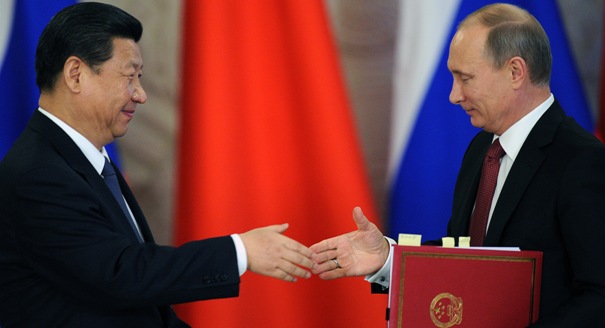
If the Kremlin allies with China too closely, it will not only estrange Russia from most of Asian countries, but also may provoke China’s appetite to gobble the newly-born child of Russia, the Eurasian Union.

Link Copied
By Akio Kawato
Published on May 16, 2014

President Vladimir Putin is planning an official visit to China in late May. On its sidelines, he may attend the summit of CICA (Conference on Interaction and Confidence Building Measures in Asia), to be held in Shanghai on May 20-21. Offshore of Shanghai, the Russian Navy will show off its muscle in a joint exercise with the Chinese (to defend the Chinese coastline?). For China, it will be a wonderful occasion to demonstrate that China and Russia are “in charge” of the security in eastern Eurasia. For Russia, it will be an opportune moment to show to the world that, despite Ukraine, Russia has a dear friend by the name of China, the second largest (purportedly the first in real purchasing power) economy in the world with a 1.4 billion population.

But things in East Asia are no less complex than in Ukraine. In Kiev, the rightist radicals, who acted not necessarily under American official guidance, irreparably complicated the situation. In East Ukraine, the “pro-Russian” radicals ignored Putin’s suggestion and held referenda on May 11, whereas many polls suggest that the majority of citizens in East Ukraine are not eager for merger with Russia… things are murky there.

In East Asia, too, faire is foule, and foule is faire. Whether China versus the United States, China versus Japan or India versus China, although they are portrayed as staunch political and military rivals, they share large and close economic relations. Vietnam and the Philippines, which have now heated territorial disputes with China, also actively promote economic relations with China. This means that if Russia overly takes sides with China in political and security affairs, it will estrange, if not antagonize, major countries in East Asia and will drive Russia even closer to China.

Russia may think that Asian nations anyway need friendship with Russia for the latter’s oil and gas. But even if China monopolizes the Russian natural resources, Asians will not be terrified, because China’s need for oil and gas elsewhere will be eased, and the global oil and gas prices may fall. Even Japan, which allegedly thirsts for oil and gas because of the total closure of her nuclear power plants, will not grumble; her import of oil and natural gas has not increased in physical volume after the great earthquake in 2011, and the Japanese now spend less electricity.

Therefore, if Russia allies with China too closely, it will not only estrange Russia from most of Asian countries, but also may provoke China’s appetite to gobble the newly-born child of Russia, the Eurasian Union.

In the immediate wake of Putin’s China visit, a chain of important events will follow: the presidential election in Ukraine (it may well be postponed) on May 25 and the pompous inauguration of the “Eurasian Union” on May 29. This means that Russia’s behavior in coming few weeks will largely determine her position in East Asia for years. An intricate balancing act is needed for Russia.

Russia may be able to rightly gauge the importance of Japan. But it tends to underestimate the power which the ASEAN yields. The aggregate GDP of the ASEAN countries (2.1 trillion dollars in 2011) is on par with Russia, and the RCEP (Regional Comprehensive Economic Partnership) under their auspices may become a basic framework for international trade in East Asia.

In East Asia today, along with the 19th-century-style imperialist confrontation, 21st-century-type economic integration is proceeding. How to deal with this region will be a good litmus test to measure Russia’s modernity.

About the Author

Akio Kawato

Writer

Akio Kawato is a former Japanese diplomat and blogger.

Akio Kawato
Writer
EconomyTradeClimate ChangeSecurityMilitaryForeign PolicyEast AsiaChinaJapanRussiaEastern EuropeUkraine

Carnegie India does not take institutional positions on public policy issues; the views represented herein are those of the author(s) and do not necessarily reflect the views of Carnegie, its staff, or its trustees.

More Work from Carnegie India

  • Commentary
    The Impact of U.S. Sanctions and Tariffs on India’s Russian Oil Imports

    This piece examines India’s response to U.S. sanctions and tariffs, specifically assessing the immediate market consequences, such as alterations in import costs, and the broader strategic implications for India’s energy security and foreign policy orientation.

      Vrinda Sahai

  • Article
    Military Lessons from Operation Sindoor

    The India-Pakistan conflict that played out between May 6 and May 10, 2025, offers several military lessons. This article presents key takeaways from Operation Sindoor and breaks down how India’s preparations shaped the outcome and what more is needed to strengthen future readiness.

      Dinakar Peri

  • Book
    India and the Sovereignty Principle: The Disaggregation Imperative

    This book offers a comprehensive analysis of India's evolving relationship with sovereignty in a complex global order. Moving beyond conventional narratives, it examines how the sovereignty principle shapes India's behavior across four critical domains—from traditional military power to contemporary data governance.

      Rudra Chaudhuri, Nabarun Roy

  • Paper
    India-China Economic Ties: Determinants and Possibilities

    This paper examines the evolution of India-China economic ties from 2005 to 2025. It explores the impact of global events, bilateral political ties, and domestic policies on distinct spheres of the economic relationship.

      Santosh Pai

  • Commentary
    NISAR Soars While India-U.S. Tariff Tensions Simmer

    On July 30, 2025, the United States announced 25 percent tariffs on Indian goods. While diplomatic tensions simmered on the trade front, a cosmic calm prevailed at the Sriharikota launch range. Officials from NASA and ISRO were preparing to launch an engineering marvel into space—the NASA-ISRO Synthetic Aperture Radar (NISAR), marking a significant milestone in the India-U.S. bilateral partnership.

      Tejas Bharadwaj

Get more news and analysis from
Carnegie India
Carnegie India logo, white
Unit C-4, 5, 6, EdenparkShaheed Jeet Singh MargNew Delhi – 110016, IndiaPhone: 011-40078687
  • Research
  • About
  • Experts
  • Projects
  • Events
  • Contact
  • Careers
  • Privacy
  • For Media
Get more news and analysis from
Carnegie India
© 2026 Carnegie Endowment for International Peace. All rights reserved.