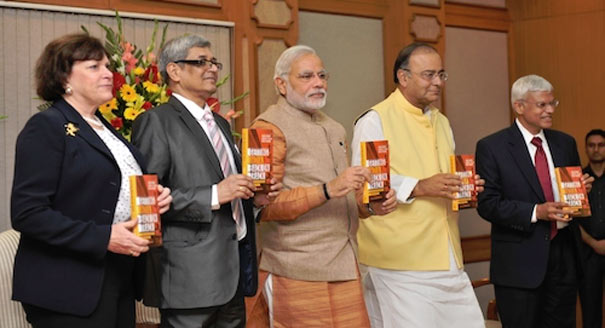
Prime Minister Modi Launches Getting India Back on Track
Two weeks after becoming India’s prime minister, Narendra Modi today launched the book Getting India Back on Track: An Action Agenda for Reform at 7 Race Course Road.
Edited by Bibek Debroy, Ashley J. Tellis, and Reece Trevor, Getting India Back on Track (published by the Carnegie Endowment for International Peace and Random House India) contains analyses and prescriptions from some of India’s most accomplished scholars on how to return the country to a path of high, sustained growth and international success.
Speaking to reporters and a small number of invited guests, the prime minister welcomed what he called "the inputs of intellectual think tanks" like Carnegie and said that policymaking should incorporate input from think tanks to help generate better policy frameworks.
Photo Credit: Press Trust of India Arun Jaitley, minister for finance, corporate affairs, and defense, said "I am going to read every part of this book. It will help us to do our job better. The book is well- timed and the title is apt."
The book’s foreword is written by Ratan N. Tata, chairman of Tata Trusts, who is a member of Carnegie’s board of trustees. Many of the book’s contributors attended today’s event, including Carnegie Board Member Sunil Mittal, chairman and group CEO of Bharti Enterprises.
“The election of Narendra Modi shows the importance of getting India back to the high growth levels we enjoyed at the beginning of this century,” Mittal said. “This book is a unique collection of ideas for how to do that from some of India’s foremost experts.”
The Carnegie Endowment for International Peace is a 100-year-old, nonpartisan think tank with research centers in Beijing, Beirut, Brussels, Moscow, and Washington. Its mission is to advance the cause of peace through analysis, development of fresh policy ideas, and direct engagement with decisionmakers in government, business, and civil society. It plans to open a New Delhi center in the near future.
“India is a very important power in the world and an increasingly influential player on the global stage,” said Carnegie President Jessica T. Mathews, who attended today’s event. “I am delighted and honored that Prime Minister Modi agreed to launch this book. We are looking forward to opening a Carnegie center in New Delhi soon so that we can contribute our scholars’ ideas and analysis to India’s rich intellectual landscape.”
Carnegie India does not take institutional positions on public policy issues; the views represented herein are those of the author(s) and do not necessarily reflect the views of Carnegie, its staff, or its trustees.
In any defense establishment, change is an ongoing process. However, despite the best of intentions, existing bureaucracies, bound by habit and years of socialization, have their limits in implementing transformative change.
As AI grows more sophisticated, as the supply chains that power it become more contested, and as access to frontier models becomes geopolitically charged, India must begin to ask a different set of questions. Not what applications it can build on someone else’s infrastructure but what the world needs.
The Indian Ocean Region hosts one of the densest concentrations of subsea cables in the world. Yet, despite accounting for a significant share of global internet traffic, India’s participation remains limited.
After the chill in ties between 2020 and 2024 that brought India–China relations to their lowest point in several decades, the two countries have engaged each other afresh. This paper argues that there are predominantly four imperatives guiding India’s approach to China, and they exist in an order of priority.