

Commentary
Dmitri Trenin
{
  "authors": [
    "Dmitri Trenin"
  ],
  "type": "commentary",
  "centerAffiliationAll": "",
  "centers": [
    "Carnegie Endowment for International Peace",
    "Carnegie Russia Eurasia Center"
  ],
  "collections": [],
  "englishNewsletterAll": "",
  "nonEnglishNewsletterAll": "",
  "primaryCenter": "Carnegie Russia Eurasia Center",
  "programAffiliation": "",
  "programs": [],
  "projects": [],
  "regions": [
    "North America",
    "United States",
    "Russia"
  ],
  "topics": [
    "Foreign Policy"
  ]
}
Source: Getty
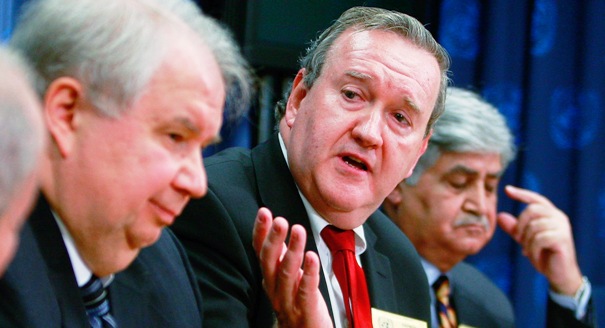
John Mroz, who died earlier this month, was the founder of the EastWest Institute, a novel concept of a “think and do tank” which sought to organize Track 2 and Track 1.5 discussions across the Cold War divide. Mroz has departed precisely at the moment when the need for his services has peaked again.
John Mroz, who died earlier this month, was well known to those Russians who, over the last three decades, participated in public policy exchanges with their American colleagues. Back in 1980 Mroz founded the EastWest Institute, a novel concept of a "think and do tank" which sought to organize Track 2 and Track 1.5 discussions across the Cold War divide.
It would be correct to say that John himself was a global institution. His ebullient energy allowed him to reach the high and mighty around the world and engage them in the cause of greater international security. The issues he took up ranged from Israel-PLO dialogue to Germany's reunification to U.S.-Russian cooperation on ballistic missile defense. Sometimes these engagements produced policy outcomes, sometimes not, but they always left an impact.
Leaving U.S.-Russian relations to occasional phone calls between the Kremlin and the White House and the periodic meetings between the two countries' foreign ministers is not a good option when the media on both sides are becoming increasingly polemical, with many journalists and experts acting as combatants in an information warfare.
A new effort to structure serious discussions between Russians and Americans is sorely needed. Track 2 and Track 1.5 exchanges are indispensable for moving the U.S.-Russian relationship off the dangerous course it has taken. John Mroz has departed precisely at the moment when the need for his services has peaked again. He will be missed.
Former Director, Carnegie Moscow Center
Trenin was director of the Carnegie Moscow Center from 2008 to early 2022.
Recent Work
Dmitri Trenin
Dmitri Trenin
Carnegie India does not take institutional positions on public policy issues; the views represented herein are those of the author(s) and do not necessarily reflect the views of Carnegie, its staff, or its trustees.

This piece argues that India’s central challenge is not managing a single flashpoint but resolving the underlying tension between expansion and institutional coherency of the BRICS grouping.

Vrinda Sahai

A partnership between India, a country of subcontinental size, and Africa, a continent of fifty-four countries, may seem asymmetric until one notes that both are home to nearly the same number of people—1.4 billion. This essay spells out the existing challenges to the partnership, its optimal potential, and the possible pathways to realize it over the next quarter-century.

Rajiv Bhatia

The U.S.–India semiconductor cooperation story is well-stocked with top-level strategic intent. What remains unresolved, however, are some underlying challenges that will determine whether the cooperation actually functions. Three such friction points stand out.

Shruti Mittal

The India–EU Free Trade Agreement (FTA) is shaping up to be one of the most consequential trade negotiations, both economically and strategically. But, what’s in the agreement, what’s missing, and what will determine its success in the years ahead
Vrinda Sahai, Nicolas Köhler-Suzuki

Trump 2.0 has unsettled India’s external environment—but has not overturned its foreign policy strategy, which continues to rely on diversification, hedging, and calibrated partnerships across a fractured order.



Milan Vaishnav, ed., Sameer Lalwani, Tanvi Madan, …