

Article
C. Raja Mohan, Darshana M. Baruah
{
  "authors": [
    "C. Raja Mohan"
  ],
  "type": "legacyinthemedia",
  "centerAffiliationAll": "dc",
  "centers": [
    "Carnegie Endowment for International Peace",
    "Carnegie India"
  ],
  "collections": [],
  "englishNewsletterAll": "ctw",
  "nonEnglishNewsletterAll": "",
  "primaryCenter": "Carnegie India",
  "programAffiliation": "SAP",
  "programs": [
    "South Asia"
  ],
  "projects": [],
  "regions": [
    "North America",
    "United States",
    "South Asia",
    "India",
    "East Asia",
    "China"
  ],
  "topics": [
    "Economy",
    "Foreign Policy"
  ]
}
Source: Getty
India must improve relations with both Washington and Beijing and not limit ties with one because of the other.
Source: Indian Express
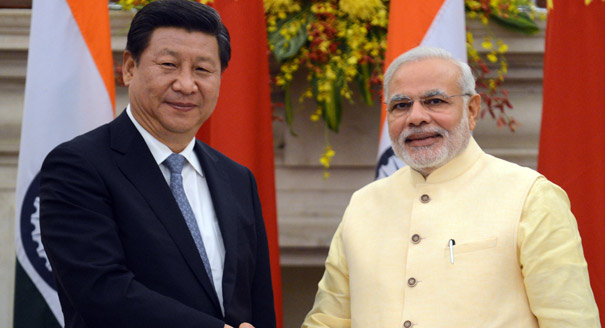
Prime Minister Narendra Modi’s visit to New York and Washington, beginning this week, will mark the peak of the NDA government’s first round of big-power diplomacy. The visit to the West follows high-level engagement with the two most important countries to our east — China and Japan.
The pace and scope of Modi’s engagement with world leaders will continue for the rest of the year, as he attends the summits of a number of multilateral forums, including the G-20 in Australia and the East Asia Summit in Myanmar.
Modi’s visit to the United States will be critical in defining the direction of India’s great-power relations through the rest of the NDA’s term. It is now commonplace to argue that the US is in irreversible decline as a great power, and will cede ground to China in Asia and the world and, therefore, is of less consequence for India.Despite its many current problems, America remains the world’s pre-eminent power in both economic and military terms. The US continues to lead the institutions of global governance — from the United Nations to multilateral financial institutions — and leads the creation of new global norms. America may no longer do the kind of brick and mortar infrastructure projects around the world that China does with great efficiency.
But the US dominates global finance and its companies surprise the world with the introduction of new technologies — whether it is fracking to release natural gas from deep underground or 3D-printing.
America is also home to the largest concentration of wealthy and influential Indians abroad. There is no other country that has so many people of Indian origin occupying important positions in government, industry and academia.
Modi has a much better appreciation than Congress leaders of America’s critical role in facilitating India’s successful pursuit of its domestic and external objectives. If there is anyone in the Congress party who understands the value of Modi’s mission to the US, it is probably former PM Manmohan Singh.
The UPA government’s first term (2004-09) saw big breakthroughs in India’s relationship with America — including the historic civil nuclear initiative, framework for defence cooperation and a broad political understanding on regional coordination in Asia, the Indian Ocean and beyond.
Singh sought to build on the legacy of his predecessor Atal Bihari Vajpayee (1998-2004), who proclaimed that India and America were “natural allies”. But the ambivalence of the Congress leadership towards America saw New Delhi squander the historic opportunities that came India’s way during UPA rule.
Modi is in a much better position than Singh to develop the full potential of the India-US relationship. To be sure, there will be no dramatic announcements during Modi’s visit to the US, certainly not of the kind we saw when Singh met George W. Bush at the White House in July 2005.
However, as he resurrects the India story, the PM has an opportunity to engage the full spectrum of the US leadership, in government and outside it, and lay out the roadmap for a vigorous expansion of the bilateral partnership in the coming years.
One reason the Congress party held back was its fear that drawing close to America might complicate India’s relations with China. This was a misplaced concern, given the deep economic interdependence and intensive political engagement between the US and China. India’s relationships with America and China are, in fact, much thinner than that between Washington and Beijing.
India’s defence ministry, under the UPA’s A.K. Antony, deliberately slowed down India’s engagement with the US by citing Chinese concerns. This was strange because China never objected to Pakistan’s longstanding military relationship with America. Nor did Beijing protest Washington’s decision to make Rawalpindi a “major non-Nato ally”.
Neither Washington nor Beijing is asking Delhi to choose between them. Nor is it a question of maintaining a symmetric relationship. India’s geography makes that impossible. America is powerful but far away, while China is a neighbour that is rising rapidly and has territorial claims against India. Delhi is also locked in a competition with Beijing in Asia and the Indian Ocean.
India, then, must improve relations with both Washington and Beijing and not limit ties with one because of the other. India, as Modi says, has the bandwidth to engage both China and the US. The objective must be to build India’s comprehensive national power through whatever cooperation is possible with both America and China.
Former Nonresident Senior Fellow, Carnegie India
A leading analyst of India’s foreign policy, Mohan is also an expert on South Asian security, great-power relations in Asia, and arms control.
Recent Work

C. Raja Mohan, Darshana M. Baruah


Alexander Gabuev, Paul Haenle, C. Raja Mohan, …
Carnegie India does not take institutional positions on public policy issues; the views represented herein are those of the author(s) and do not necessarily reflect the views of Carnegie, its staff, or its trustees.

In any defense establishment, change is an ongoing process. However, despite the best of intentions, existing bureaucracies, bound by habit and years of socialization, have their limits in implementing transformative change.

Anit Mukherjee
As AI grows more sophisticated, as the supply chains that power it become more contested, and as access to frontier models becomes geopolitically charged, India must begin to ask a different set of questions. Not what applications it can build on someone else’s infrastructure but what the world needs.

Konark Bhandari

The Indian Ocean Region hosts one of the densest concentrations of subsea cables in the world. Yet, despite accounting for a significant share of global internet traffic, India’s participation remains limited.

Charukeshi Bhatt

How is AI reshaping space security, creating governance challenges, and where does international diplomacy stand today?


Tejas Bharadwaj, Almudena Azcárate Ortega

After the chill in ties between 2020 and 2024 that brought India–China relations to their lowest point in several decades, the two countries have engaged each other afresh. This paper argues that there are predominantly four imperatives guiding India’s approach to China, and they exist in an order of priority.

Saheb Singh Chadha