

Commentary
Gwendolyn Sasse
{
  "authors": [
    "Gwendolyn Sasse"
  ],
  "type": "legacyinthemedia",
  "centerAffiliationAll": "dc",
  "centers": [
    "Carnegie Endowment for International Peace",
    "Carnegie Europe"
  ],
  "collections": [
    "Europe’s Eastern Neighborhood",
    "Transatlantic Cooperation"
  ],
  "englishNewsletterAll": "ctw",
  "nonEnglishNewsletterAll": "",
  "primaryCenter": "Carnegie Europe",
  "programAffiliation": "EP",
  "programs": [
    "Europe"
  ],
  "projects": [],
  "regions": [
    "Russia",
    "Europe",
    "Eastern Europe",
    "Ukraine",
    "Western Europe",
    "Iran"
  ],
  "topics": [
    "Foreign Policy",
    "Security"
  ]
}
Source: Getty
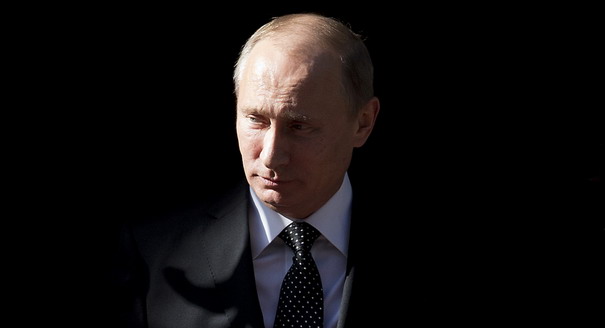
Putin is not an irrational foreign policy actor, but the absence of a bigger strategy on his part means that the EU still has an opening to influence relations with Russia.
Source: The Week
If there's one place John Kerry and most European leaders would like to be right now, it's probably inside Vladimir Putin's head. Wouldn't it be great to know what he's thinking? To see his Grand Strategy?
However, Putin's actions so far suggest that he's reacting to political opportunities as they present themselves, rather than following some sinister master plan. The fact that political opportunities have presented themselves means the institutions meant to safeguard European security are broken. So, if we want to avoid another conflict in the future, the strategy isn't to second guess Putin's next steps — it's to illuminate and address those tricky, institutional issues.
It's easy to look back and see the entire conflict as inevitable. With hindsight, we can construct a narrative that lends logic to the events and the way in which they unfolded. In fact, the more unlikely the events are, the more such a narrative is needed — and the more flawed that narrative is likely to be. It's easy to list reasons why Russia wanted Crimea back or why Crimeans wanted to 'return' to Russia. But the fact is that there was no conflict in or over Crimea before March 2014. Similarly, eastern Ukraine was well represented at the center of Ukrainian politics and Russia enjoyed a special regional language status. Ukraine's demands for more regional autonomy had resurfaced regularly since its independence, but Ukraine and Russia could manage them politically. By contrast, this year Putin reacted to a particular political situation in Kyiv, resulting in the take-over of Crimea and subsequent support for regional separatists in the Donbas region.So, hindsight, in this case, fools us. Ironically, Europe's dense institutional environment is usually thought of as the basis of its stability. However, this network of international institutions with overlapping memberships and remits — the EU, NATO, the OSCE, the Council of Europe — billed as one of the major post-Cold War achievements and models for the rest of the world, has not helped to prevent or resolve the crisis.
In fact, the overall coherence of these institutions is a myth. They are not composed of unified communities of states but of states with diverse interests that pull in different directions. Some want to engage in an antagonistic relationship with Russia, some want compromise and pragmatism, and some have other priorities. These outwardly unified but internally divided institutions have become part of the problem rather than offering solutions to the need for a stable relationship with Russia.
The EU's ambiguous relationship with Ukraine, modeled on the conditionality-based EU accession process but without a clear membership perspective, and NATO's intermittent actions "preparing" Ukraine for future membership were among several factors playing into the Ukraine crisis, however much these institutions try to claim the opposite. Their respective instincts to push ahead with what they have been doing all along — in this case ratify the EU Association Agreement with Ukraine in the midst of the crisis and, in NATO's case, contemplate Ukrainian membership, a military build-up in Eastern Europe, and explicitly treat Russia as the enemy, further stokes the conflict.
Putin's reaction to Western post-Cold War bravado has exposed and exploited the inconsistencies of the EU, NATO, the OSCE, and the UN. He is neither a grand strategist nor an irrational foreign policy actor, as Western politicians and media have suggested. But the absence of a bigger strategy on Putin's part means that there's still an opening to interact with him — and influence future relations with Russia.
And there's reason to believe that Putin's next move won't spark similar steps across the world: It's unlikely that other authoritarian leaders will follow Putin's lead, given the specifics of the situation in Ukraine. What's more, the externally supported destabilization from within that characterizes the Ukrainian situation bears both domestic and international risks. Even (semi-)authoritarian leaders generally avoid instability so they don't endanger their own rule. Putin's engagement is risky on several fronts: He's facing economic costs, isolation from the West, a domestic backlash and, most importantly, the risk of losing control on the ground.
Authoritarian leaders in the former Soviet Union and beyond are aware of these risks. Thus, instead of asking whether they'll follow suit, a better question is: Could Russia try the same tactics in Moldova, the Baltic States, or Kazakhstan? Could Ukraine become a template for other interventions? Russia is unlikely to act upon it in its neighboring states anytime soon. But it now has an effective new model to gain fast leverage.
It's a model based on uncertainty — for those implementing it, for those on the receiving end, and for those trying to broker a peace agreement. There has been uncertainty about Putin's next steps, about whether Russia had already "invaded" or not, about who or what crossed the Russian-Ukrainian border, about who exactly controls military action on the ground, about whether the cease-fire is still in place, and about the effects of Western sanctions and diplomatic efforts.
Those Cold War institutions are supposed to cut down on all that uncertainty. Authoritarian regimes may pick and choose their opportunities for war and peace, but Europe's current institutional set-up enables this and requires a rethink.
Nonresident Senior Fellow, Carnegie Europe
Gwendolyn Sasse is a nonresident senior fellow at Carnegie Europe. Her research focuses on Eastern Europe, with a particular focus on Ukrainian politics and society, EU enlargement, and comparative democratization.
Recent Work
Gwendolyn Sasse
Gwendolyn Sasse
Carnegie India does not take institutional positions on public policy issues; the views represented herein are those of the author(s) and do not necessarily reflect the views of Carnegie, its staff, or its trustees.

After the chill in ties between 2020 and 2024 that brought India–China relations to their lowest point in several decades, the two countries have engaged each other afresh. This paper argues that there are predominantly four imperatives guiding India’s approach to China, and they exist in an order of priority.

Saheb Singh Chadha

This piece argues that India’s central challenge is not managing a single flashpoint but resolving the underlying tension between expansion and institutional coherency of the BRICS grouping.

Vrinda Sahai

The ASML MoU with Tata Electronics is an indicator of how far the Indian semiconductor ecosystem has come. This ecosystem has been years in the making and represents real commercial logic.

Konark Bhandari

A partnership between India, a country of subcontinental size, and Africa, a continent of fifty-four countries, may seem asymmetric until one notes that both are home to nearly the same number of people—1.4 billion. This essay spells out the existing challenges to the partnership, its optimal potential, and the possible pathways to realize it over the next quarter-century.

Rajiv Bhatia

The India–EU Free Trade Agreement (FTA) is shaping up to be one of the most consequential trade negotiations, both economically and strategically. But, what’s in the agreement, what’s missing, and what will determine its success in the years ahead
Vrinda Sahai, Nicolas Köhler-Suzuki