

Article
C. Raja Mohan, Darshana M. Baruah
{
  "authors": [
    "C. Raja Mohan"
  ],
  "type": "legacyinthemedia",
  "centerAffiliationAll": "dc",
  "centers": [
    "Carnegie Endowment for International Peace",
    "Carnegie China",
    "Carnegie India"
  ],
  "collections": [
    "China’s Foreign Relations",
    "China and the Developing World"
  ],
  "englishNewsletterAll": "ctw",
  "nonEnglishNewsletterAll": "",
  "primaryCenter": "Carnegie India",
  "programAffiliation": "SAP",
  "programs": [
    "South Asia"
  ],
  "projects": [],
  "regions": [
    "South Asia",
    "India",
    "East Asia",
    "China"
  ],
  "topics": [
    "Economy",
    "Trade",
    "Foreign Policy"
  ]
}
Source: Getty
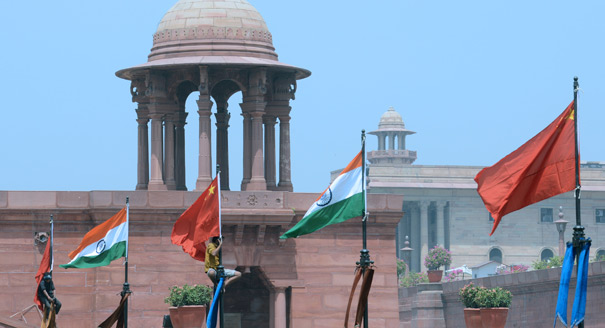
Chinese President Xi is trying to persuade Indian Prime Minister Modi to support China’s Southern Silk Road initiative.
Source: Indian Express
At the edge of China’s long border with Myanmar, this town could one day become the heart of the ancient Southern Silk Road that President Xi Jinping wants to rebuild with India. It is not clear if Xi can persuade Prime Minister Narendra Modi to join in China’s vigorous effort to connect the two nations through Myanmar and Bangladesh. But try he will.
In the year-and-a-half that he has taken charge as the President of China, Xi Jinping has made the Silk Road initiative a central plank of his regional policy. Last week in Tajikistan, Xi won support for his initiative on developing a Silk Road Industrial Belt between China and Central Asia.
This week in Maldives and Sri Lanka, Xi is pitching for support of his plans for a Maritime Silk Road linking southern China with the Indian Ocean. Xi is eager for India’s participation, especially in the revival of the Southern Silk Road now called the BCIM (Bangladesh, China, India, Myanmar) Corridor.As Xi arrives, his plans for Southern Silk Road awaits Modi’s backing very much part of Tengchong’s memory and imagination. Local tour operators say Tengchong is 700 km from Kunming, the capital of Yunnan province; but Myitkyina in northern Myanmar is only 50 km from and the Indian border begins at 600 km to the south west.
With China’s heartland far away to the north east of Yunnan, trade with the subcontinent and beyond has been a very important part of Tengchong’s long history. It was the centre of the Southern Silk Road that is said to predate the Northern Silk Road running from Xian, the ancient capital of China to the Mediterranean.
The Southern Silk Road flourished for centuries. Large horse caravans travelled between Tibet, Sichuan, Yunnan, northern Myanmar, and eastern India. They moved goods and ideas, traders and monks across this vast and difficult terrain.
Living on the frontiers of the Chinese empires, the people of Yunnan see long distance trade and commerce as central to their lives. Local folklore here says when a young man wanted a bride in the past, he had to prove his credentials by travelling abroad on a trade mission.
As late as the early 19th century, Tengchong had bigger trade volumes than Canton in southern China that would later become the throbbing heart of Beijing’s global trade. Once it got control of Burma, the British Raj set up a consulate here at the turn of the 20th century. The local government is restoring the consulate building destroyed during the Second World War.
During the 19th century, the British Raj explored the possibilities for building rail and road links to Yunnan through Burma. But the projects did not take off for financial reasons.
India also figures in Tengchong’s war against the Japanese occupation in the early 1940s. The Stilwell Road from Ledo, Assam, runs through the heart of Tengchong and is etched in the town’s remembrance of the Second World War.
Built by the Allies, the Stillwell Road helped disrupt the Japanese control of the Burma-Yunnan road and delivered much needed supplies to the besieged Chinese nationalist forces. Allied bombing of Japanese forces from air bases in eastern India, Tengchong remembers, was critical in the liberation of Yunnan.
Yunnan came back into view in 2000 as Beijing embarked on the “Go-West” strategy. China poured billions of dollars to develop its interior regions that had remained poor in comparison to China’s eastern seaboard that had rapidly integrated into the world markets during the 1980s and 1990s.
One objective of Xi’s Silk Road initiative is to further accelerate the development of its frontier regions by connecting them to markets beyond borders through trans-frontier roads and industrial corridors.
While Yunnan’s connectivity with South East Asia has rapidly grown in recent years, its links with the subcontinent remain underdeveloped. Changing that has been at the top of Xi’s agenda.
After prolonged nudging from Beijing, the UPA government last year agreed with China to formally study the proposal along with Bangladesh and Myanmar. An agreement on how to proceed remains to be hammered out by the four countries.
Until now, Delhi has tended to view the BCIM corridor from a narrow diplomatic perspective. If Modi brings a domestic developmental dimension that will focus on improving connectivity within and across India’s frontiers, Delhi might take a more pro-active approach to the BCIM corridor. On their part, Tengchong and Yunnan are raring to go.
This article was originally published in the Indian Express.
Former Nonresident Senior Fellow, Carnegie India
A leading analyst of India’s foreign policy, Mohan is also an expert on South Asian security, great-power relations in Asia, and arms control.
Recent Work

C. Raja Mohan, Darshana M. Baruah


Alexander Gabuev, Paul Haenle, C. Raja Mohan, …
Carnegie India does not take institutional positions on public policy issues; the views represented herein are those of the author(s) and do not necessarily reflect the views of Carnegie, its staff, or its trustees.

In any defense establishment, change is an ongoing process. However, despite the best of intentions, existing bureaucracies, bound by habit and years of socialization, have their limits in implementing transformative change.

Anit Mukherjee

As AI grows more sophisticated, as the supply chains that power it become more contested, and as access to frontier models becomes geopolitically charged, India must begin to ask a different set of questions. Not what applications it can build on someone else’s infrastructure but what the world needs.

Konark Bhandari

The Indian Ocean Region hosts one of the densest concentrations of subsea cables in the world. Yet, despite accounting for a significant share of global internet traffic, India’s participation remains limited.

Charukeshi Bhatt

How is AI reshaping space security, creating governance challenges, and where does international diplomacy stand today?


Tejas Bharadwaj, Almudena Azcárate Ortega

After the chill in ties between 2020 and 2024 that brought India–China relations to their lowest point in several decades, the two countries have engaged each other afresh. This paper argues that there are predominantly four imperatives guiding India’s approach to China, and they exist in an order of priority.

Saheb Singh Chadha