

Article
Thomas de Waal
{
  "authors": [
    "Thomas de Waal"
  ],
  "type": "commentary",
  "centerAffiliationAll": "",
  "centers": [
    "Carnegie Endowment for International Peace",
    "Carnegie Europe",
    "Carnegie Russia Eurasia Center"
  ],
  "collections": [],
  "englishNewsletterAll": "",
  "nonEnglishNewsletterAll": "",
  "primaryCenter": "Carnegie Europe",
  "programAffiliation": "",
  "programs": [],
  "projects": [],
  "regions": [
    "Russia",
    "Eastern Europe",
    "Ukraine"
  ],
  "topics": [
    "Security",
    "Military",
    "Foreign Policy"
  ]
}
Source: Getty
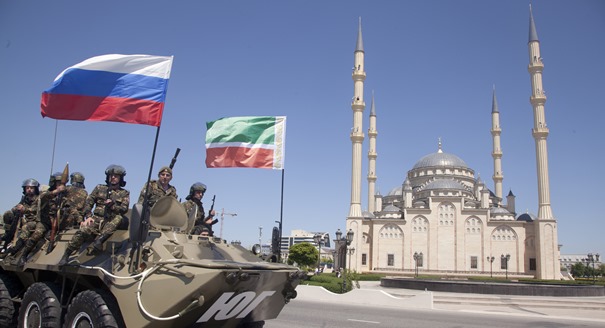
Memorial’s new report documents the involvement of Chechen fighters in the conflict in Donbass. Their presence there is all about Chechen leader Ramzan Kadyrov and a gesture of loyalty to Moscow.
Almost every recent conflict in the post-Soviet space and Middle East has had a “Chechen trace,” whether real or imagined.
Chechen volunteers fought on the side of the Azerbaijanis in the Karabakh conflict and with the Abkhaz in the conflict in Abkhazia of 1992-3. Feared Chechen warrior—and later terrorist—Shamil Basayev even became deputy minister of defense in Abkhazia as a reward for his exploits there.
Sightings of Chechen jihadis were reported in the wars in Afghanistan and Iraq, although it subsequently emerged that pretty much anyone speaking Russian, carrying a gun and fighting against Western forces had been written off as a “Chechen.” Reports of Chechen militants in Syria have been much more credible.
So when there were yet more reports of Chechens fighting on the Russian side in Donbass, it was easy to be skeptical. Were these just more imaginary Chechen bogeyman, dreamed up by over-excited Ukrainian journalists? Or were they the real thing?
It seems they were for real. In their latest bulletin, the ever-impressive Russian human rights organization Memorial has published a detailed report which sets out all the available facts on the issue of Chechens and the Donbass conflict.
The first wave of Chechen involvement there came in May. Caucasian Knot on May 29 reported that the bodies of up to 45 Chechens who had fought in Donbass had been brought home for burial. On the same day, U.S. Secretary of State John Kerry raised concerns about the issue.
A second wave of sightings came in August as the fighting intensified. Two videos, posted on Youtube in the last few days of August, show Chechen-speaking men in camouflage fighting with the Russians in Donbass. In the first one, we see them in a column of tanks in an open plain, getting ready for battle.
In the second, they are involved in the battle for the town of Novoazovsk. One of the armored vehicles bears the inscription Za Donbass, “For Donbass.”
If the presence of Chechen fighters (along with smaller numbers of other North Caucasian nationalities) is no longer a mystery, the reason for them being there still is. Why would Chechens, of all people, get involved in the separatist rebellion of ethnic Russians in Ukraine?
As Memorial and others have suggested, it is all about one man, Ramzan Kadyrov.
Kadyrov has been the local despot of Chechnya since 2007. For several years, he made himself exceptionally useful to the Kremlin for being seen to have crushed the Islamist insurgency there. But more recently he has to had contend with a resurgent ideology of ethnic Russian nationalism and the slogan “Stop Feeding the Caucasus.”
Kadyrov tackles this problem by positioning his Chechnya as a key location of “anti-Western” sentiment in Russia. In 2009 he made the fantastic claim that the horrific Chechen war of 1994 was the result of a Western plot to break up Russia, thereby absolving both Russians and Chechens for the conflict.
By sending battle-hardened Chechen warriors to Donbass, covertly or otherwise, Kadyrov was signaling his loyalty to his patron, President Putin and trying to stay relevant in a fast-moving domestic political situation in Russia. Yet it is hard to imagine that for ordinary Chechens, the Russia-Ukraine conflict can be worth the lives of their loved ones.

Senior Fellow, Carnegie Europe
Thomas de Waal is a senior fellow at Carnegie Europe, specializing in Eastern Europe and the Caucasus.
Recent Work
Thomas de Waal
Thomas de Waal
Carnegie India does not take institutional positions on public policy issues; the views represented herein are those of the author(s) and do not necessarily reflect the views of Carnegie, its staff, or its trustees.

After the chill in ties between 2020 and 2024 that brought India–China relations to their lowest point in several decades, the two countries have engaged each other afresh. This paper argues that there are predominantly four imperatives guiding India’s approach to China, and they exist in an order of priority.

Saheb Singh Chadha

This piece argues that India’s central challenge is not managing a single flashpoint but resolving the underlying tension between expansion and institutional coherency of the BRICS grouping.

Vrinda Sahai

A partnership between India, a country of subcontinental size, and Africa, a continent of fifty-four countries, may seem asymmetric until one notes that both are home to nearly the same number of people—1.4 billion. This essay spells out the existing challenges to the partnership, its optimal potential, and the possible pathways to realize it over the next quarter-century.

Rajiv Bhatia

The India–EU Free Trade Agreement (FTA) is shaping up to be one of the most consequential trade negotiations, both economically and strategically. But, what’s in the agreement, what’s missing, and what will determine its success in the years ahead
Vrinda Sahai, Nicolas Köhler-Suzuki
The induction of INS Aridhaman, which features several technological enhancements, now gives India the third nuclear ballistic missile submarine to ensure continuous at-sea deterrent.

Dinakar Peri