

Article
Marc Pierini
{
  "authors": [
    "Marc Pierini"
  ],
  "type": "legacyinthemedia",
  "centerAffiliationAll": "dc",
  "centers": [
    "Carnegie Endowment for International Peace",
    "Carnegie Europe"
  ],
  "collections": [
    "Transatlantic Cooperation",
    "EU Integration and Enlargement"
  ],
  "englishNewsletterAll": "ctw",
  "nonEnglishNewsletterAll": "",
  "primaryCenter": "Carnegie Europe",
  "programAffiliation": "EP",
  "programs": [
    "Europe"
  ],
  "projects": [],
  "regions": [
    "Europe",
    "Western Europe",
    "Iran"
  ],
  "topics": [
    "Foreign Policy",
    "EU",
    "Security"
  ]
}
Source: Getty
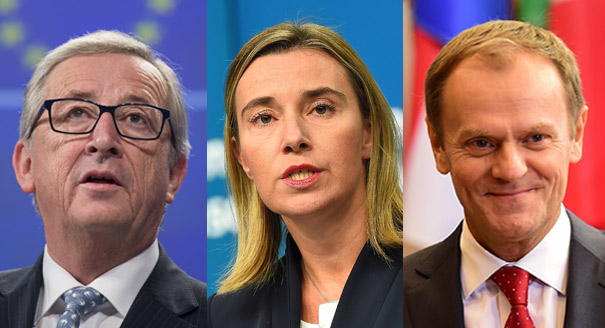
The EU’s three new leaders have the tools and the rank to tackle Europe’s crises. To be successful, the trio needs the support of member states and the trust of the United States.
Source: EUobserver
BRUSSELS - Donald Tusk took office as president of the European Council on 1 December, completing the new EU leadership team.
On the foreign policy front, Tusk, together with European Commission president Jean-Claude Juncker and EU high representative Federica Mogherini, will become the second generation of EU leaders after the entry into force of the Lisbon Treaty, which was supposed to give the EU new visibility on the world stage.
An old rule says that "the EU only makes progress by way of an external shock."If true, this new trio stands a bigger chance for success than their predecessors as the EU faces multiple crises in its neighbourhoods. From Ukraine to relations with Russia, and from Syria and Iraq to battling ISIS, these crises represent many opportunities for the Tusk-Juncker-Mogherini trio.
They have many cards in their hands, but will also need a little support.
The biggest strength of the new trio is its political legitimacy. Juncker comes from the centre-right party that won the most seats in the May 2014 European Parliament elections.
Wisely, he designated the most politically experienced commission that Brussels has ever seen, including five former prime ministers, 19 former ministers, three former EU commissioners, and just one "rookie commissioner".
Former Polish PM Tusk was then appointed president of the European Council.
#Tusk's appointment gives recognition of Poland's crucial role in the EU's relationships with Ukraine and Russia.Tweet This
Ten years after the accession of most Central European states to the EU, his appointment gives recognition to the region's fundamental importance in the union and, indeed, recognition of Poland's crucial role in the EU's relationships with Ukraine and Russia.
Tusk's presence at the helm of EU summitry therefore carries an enormous political significance.
Finally, appointing Mogherini, a true "rookie foreign minister" in Italy, acknowledges the political weight that Matteo Renzi's Partito Democratico carries after the May European elections, especially as so many other parties in power suffered at the hands of eurosceptics.
.@FedericaMog's appointment also signifies the return of Italy to front-stage EU politics.Tweet This
Mogherini's appointment also signifies the return of Italy to front-stage EU politics.
The three new leaders have strong intellectual credentials and communication skills.
In addition, the synergies between the European External Action Service, the diplomatic corps headed by Mogherini, and the EU commission, headed by Juncker - where Mogherini also holds a vice president seat - have been reconstructed.
This gives the hope that foreign policy will now work hand-in-hand with the “technical" instruments under the commission's control, including trade policy, financial sanctions, development co-operation, humanitarian assistance, visa policy and migration.
The trio will hopefully put to rest a lacklustre five year inception period of the Lisbon Treaty.
While the "big three" - France, Germany, and the United Kingdom - thought they would inspire and implement EU foreign policy during this period, they proved largely ineffectual, be it on Libya, Syria, or Ukraine.
As a result, other EU member states developed a real frustration that now stands to be corrected.
The deep crisis in Ukraine and the related rampant confrontation with Russia, as well as the Syrian-Iraq-ISIS conundrum, provide ample opportunities for the new EU leaders to prove that the proper combination of national and EU foreign policy tools can achieve lasting influence when implemented within smart policies proposed by the relevant EU institutions.
This is, of course, more easily said than done.
The Tusk-Juncker-Mogherini trio will need to fulfill two major conditions. First, they will need, as they proclaimed, to work together in a seamless fashion and avoid disastrous incidents seen recently, where a commissioner and the high representative followed each other on Maidan Square in Kiev without much co-ordination or consistency.
They will have to operate their many tools in a co-ordinated fashion, instead of being guided by the incomprehensible rules dividing their portfolios or their inter-institutional relations.
They will also have to communicate efficiently to the public: faced with such major foreign policy crises, European citizens want to understand where their leaders take them.
Yet political clout, institutional tools, and smart brains will not be enough.
The trio will also need to be given a genuine chance by the "big three" member states, instead of being either bypassed or ostensibly left out of the decision-making room.
Can the @eucopresident-@JunckerEU-@FedericaMog trio put the EU on the world map?Tweet This
Tusk, Juncker, and Mogherini will also have to earn the trust of the United States, which remains by a long shot the most influential Western actor in areas of strategic interest to the EU.
Can the new trio put the EU on the world map? Only time will tell, probably sooner than later.

Senior Fellow, Carnegie Europe
Marc Pierini is a senior fellow at Carnegie Europe, where his research focuses on developments in the Middle East and Turkey from a European perspective.
Recent Work
Marc Pierini
Marc Pierini
Carnegie India does not take institutional positions on public policy issues; the views represented herein are those of the author(s) and do not necessarily reflect the views of Carnegie, its staff, or its trustees.

In any defense establishment, change is an ongoing process. However, despite the best of intentions, existing bureaucracies, bound by habit and years of socialization, have their limits in implementing transformative change.

Anit Mukherjee

After the chill in ties between 2020 and 2024 that brought India–China relations to their lowest point in several decades, the two countries have engaged each other afresh. This paper argues that there are predominantly four imperatives guiding India’s approach to China, and they exist in an order of priority.

Saheb Singh Chadha

This piece argues that India’s central challenge is not managing a single flashpoint but resolving the underlying tension between expansion and institutional coherency of the BRICS grouping.

Vrinda Sahai
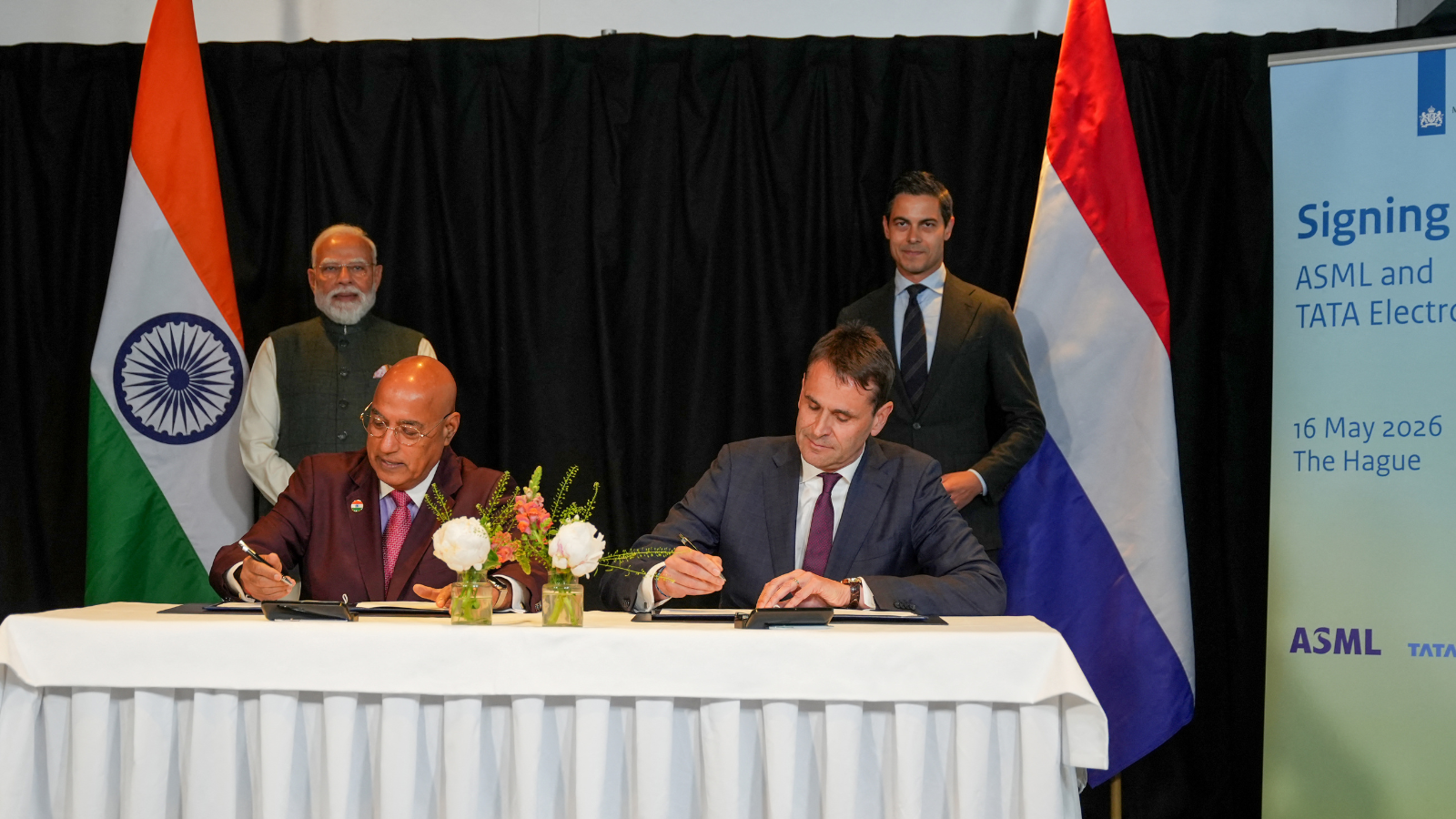
The ASML MoU with Tata Electronics is an indicator of how far the Indian semiconductor ecosystem has come. This ecosystem has been years in the making and represents real commercial logic.

Konark Bhandari

A partnership between India, a country of subcontinental size, and Africa, a continent of fifty-four countries, may seem asymmetric until one notes that both are home to nearly the same number of people—1.4 billion. This essay spells out the existing challenges to the partnership, its optimal potential, and the possible pathways to realize it over the next quarter-century.

Rajiv Bhatia