

Article
Deborah Gordon, Stephen D. Ziman
{
  "authors": [
    "Deborah Gordon"
  ],
  "type": "legacyinthemedia",
  "centerAffiliationAll": "dc",
  "centers": [
    "Carnegie Endowment for International Peace"
  ],
  "collections": [],
  "englishNewsletterAll": "ctw",
  "nonEnglishNewsletterAll": "",
  "primaryCenter": "Carnegie Endowment for International Peace",
  "programAffiliation": "SCP",
  "programs": [
    "Sustainability, Climate, and Geopolitics"
  ],
  "projects": [
    "Carnegie Oil Initiative"
  ],
  "regions": [
    "North America",
    "United States"
  ],
  "topics": [
    "Climate Change"
  ]
}
Source: Getty
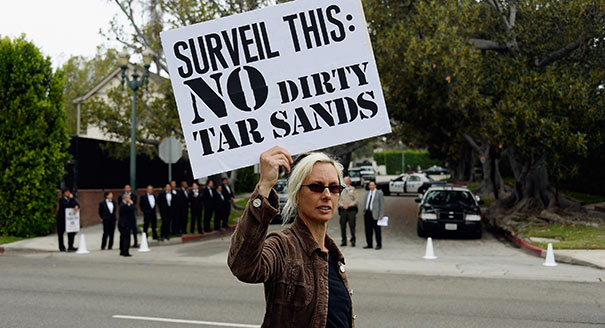
The Keystone XL pipeline is a canary in the mine. It is a warning of what’s to come.
Source: Scientific American
When it comes to Keystone XL, it’s not really about the pipeline. It’s about the numerous unintended consequences that the pipeline portends. This is what the U.S. State Department—and the American public—should be most concerned about. If Canada intends to be the next global oil powerhouse with its oil sands and beyond, it behooves the U.S. to seriously deliberate permitting, aiding, and abetting riskier resource development. So further delay makes sense.
The economic, geopolitical, and environmental implications of Canada’s bitumen motherlode—one that rivals Ghawar, Saudi Ariabia’s supergiant conventional oilfield—are as enormous as the oil play itself. As such, Keystone raises serious questions, which have yet to be adequately answered. What type of oils does Canada intend to export? What exactly will be in KXL and affiliated pipelines? How will Canada’s unbridled bitumen development affect global geopolitics? Will Canadian oils induce new price volatility? What global infrastructure investments will extra-heavy oils lock in? And what new petroleum products (especially bottom-of-the-barrel pet coke) will be increasingly peddled in the marketplace?
Beyond the oil sands—sandstone saturated with bitumen—is another more plentiful and insidious petroleum resource. Few talk about it. Few even know about it. But buried under the oil sands are hard-rock carbonate reservoirs laced with bitumen.These carbonates are more solid and even heavier than the tarry oil sands. They are trapped even deeper in the Earth’s natural limestone and dolomite. Some 600 billion barrels of oil in place is thought to be locked in Canada’s carbonates. (That’s in addition to the 1.3 trillion barrels of oil sands, making Canada the world’s most oil-rich nation.) Not all of these bitumen resources are economically or technically recoverable today. But recent improvements in technology, such as co-injecting chemical additives, using of solvents, drilling horizontally—and fracking—are improving recovery.
Commercial-scale pilots have recently been successful producing the bitumen carbonates. Full-scale development is now slated with Shell, Suncor, and Husky holding the majority of the current carbonate leases.
So the question remains, how far into the unknown will Canada go for oil? Acting like these uncharted oil resources are manageable does not deem them so. Oversight is critical—within Canada where they would be extracted, in the U.S. where they would be transported and possibly refined, and in oil importing nations around the world where they will be consumed.
So the Keystone XL pipeline is a canary in the mine. It is a warning of what’s to come. It forces us to question what we are getting into now that technology is unlocking oil reserves that had previously been inaccessible. And this goes for oils beyond Canada’s oil sands and bitumen carbonates. The gassy, watery, depleted, ultra-deep, Arctic oils as well as the petroleum products made from coal and natural gas all create urgency in how we approach our oil future.
As the world globalizes toward an expanding and increasingly tentative balance between the production and consumption of petroleum products, this calls for a lot more transparency on oil resources. The sheer volumes, different types, remote locations, market dynamics, technological prowess, huge capital, and political maneuvering make it difficult to safely navigate the oil sector. Starting with North America, the boom in oil deserves durable policy to manage risks.
The best way to make sound private and public oil decisions is out in the open with full disclosure. This applies to the pipeline, other infrastructure investments, trade agreements, environmental regulations, safety guidelines, insurance policies, production allowances, operational practices, and rules that govern this sector. The end game is competition between oils so that those with the lowest private and social costs are utilized and those with high costs are left in the ground.
This article was originally published in Scientific American.

Former Director and Senior Fellow, Energy and Climate Program
Gordon was director of Carnegie’s Energy and Climate Program, where her research focuses on oil and climate change issues in North America and globally.
Recent Work
Deborah Gordon, Stephen D. Ziman
Deborah Gordon, Smriti Kumble, David Livingston
Carnegie India does not take institutional positions on public policy issues; the views represented herein are those of the author(s) and do not necessarily reflect the views of Carnegie, its staff, or its trustees.

India and the United States are close to concluding a Reciprocal Defense Procurement Agreement (RDPA) that will allow firms from the two countries to sell to each other’s defense establishments more easily. While this may not remedy the specific grievances both sides may have regarding larger bilateral issues, an RDPA could restore some momentum, following the trade deal announcement.

Konark Bhandari

On the last day of the India AI Impact Summit, India signed Pax Silica, a U.S.-led declaration seemingly focused on semiconductors. While India’s accession to the same was not entirely unforeseen, becoming a signatory nation this quickly was not on the cards either.
Konark Bhandari

This piece examines India’s response to U.S. sanctions and tariffs, specifically assessing the immediate market consequences, such as alterations in import costs, and the broader strategic implications for India’s energy security and foreign policy orientation.

Vrinda Sahai
On July 30, 2025, the United States announced 25 percent tariffs on Indian goods. While diplomatic tensions simmered on the trade front, a cosmic calm prevailed at the Sriharikota launch range. Officials from NASA and ISRO were preparing to launch an engineering marvel into space—the NASA-ISRO Synthetic Aperture Radar (NISAR), marking a significant milestone in the India-U.S. bilateral partnership.

Tejas Bharadwaj
The India-U.S. relationship currently appears buffeted between three “Ts”—TRUST, Tariffs, and Trump.

Arun K. Singh