

Article
Frederic Wehrey, Charles H. Johnson
{
  "authors": [
    "Frederic Wehrey"
  ],
  "type": "legacyinthemedia",
  "centerAffiliationAll": "dc",
  "centers": [
    "Carnegie Endowment for International Peace",
    "Malcolm H. Kerr Carnegie Middle East Center"
  ],
  "collections": [],
  "englishNewsletterAll": "menaTransitions",
  "nonEnglishNewsletterAll": "",
  "primaryCenter": "Carnegie Endowment for International Peace",
  "programAffiliation": "MEP",
  "programs": [
    "Middle East"
  ],
  "projects": [],
  "regions": [
    "North Africa",
    "Libya",
    "Maghreb"
  ],
  "topics": [
    "Security"
  ]
}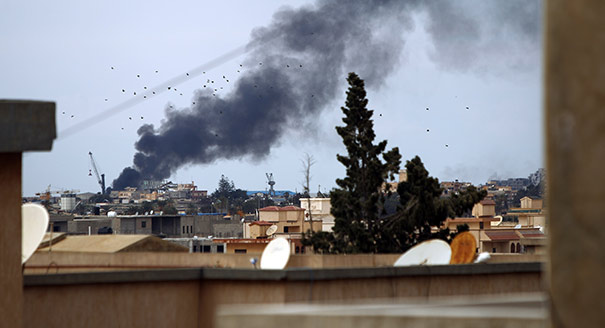
Source: Getty
The brutal murder of Egyptian Christians in Libya by the Islamic State has brought the ongoing chaos in Libya to the forefront.
Source: KCRW’s To the Point
The brutal murder of Egyptian Christians in Libya by the Islamic State has brought the ongoing chaos in Libya to the forefront. Speaking on KCRW’s To the Point, Carnegie’s Frederic Wehrey explained how the Islamic State has exploited the vacuum created by the civil war in order to gain a foothold in the country.
General Khalifa Hifter is a polarizing figure who is fighting with one faction, Operation Dignity. Wehrey said that many fear that General Hifter wants to bring back the “deep state” in Libya. “But he’s selling something that’s very appealing and that’s a return to stability, a return to security,” Wehrey added. He explained that the problem is the way Hifter is trying to bring stability back, through labeling all Islamist opposition as terrorists, which could further polarize and destabilize Libya.
Wehrey concluded that while there are extremist Islamist militias in the east, militias are not necessarily ideological and instead fight “for their town, for their tribe, for their particular region.” Labeling those militias as terrorist can be dangerous as some subscribe to democracy and the constitution, he warned.

Senior Fellow, Middle East Program
Frederic Wehrey is a senior fellow in the Middle East Program at the Carnegie Endowment for International Peace, where his research focuses on governance, conflict, and security in Libya, North Africa, and the Persian Gulf.
Recent Work
Frederic Wehrey, Charles H. Johnson
Frederic Wehrey, Charles H. Johnson
Carnegie India does not take institutional positions on public policy issues; the views represented herein are those of the author(s) and do not necessarily reflect the views of Carnegie, its staff, or its trustees.

In any defense establishment, change is an ongoing process. However, despite the best of intentions, existing bureaucracies, bound by habit and years of socialization, have their limits in implementing transformative change.

Anit Mukherjee

After the chill in ties between 2020 and 2024 that brought India–China relations to their lowest point in several decades, the two countries have engaged each other afresh. This paper argues that there are predominantly four imperatives guiding India’s approach to China, and they exist in an order of priority.

Saheb Singh Chadha

A partnership between India, a country of subcontinental size, and Africa, a continent of fifty-four countries, may seem asymmetric until one notes that both are home to nearly the same number of people—1.4 billion. This essay spells out the existing challenges to the partnership, its optimal potential, and the possible pathways to realize it over the next quarter-century.

Rajiv Bhatia

This piece argues that the present Indian strategy, based on opportunistic diversification and utilization of limited strategic reserves, remains inadequate when confronting supply disruptions. It evaluates India’s options in the short, medium, and long terms.

Vrinda Sahai

This piece examines India’s response to U.S. sanctions and tariffs, specifically assessing the immediate market consequences, such as alterations in import costs, and the broader strategic implications for India’s energy security and foreign policy orientation.
Vrinda Sahai