

Commentary
Balázs Jarábik
{
  "authors": [
    "Balázs Jarábik"
  ],
  "type": "commentary",
  "centerAffiliationAll": "",
  "centers": [
    "Carnegie Endowment for International Peace",
    "Carnegie Russia Eurasia Center"
  ],
  "collections": [],
  "englishNewsletterAll": "",
  "nonEnglishNewsletterAll": "",
  "primaryCenter": "Carnegie Endowment for International Peace",
  "programAffiliation": "",
  "programs": [],
  "projects": [],
  "regions": [
    "Russia",
    "Eastern Europe",
    "Ukraine",
    "Western Europe"
  ],
  "topics": [
    "Political Reform",
    "Security",
    "Military",
    "Foreign Policy",
    "Civil Society"
  ]
}
Source: Getty
As terrible as it sounds, Kyiv’s endless dysfunction is the Kremlin’s most powerful ally in the current crisis.
As terrible as it sounds, Kyiv’s endless dysfunction is the Kremlin’s most powerful ally in the current crisis—a point that is glossed over in Western policy debates on sending lethal aid to Ukraine.
The hope of Western foreign policy hawks is that the Putin regime will fall before Ukraine has a chance to descend into utter political and economic chaos. But as George Soros pointed out in Munich, Ukraine is already on the verge of collapse. Unless Western policymakers take the country’s internal fragility into account when discussing ways to help Kyiv achieve its goals, the promises of last year’s Maidan revolution may be snuffed out, potentially in a matter of months.
The Kyiv is overwhelmed with expectations that the worst is yet to come.Tweet This
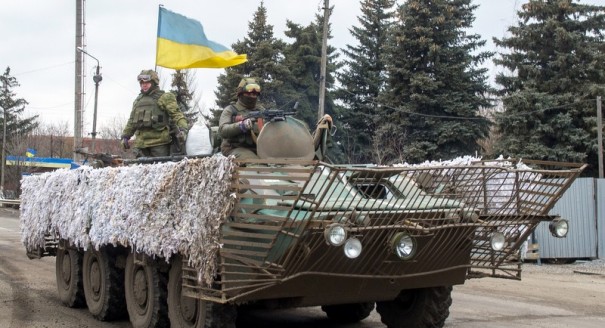
On and off the battlefield, the army inherited from Soviet times is a mess of corruption and ineffectiveness. The top officer corps is (still) incompetent and widely blamed for a string of setbacks on the battlefield. The generals are also under political pressure from Kyiv to deliver largely symbolic victories; in this way, the town of Debaltsevo has become a new Donetsk airport. In such a context, the brunt of the real fighting is born by volunteer battalions who are not yet properly integrated into the regular army.
The old ways of doing business—through endemic corruption and state capture by oligarchs and their proxies—are still the rule, not the exception. Almost exactly one year after the mass killings on the Maidan, not a single top figure has been jailed for corruption. Even the shooting of innocent protesters by snipers and riot police in the heart of Kyiv has yet to be properly investigated. Despite a surge in national identity, huge numbers of average Ukrainians are balking at signing up for military service, even in the country’s west where nationalist sentiment runs deep. Most do not see the war in Donbas as theirs. To stem draft dodging, the government has pursued restrictions on foreign and even inter-oblast travel for draft-age men. A law recently passed by the parliament allows field commanders to use arms against deserters in the shoot but not kill fashion.
A key issue is that the ruling elite still seems unable or unwilling to communicate clearly with the citizens in the way they deserve to be treated after the heroic days on the Maidan—that is, with honesty and dignity. Instead, the government flits from one unfulfilled promise to another, whether it comes to reclaiming Donbas, reforming ruined institutions, or moving against corruption. Rather than providing Ukrainians with basic information about its plans to cope with the enormous challenges on the military, economic, and social fronts, the government is retreating into dishing out propaganda. But copying the “information war” waged by Russia is at best a distraction. At worst, it creates a virtual world where blame for the government’s failings can be sloughed off or shifted to the people of Ukraine themselves for being insufficiently “patriotic.”
Ukraine must first set achievable goals and start helping itself.Tweet This
The Kyiv I encountered last week is overwhelmed with expectations that the worst is yet to come. The fear comes not only from the war, but from the effects of an economy in free-fall. The sad local reality is that military aid might give a shot in the arm to the Ukrainian army and prolong the war, but unless the West is willing to consider a war against Russia, it will be another distraction from tackling the country’s urgent socio-economic problems and the existential threat they pose to the survival of the government.
To be fair, it is not all bad. A sense of civic volunteerism grows ever stronger where it is needed. Almost 20,000 citizens of Kyiv have signed up to take part in newly formed street police patrols. The impressive reform team in place in key economic ministries has strong backing from the presidential administration. Building on incremental successes like these to stimulate reforms is the best way for the West to assist effectively. But Ukraine must first set achievable goals and start helping itself instead of using Russian aggression—and now Western inaction—as an excuse for all of its domestic shortcomings.

Political analyst, former Slovak diplomat, and consultant specializing in Eastern Europe
Recent Work
Balázs Jarábik
Balázs Jarábik
Carnegie India does not take institutional positions on public policy issues; the views represented herein are those of the author(s) and do not necessarily reflect the views of Carnegie, its staff, or its trustees.

In any defense establishment, change is an ongoing process. However, despite the best of intentions, existing bureaucracies, bound by habit and years of socialization, have their limits in implementing transformative change.

Anit Mukherjee

After the chill in ties between 2020 and 2024 that brought India–China relations to their lowest point in several decades, the two countries have engaged each other afresh. This paper argues that there are predominantly four imperatives guiding India’s approach to China, and they exist in an order of priority.

Saheb Singh Chadha

This piece argues that India’s central challenge is not managing a single flashpoint but resolving the underlying tension between expansion and institutional coherency of the BRICS grouping.

Vrinda Sahai

A partnership between India, a country of subcontinental size, and Africa, a continent of fifty-four countries, may seem asymmetric until one notes that both are home to nearly the same number of people—1.4 billion. This essay spells out the existing challenges to the partnership, its optimal potential, and the possible pathways to realize it over the next quarter-century.

Rajiv Bhatia

The India–EU Free Trade Agreement (FTA) is shaping up to be one of the most consequential trade negotiations, both economically and strategically. But, what’s in the agreement, what’s missing, and what will determine its success in the years ahead
Vrinda Sahai, Nicolas Köhler-Suzuki