

Article
This piece argues that India’s central challenge is not managing a single flashpoint but resolving the underlying tension between expansion and institutional coherency of the BRICS grouping.
Vrinda Sahai
{
  "authors": [
    "Isaac Webb"
  ],
  "type": "commentary",
  "centerAffiliationAll": "",
  "centers": [
    "Carnegie Endowment for International Peace",
    "Carnegie Russia Eurasia Center"
  ],
  "collections": [],
  "englishNewsletterAll": "",
  "nonEnglishNewsletterAll": "",
  "primaryCenter": "Carnegie Endowment for International Peace",
  "programAffiliation": "",
  "programs": [],
  "projects": [
    "Eurasia in Transition"
  ],
  "regions": [
    "Russia",
    "Eastern Europe",
    "Ukraine"
  ],
  "topics": [
    "Security",
    "Foreign Policy"
  ]
}
Source: Getty
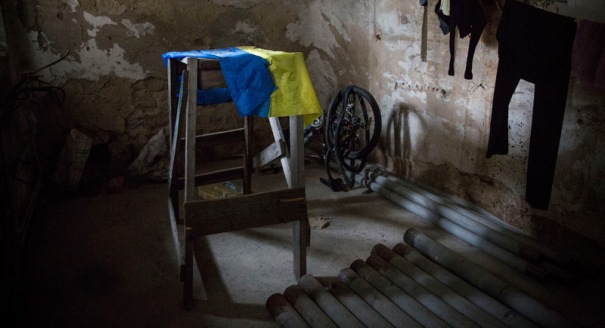
The fact that the process of prisoner exchanges is still incomplete after months of fits and starts volumes about the messiness of the situation in eastern Ukraine.
Despite a relative lull in fighting in eastern Ukraine over the past several weeks—daily casualties have hovered in the single digits recently—prisoner of war (POW) exchanges, a central element of the Minsk agreements, have stalled. According to the February 11 “Minsk II” treaty, the Ukrainian and separatist leadership had until the end of February to withdraw heavy weaponry from the conflict zone. After this process was completed, they would have five days to exchange prisoners on an “all for all” basis.
Two months after Minsk II, the OSCE has been unable to confirm the complete withdrawal of heavy weaponry from the line of contact. After the Ukrainian side negotiated the release of 16 Ukrainian POWs on April 6 (Kyiv did not release any prisoners at that time), former Ukrainian President and member of the trilateral contact group on Ukraine Leonid Kuchma announced that prisoner exchanges had been officially suspended. For now, he lamented, only volunteers are addressing the issue. (Volunteer groups have had mixed success in negotiations. “Patriot,” a group funded by private donations, was able to negotiate the release of 42 Ukrainians, including 13 civilians, without the government of Ukraine giving up any POWs in return. Other groups’ efforts have been less fruitful.)
The Security Service of Ukraine (SBU), which has played an important role in arranging POW swaps, is singing a different tune, continuing to insist that negotiations are ongoing “at the highest level.” The head of prisoner exchanges in the Ukrainian Defense Ministry also says that he expects that process will resume “in the coming days.” These conflicting messages reflect the fact that the Ukrainian government has yet to come up with a properly functioning mechanism for POW exchanges. As Kuchma has noted, there is no single group in charge of the process in Kyiv.
The Russian government continues to deny that Moscow is a party to the conflict in eastern Ukraine and has refused to release the most high-profile Ukrainian POW, military pilot Nadiya Savchenko, whom it has accused of complicity in the killing of two Russian journalists. However, according to the leader of one Russian human rights organization, more than 1,000 Ukrainian POWs were held in Russian hospitals and detention facilities at the beginning of the year. The head of a Ukrainian volunteer organization that works on POW exchanges claims that the number of Ukrainian soldiers in captivity in Russia is closer to 100 currently.
Separatist leaders maintain, somewhat contradictorily, that they no longer have any POWs to exchange and that all swaps must be postponed until several other unrelated provisions of the Minsk accords are fulfilled. The total number of pro-Kyiv prisoners held by the separatists remains unclear. The SBU believes that more than 400 Ukrainian soldiers remain in captivity in the Donbas. Ukrainian volunteers estimate that 200 POWs are being held in the Donetsk People’s Republic (DPR), some of whom have been in captivity for more than seven months. On April 6, DPR “Commissioner for Human Rights” Darya Morozova claimed that 1,378 separatist supporters remain in Ukrainian custody. Less than a week later, she alleged that 200 separatist soldiers and “no less than two thousand civilians” remain in Ukrainian custody.
The fact that the process of prisoner exchanges is still incomplete after months of fits and starts—not to mention harrowing accounts and images of the brazen mistreatment of prisoners—speaks volumes about the messiness of the situation in eastern Ukraine. Resolution of the POW issue is complicated by the direct involvement of an array of competing interests in the Donbas, including those of local separatists, criminal gangs, shady business figures, Russian “volunteers,” as well as representatives from the Russian special services and military organizations.
A recent move (with European support) to create a website with information about captive and killed soldiers in the Donbas is a step in the right direction, but far more needs to be done. Kuchma suggests creating a central body to oversee the work of governmental and non-governmental groups who are currently involved in POW exchanges. Unfortunately, with hundreds of soldiers and civilians remaining in captivity, it is hard to imagine a speedy resolution to this often-overlooked humanitarian issue.
Isaac Webb is a junior fellow in the Carnegie Endowment for International Peace’s Russia and Eurasia Program.
Isaac Webb
Former Junior Fellow, Russia and Eurasia Program
Carnegie India does not take institutional positions on public policy issues; the views represented herein are those of the author(s) and do not necessarily reflect the views of Carnegie, its staff, or its trustees.

This piece argues that India’s central challenge is not managing a single flashpoint but resolving the underlying tension between expansion and institutional coherency of the BRICS grouping.

Vrinda Sahai

A partnership between India, a country of subcontinental size, and Africa, a continent of fifty-four countries, may seem asymmetric until one notes that both are home to nearly the same number of people—1.4 billion. This essay spells out the existing challenges to the partnership, its optimal potential, and the possible pathways to realize it over the next quarter-century.

Rajiv Bhatia

The India–EU Free Trade Agreement (FTA) is shaping up to be one of the most consequential trade negotiations, both economically and strategically. But, what’s in the agreement, what’s missing, and what will determine its success in the years ahead
Vrinda Sahai, Nicolas Köhler-Suzuki

This piece argues that the present Indian strategy, based on opportunistic diversification and utilization of limited strategic reserves, remains inadequate when confronting supply disruptions. It evaluates India’s options in the short, medium, and long terms.
Vrinda Sahai

Trump 2.0 has unsettled India’s external environment—but has not overturned its foreign policy strategy, which continues to rely on diversification, hedging, and calibrated partnerships across a fractured order.



Milan Vaishnav, ed., Sameer Lalwani, Tanvi Madan, …