
• Research
  • About
  • Experts
Carnegie India logoCarnegie lettermark logo
AI
{
  "authors": [
    "Carole Nakhle",
    "Philip Daniel",
    "Anthony Paul",
    "Salli A. Swartz",
    "Satya Widya Yudha"
  ],
  "type": "other",
  "centerAffiliationAll": "dc",
  "centers": [
    "Carnegie Endowment for International Peace",
    "Malcolm H. Kerr Carnegie Middle East Center"
  ],
  "collections": [],
  "englishNewsletterAll": "menaTransitions",
  "nonEnglishNewsletterAll": "",
  "primaryCenter": "Malcolm H. Kerr Carnegie Middle East Center",
  "programAffiliation": "MEP",
  "programs": [
    "Middle East"
  ],
  "projects": [
    "Carnegie Oil Initiative"
  ],
  "regions": [],
  "topics": [
    "Economy",
    "Climate Change"
  ]
}

Source: Getty

Other
Malcolm H. Kerr Carnegie Middle East Center

Race to the Bottom? How the Price Drop is Impacting Fiscal and Contract Terms

The oil price is the most obvious trigger of change in the relationship between host governments and investors.

Link Copied
By Carole Nakhle, Philip Daniel, Anthony Paul, Salli A. Swartz, Satya Widya Yudha
Published on Jun 28, 2015
Project hero Image

Project

Carnegie Oil Initiative

The Carnegie Oil Initiative analyzed global oils, assessing their differences from climate, environmental, economic, and geopolitical perspectives. This knowledge provides strategic guidance and policy frameworks for decision making.

Learn More

Source: Natural Resource Governance Institute

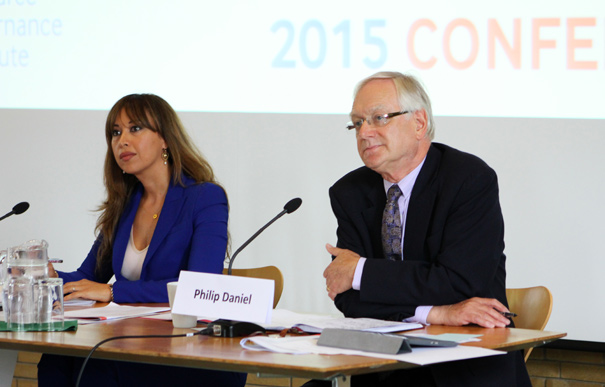
This year, the NRGI conference focused on the implications of falling commodity prices, bringing together policy makers, practitioners, academics and other leading experts (including many from developing countries) to discuss the salient policy and governance challenges and the latest analysis on these issues. The conference provided a forum for highly interactive debate, showcasing new thinking, policy experience and emerging practice.

Carnegie’s Carole Nakhle initiated the talk with a discussion on the oil price’s impact on the bargaining power between host governments and investors at the negotiating table.

This conference was originally published by the Natural Resource Governance Institute and was hosted at the University of Oxford’s St. Catherine’s College in partnership with OxCarre​.

About the Authors

Carole Nakhle

Former Nonresident Scholar, Middle East Center

Nakhle was a nonresident scholar at Carnegie Middle East Center, specializing in international petroleum contracts and fiscal regimes for the oil and gas industry, world oil and gas market developments, energy policy, and oil and gas revenue management.

Philip Daniel

Anthony Paul

Salli A. Swartz

Satya Widya Yudha

Authors

Carole Nakhle
Former Nonresident Scholar, Middle East Center
Carole Nakhle
Philip Daniel
Anthony Paul
Salli A. Swartz
Satya Widya Yudha
EconomyClimate Change

Carnegie India does not take institutional positions on public policy issues; the views represented herein are those of the author(s) and do not necessarily reflect the views of Carnegie, its staff, or its trustees.

More Work from Carnegie India

  • Article
    India’s Press Note 3 Gamble: Opening the FDI Door to China

    On March 10, 2026, India’s Union Cabinet approved amendments to Press Note 3, a regulation that mandated government approval on all foreign direct investment (FDI) from countries sharing a land border with India. This amendment raises questions primarily about whether its stated benefits will materialize and if the risks have been adequately weighed. This piece will address the same.

      Konark Bhandari

  • Commentary
    The Impact of U.S. Sanctions and Tariffs on India’s Russian Oil Imports

    This piece examines India’s response to U.S. sanctions and tariffs, specifically assessing the immediate market consequences, such as alterations in import costs, and the broader strategic implications for India’s energy security and foreign policy orientation.

      Vrinda Sahai

  • Paper
    India-China Economic Ties: Determinants and Possibilities

    This paper examines the evolution of India-China economic ties from 2005 to 2025. It explores the impact of global events, bilateral political ties, and domestic policies on distinct spheres of the economic relationship.

      Santosh Pai

  • Commentary
    TRUST and Tariffs

    The India-U.S. relationship currently appears buffeted between three “Ts”—TRUST, Tariffs, and Trump.

      Arun K. Singh

  • Article
    Can Geopolitical Alignment Seal the India-EU FTA?

    This article argues that the geopolitical circumstances have never been more conducive, not merely for the early conclusion of the free trade agreement (FTA) between India and the EU, but also for crafting a substantive and comprehensive strategic partnership.

      Mohan Kumar

Get more news and analysis from
Carnegie India
Carnegie India logo, white
Unit C-4, 5, 6, EdenparkShaheed Jeet Singh MargNew Delhi – 110016, IndiaPhone: 011-40078687
  • Research
  • About
  • Experts
  • Projects
  • Events
  • Contact
  • Careers
  • Privacy
  • For Media
Get more news and analysis from
Carnegie India
© 2026 Carnegie Endowment for International Peace. All rights reserved.