

Commentary
Andrei Kolesnikov
{
  "authors": [
    "Andrei Kolesnikov"
  ],
  "type": "commentary",
  "centerAffiliationAll": "",
  "centers": [
    "Carnegie Endowment for International Peace",
    "Carnegie Russia Eurasia Center"
  ],
  "collections": [
    "Inside Russia"
  ],
  "englishNewsletterAll": "",
  "nonEnglishNewsletterAll": "",
  "primaryCenter": "Carnegie Endowment for International Peace",
  "programAffiliation": "",
  "programs": [],
  "projects": [],
  "regions": [
    "Russia"
  ],
  "topics": [
    "Political Reform",
    "Economy"
  ]
}
Source: Getty
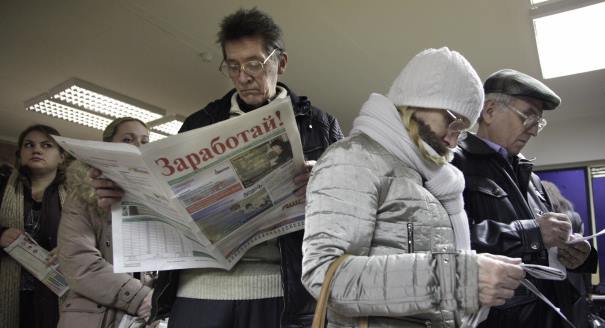
Russian consumers are increasingly unhappy, but their discontent is being frozen in depression rather than manifested in social protest.
Source: Gazeta.ru
In Russia, a proverbial battle is being fought between the refrigerator and the television set: people’s living conditions vs. state propaganda.
As we know, television is winning. Even the young woman giving the weather forecast on Russian television is talking about Syria. The Russian consumer forgets that he hasn’t eaten yet; his stomach fills with pride at Russia’s bombing campaign, which is a substitute for missing food imports.
Angus Deaton, the British economist who was awarded this year’s Nobel Prize in Economics “for his analysis of consumption, poverty, and welfare,” advanced the idea that happiness is an important factor in economics. That fits with the current state of Russia: as long as one can find happiness on the TV screen, one can get by with decreasing amounts of food.
Some new polling data from the Levada Center suggests that the public is not exactly content. Seventy-seven percent of the population agrees that the country is in crisis. A total of 38 percent “absolutely agree” with that characterization—a 10-point increase since March of this year.
Consumer demand is falling across the board. Racketeers in the shadow economy who offer “protection” to businesses can’t get enough money from their clients. There are no statistics on families that live only on Grandma’s pension (including in families where the other adult is a single mother), but Russia clearly has many of them and these households are cutting back their demand as well.
The number of pessimists is steadily growing. According to the Levada Center poll, 23 percent of respondents now expect “a protracted crisis, whose consequences will be felt for a number of years.”
But people still tend to blame the West for the crisis, rather than their own government. Thirty-four percent of Russians blame their problems on external factors. Most believe the government is doing an “average” job, not many describe its performance as bad.
Overall, people are in no mood to protest. Understanding that the country is in crisis, and that there is nothing he can do about it, the average Russian chooses to sit and wait, to buy popcorn (a new trend in consumer behavior, incidentally) and stare at the TV screen.
As recently as this spring, according to the ISAF survey, the same person was much more active, looking for a second job, acquiring new skills, calculating survival strategies. But now he is frozen in immobility. This freezing game is quite consistent with the perennial condition of the Russian labor market: a part-time working week, frozen or reduced salaries, and declining productivity—but low official unemployment statistics.
How will the situation develop? Over the long term, we will most likely witness the erosion of Russia’s social pyramid. Those below middle class—who constitute the social and electoral base of the current regime—will decline into poverty. They will not rebel, however—the ruling class will hand out some goodies during the next election campaign in exchange for their votes.
The middle class will move a notch down: people will stop traveling abroad, work just to feed themselves, cut corners to pay for housing and utilities, and hold onto their old cars. How can they protest against the regime that once allowed them to prosper? That would show lack of respect. Besides, they’d rather think about how to make a living than run around the streets and squares waving some placards that no one understands. They’d better vote for the hand that feeds them or there might be nothing to eat at all.
The upper classes are quite comfortable and have no plans to lose what they enjoy. Unlike other parts of the economy, the raw material sector that they’ve been traditionally clinging to for their sustenance is breaking even and sometimes even making a profit.
One can live in a state of depression like this for years. And we are not talking just about economic depression, but about political depression, social depression, and most importantly a state of mind.
If Russia’s leaders only left the country alone and stopped imposing all their initiatives and regulations, it would gradually emerge from the crisis. That was what happened in 1998-99, when the country was run by the fear-stricken government of Yevgeny Primakov, which is now, ironically, remembered as the most liberal one in the country’s history. But there is little hope of that happening. So keep your eyes on the contents of the refrigerator and the television.
This publication originally appeared in Russian on Gazeta.ru.
Former Senior Fellow, Carnegie Russia Eurasia Center
Kolesnikov was a senior fellow at the Carnegie Russia Eurasia Center.
Recent Work
Andrei Kolesnikov
Andrei Kolesnikov
Carnegie India does not take institutional positions on public policy issues; the views represented herein are those of the author(s) and do not necessarily reflect the views of Carnegie, its staff, or its trustees.

This piece argues that India’s central challenge is not managing a single flashpoint but resolving the underlying tension between expansion and institutional coherency of the BRICS grouping.

Vrinda Sahai

On March 10, 2026, India’s Union Cabinet approved amendments to Press Note 3, a regulation that mandated government approval on all foreign direct investment (FDI) from countries sharing a land border with India. This amendment raises questions primarily about whether its stated benefits will materialize and if the risks have been adequately weighed. This piece will address the same.

Konark Bhandari

This piece examines India’s response to U.S. sanctions and tariffs, specifically assessing the immediate market consequences, such as alterations in import costs, and the broader strategic implications for India’s energy security and foreign policy orientation.
Vrinda Sahai
This paper examines the evolution of India-China economic ties from 2005 to 2025. It explores the impact of global events, bilateral political ties, and domestic policies on distinct spheres of the economic relationship.
Santosh Pai
The India-U.S. relationship currently appears buffeted between three “Ts”—TRUST, Tariffs, and Trump.
Arun K. Singh