

Commentary
Andrei Kolesnikov
{
  "authors": [
    "Andrei Kolesnikov"
  ],
  "type": "commentary",
  "blog": "Carnegie Politika",
  "centerAffiliationAll": "dc",
  "centers": [
    "Carnegie Endowment for International Peace",
    "Carnegie Russia Eurasia Center"
  ],
  "collections": [],
  "englishNewsletterAll": "ctw",
  "nonEnglishNewsletterAll": "",
  "primaryCenter": "Carnegie Russia Eurasia Center",
  "programAffiliation": "russia",
  "programs": [
    "Russia and Eurasia"
  ],
  "projects": [],
  "regions": [
    "Russia",
    "Caucasus"
  ],
  "topics": [
    "Political Reform",
    "Domestic Politics"
  ]
}
Source: Getty
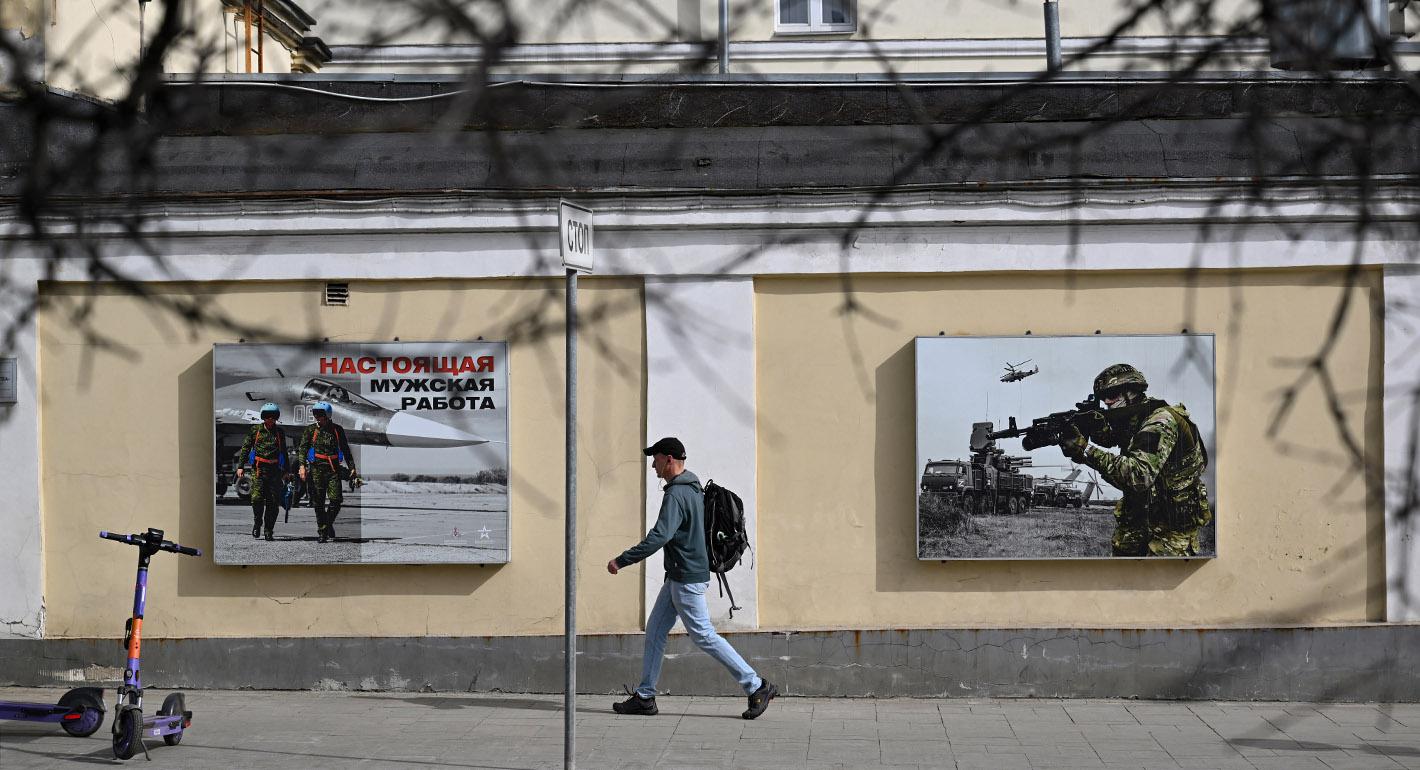
The formation in Russia of a new concept of “fairness” is testament to how long the war in Ukraine is expected to continue. The “special military operation” is fast approaching a way of life.
Russian President Vladimir Putin is creating his own model of a just society and efficient economy. It marries political mobilization and emotional demobilization, alternates between talk of war and peace, and offers massive assistance to those working “for victory.”
To borrow terms coined by the German-American philosopher Herbert Marcuse, Putin is at once engaged in the construction of a warfare state and a welfare state. His promise to Russians is that for the next six years, the beneficiaries of his regime’s largesse will be those parts of society directly linked to the war in Ukraine. Those opposed to the war are to be cut out of the social contract, as are top taxpayers, who are set to pay even more under the new model.
This new concept of fairness is extremely uneven. The move to replace Russia’s current flat tax with a progressive rate, as announced by Putin in a recent address, destroys the stability and predictability of Russia’s tax system. It does, however, make clear the president’s priorities—and not the economic kind.
Politically, Putin is concerned with the loyalty of specific segments of the population: those reliant on the state, those fighting in the war, those involved in the manufacture of what are euphemistically referred to as “finished metal goods,” and those prepared to take advantage of state incentives for having more children—to create more soldiers and state-dependent citizens.
The problem is, buying the loyalty of millions is not cheap. All this largesse will be paid for by productive workers and top taxpayers—the remnants of the middle class—while those who “work” to “defeat” the West and crush civil society reap the rewards.
The former may look for ways to avoid paying taxes they deem unfair, which will only reduce tax collection. Meanwhile, the latter may find that their handouts are offset by rising inflation brought on by massive military and social spending. Balancing the budget could become difficult, with consequences for the welfare of Putin’s support base.
Similarly in jeopardy are the oil and gas revenues on which Russia relies, as well as the country’s exports. The imports front is not exactly rosy either, but as part of its pursuit of autarky, the Kremlin is set on reducing imports so that as much as possible is manufactured domestically.
As a result, Russia is destined to become ever more dependent on China. There are also a few reality checks in store for the managerial elite, who have forgotten that import substitution is not possible without the import of parts, components, seeds, and feed, and that the conversion to civilian production is no easy feat.
That Putin has set about forming this new “fairness” speaks to how long the war is expected to go on for. The “special military operation” is in fact a way of life and an economic structure tailored to autarky, the manufacture of “metal goods,” and the redistribution of property.
It could even be described as something of a national idea. The plan for Putin’s fifth presidential term involuntarily reflects the regime’s current problems, from the need to buy people’s loyalty to an impending budget shortfall. Why else raise taxes for the highest earners in a modern-day dekulakization campaign that leaves today’s kulaks alive to subsidize the siloviki, or security services, and those who depend on the state for their livelihoods?
The Russian autocrat has paid scant attention to the country’s business community recently. During the presidential campaign, he paid lip service to entrepreneurs to create the appearance of normalcy and hint at the opportunities for Russia’s peaceful development. And since his reelection, Putin’s only concession in this regard has been deigning to meet with Alexander Shokhin, head of the Russian Union of Industrialists and Entrepreneurs, the leading business lobby group.
Yet it is business that Putin expects to shell out a sizeable proportion of the funds for buying people’s loyalty. The Kremlin’s pitch to entrepreneurs is that they may make money without fear of going to prison—on the condition that they share the spoils with the regime.
This state-based model works in a rental economy. But oil and gas rents are falling (albeit gradually), and the only alternative would be to move to an open market economy: the very model the Russian state is moving away from. Money is needed to deliver on the regime’s many promises and also to sustain the war indefinitely. And so it becomes necessary to raise taxes and divert funding from the development of human capital.
This model is unsustainable in the long term, but could serve the regime well in the short to medium term. For the time being, the Kremlin can count on the indifference of much of society and its willingness to be dependent on the government. A fresh poll by the Russian Public Opinion Research Center found that more than half of Russians (53 percent) believe high taxes are acceptable so long as the poor receive greater assistance in the form of free services (education, healthcare, and security).
Notably, a third of respondents were not in favor of tax hikes due to the sometimes dubious quality and accessibility of public services. Unsurprisingly, the wealthiest respondents were most likely to favor a flat tax.
Responsible taxpayers may feel that they deserve to know how their taxes are used by the government. But it is impossible for them to influence political decisionmaking in the absence of working democratic institutions, accountability, and turnover at the top.
Most taxpayers, then, have no choice but to allow the government to spend their taxes on the war and those parts of society involved in it. While such a model cannot last, Putin can rest assured that as he commences his fifth term as president, he will face minimal discontent.
Former Senior Fellow, Carnegie Russia Eurasia Center
Kolesnikov was a senior fellow at the Carnegie Russia Eurasia Center.
Recent Work
Andrei Kolesnikov
Andrei Kolesnikov
Carnegie does not take institutional positions on public policy issues; the views represented herein are those of the author(s) and do not necessarily reflect the views of Carnegie, its staff, or its trustees.

Ex-president Gurbanguly Berdimuhamedov remains interested in politics, but his son Serdar, Turkmenistan’s current president, is becoming increasingly independent and willing to break with his father’s legacy. If their covert rivalry goes too far, both risk losing power.

Galiya Ibragimova

Despite a new textbook, an influx of Russian teachers and managers, and an end to the teaching of Ukrainian, the Kremlin is unlikely to have “reprogrammed” locals.

Konstantin Skorkin

For every ruble allocated to social policy, health, and education in 2027, double that amount is earmarked for the army, the police, and the security services.

Alexandra Prokopenko

Cargo traffic through Russia’s Northern Sea Route has increased because of the disruption caused by the conflict in the Middle East, the Ukraine war, and U.S.-China tensions.

Mikhail Korostikov
An analysis of traffic accident data suggests that Ukrainian drone attacks caused a material but not disastrous fall in Russian gasoline consumption over the summer.

Sergey Vakulenko